


Mechanism of activation gating in the full-length KcsA K+ channel
- PMID: 21730186
- PMCID: PMC3141920
- DOI: 10.1073/pnas.1105112108
Mechanism of activation gating in the full-length KcsA K+ channel
Abstract
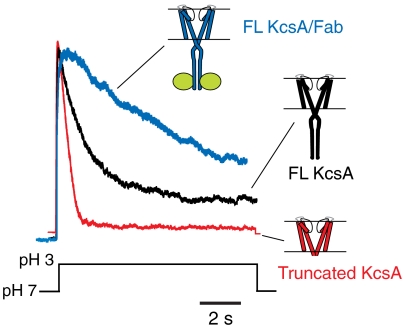
Using a constitutively active channel mutant, we solved the structure of full-length KcsA in the open conformation at 3.9 Å. The structure reveals that the activation gate expands about 20 Å, exerting a strain on the bulge helices in the C-terminal domain and generating side windows large enough to accommodate hydrated K(+) ions. Functional and spectroscopic analysis of the gating transition provides direct insight into the allosteric coupling between the activation gate and the selectivity filter. We show that the movement of the inner gate helix is transmitted to the C-terminus as a straightforward expansion, leading to an upward movement and the insertion of the top third of the bulge helix into the membrane. We suggest that by limiting the extent to which the inner gate can open, the cytoplasmic domain also modulates the level of inactivation occurring at the selectivity filter.
Conflict of interest statement
The authors declare no conflict of interest.
Figures


 (Upper), NiEdda accessibility parameter ΠNiEdda (Lower). (B) The normalized difference for each environmental parameter was mapped onto the FL-open channel structure, where increases in local dynamics or water accessibility are depicted in shades of red, whereas decreasing changes as shades of blue according to the color spectrum below. On the left, the frame highlights the large changes in local dynamics at the inner face of the bulge helix. On the right, the bar and arrow suggest that the region immediately below the activation gate might embed into the membrane upon opening. (C) A cartoon model depicting the conformational transitions of the gate and C-terminal domain in full-length KcsA upon gating. Two diagonally-related subunits are shown. Blue model, closed state; red model, open state. The gray bars represent the approximate limits of the plasma membrane.
References
Publication types
MeSH terms
Substances
Associated data
- Actions
Grants and funding
LinkOut - more resources
Full Text Sources
Molecular Biology Databases
