


Emerging disparities in overweight by educational attainment in Chinese adults (1989-2006)
- PMID: 21730966
- PMCID: PMC3193889
- DOI: 10.1038/ijo.2011.134
Emerging disparities in overweight by educational attainment in Chinese adults (1989-2006)
Abstract
Objective: To test whether a disparity in overweight by socioeconomic status (SES; represented by educational attainment) has emerged among men or women during a recent 17-year period in China.
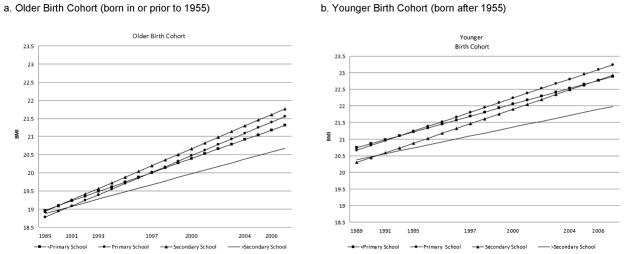
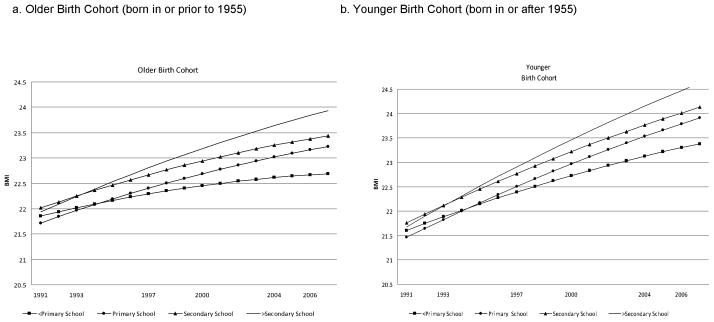
Methods: Data from the China Health and Nutrition Survey (CHNS), a panel study including 7314 women and 6492 men, are used to longitudinally track the body mass index (BMI) and odds of overweight by educational attainment among Chinese adults (baseline age 18-50) from 1989 to 2006 to determine whether individuals of low (<primary school) versus high (>secondary school) educational attainment experienced a disproportionately faster increase in BMI or odds of overweight (BMI≥25) over time. The unadjusted mean BMI and prevalence of overweight by education are presented. Sex-stratified, random-effects models are used to estimate the associations, and interactions by birth cohort are included.
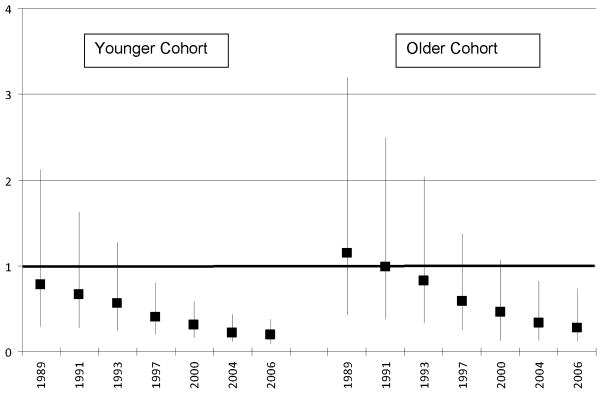
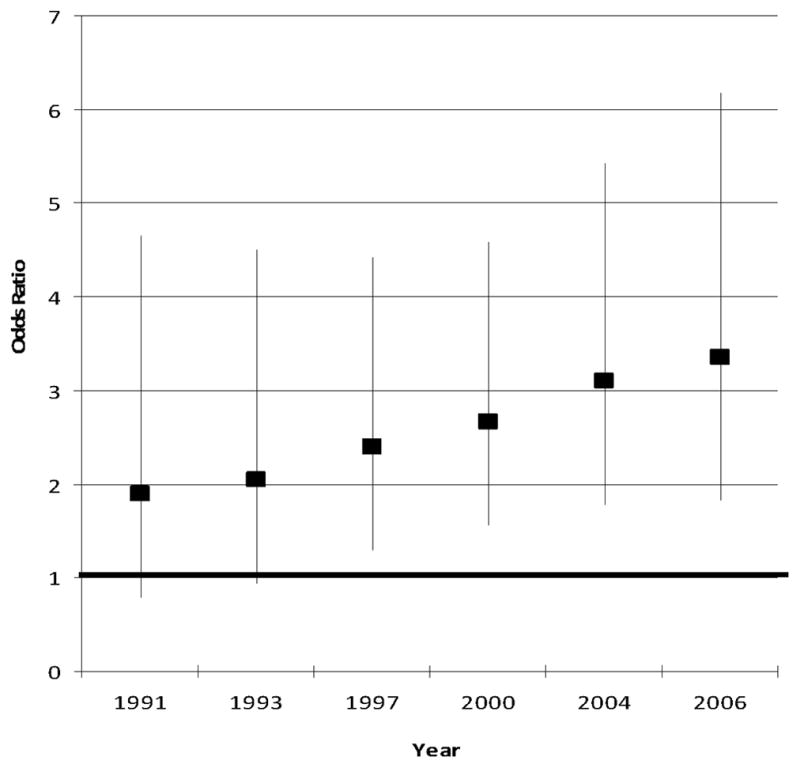
Findings: Overweight prevalence doubled for women and tripled for men. In 1989, among women, the odds of overweight were not different for those of high versus those of low educational attainment; however, by 2006, the odds of overweight were significantly lower for those with the highest education in both the younger (odds ratio (OR) 0.22 (CI 0.11, 0.42)) and the older (OR 0.27 (CI 0.10, 0.72)) birth cohorts. The reverse trend is seen for men, who also begin with no difference in odds of overweight by SES, but by 2006, the OR for the highest versus the lowest education group was 3.4 (CI 1.82, 6.18).
Conclusions: Over 17 years, low SES has become associated with higher BMI and odds of overweight among Chinese women, whereas high SES remains a risk factor for overweight among Chinese men.
Conflict of interest statement
CONFLICT OF INTEREST
None of the authors has any affiliation, financial agreements or other potential conflicts of interest with regards to this manuscript.
Figures
References
Publication types
MeSH terms
Grants and funding
LinkOut - more resources
Full Text Sources
Medical
