


Plasma chemokine levels are associated with the presence and extent of angiographic coronary collaterals in chronic ischemic heart disease
- PMID: 21731663
- PMCID: PMC3120847
- DOI: 10.1371/journal.pone.0021174
Plasma chemokine levels are associated with the presence and extent of angiographic coronary collaterals in chronic ischemic heart disease
Abstract
Background: In patients with chronic ischemic heart disease (IHD), the presence and extent of spontaneously visible coronary collaterals are powerful determinants of clinical outcome. There is marked heterogeneity in the recruitment of coronary collaterals amongst patients with similar degrees of coronary artery stenoses, but the biological basis of this heterogeneity is not known. Chemokines are potent mediators of vascular remodeling in diverse biological settings. Their role in coronary collateralization has not been investigated. We sought to determine whether plasma levels of angiogenic and angiostatic chemokines are associated with of the presence and extent of coronary collaterals in patients with chronic IHD.
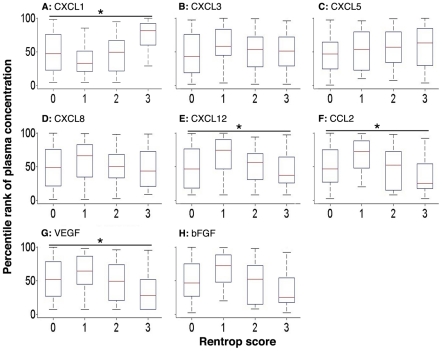
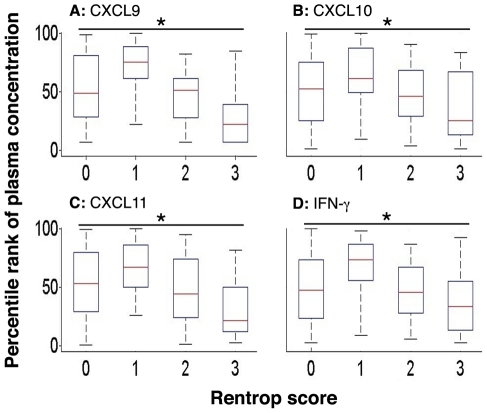
Methodology/principal findings: We measured plasma concentrations of angiogenic and angiostatic chemokine ligands in 156 consecutive subjects undergoing coronary angiography with at least one ≥90% coronary stenosis and determined the presence and extent of spontaneously visible coronary collaterals using the Rentrop scoring system. Eighty-eight subjects (56%) had evidence of coronary collaterals. In a multivariable regression model, the concentration of the angiogenic ligands CXCL5, CXCL8 and CXCL12, hyperlipidemia, and an occluded artery were associated with the presence of collaterals; conversely, the concentration of the angiostatic ligand CXCL11, interferon-γ, hypertension and diabetes were associated with the absence of collaterals (ROC area 0.91). When analyzed according to extent of collateralization, higher Rentrop scores were significantly associated with increased concentration of the angiogenic ligand CXCL1 (p<0.0001), and decreased concentrations of angiostatic ligands CXCL9 (p<0.0001), CXCL10 (p = 0.002), and CXCL11 (p = 0.0002), and interferon-γ (p = 0.0004).
Conclusions/significance: Plasma chemokine concentrations are associated with the presence and extent of spontaneously visible coronary artery collaterals and may be mechanistically involved in their recruitment.
Conflict of interest statement
Figures
References
-
- Rosamond W, Flegal K, Furie K, Go A, Greenlund K, et al. Heart disease and stroke statistics–008 update: a report from the American Heart Association Statistics Committee and Stroke Statistics Subcommittee. Circulation. 2008;117:e25–146. - PubMed
-
- Regieli JJ, Jukema JW, Nathoe HM, Zwinderman AH, Ng S, et al. Coronary collaterals improve prognosis in patients with ischemic heart disease. Int J Cardiol. 2009;132:257–262. - PubMed
-
- Hirai T, Fujita M, Nakajima H, Asanoi H, Yamanishi K, et al. Importance of collateral circulation for prevention of left ventricular aneurysm formation in acute myocardial infarction. Circulation. 1989;79:791–796. - PubMed
-
- Kodama K, Kusuoka H, Sakai A, Adachi T, Hasegawa S, et al. Collateral channels that develop after an acute myocardial infarction prevent subsequent left ventricular dilation. J Am Coll Cardiol. 1996;27:1133–1139. - PubMed
-
- Habib GB, Heibig J, Forman SA, Brown BG, Roberts R, et al. Influence of coronary collateral vessels on myocardial infarct size in humans. Results of phase I thrombolysis in myocardial infarction (TIMI) trial. The TIMI Investigators. Circulation. 1991;83:739–746. - PubMed
Publication types
MeSH terms
Substances
Grants and funding
LinkOut - more resources
Full Text Sources
Research Materials
