


Academic impact of a public electronic health database: bibliometric analysis of studies using the general practice research database
- PMID: 21731733
- PMCID: PMC3120870
- DOI: 10.1371/journal.pone.0021404
Academic impact of a public electronic health database: bibliometric analysis of studies using the general practice research database
Abstract
Background: Studies that use electronic health databases as research material are getting popular but the influence of a single electronic health database had not been well investigated yet. The United Kingdom's General Practice Research Database (GPRD) is one of the few electronic health databases publicly available to academic researchers. This study analyzed studies that used GPRD to demonstrate the scientific production and academic impact by a single public health database.
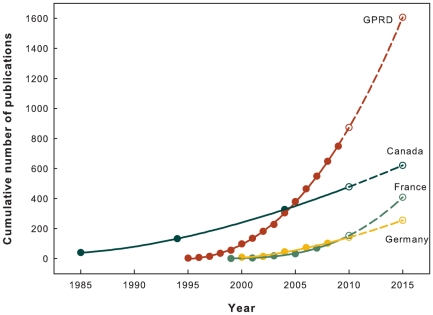
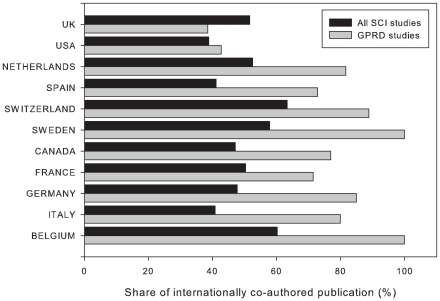
Methodology and findings: A total of 749 studies published between 1995 and 2009 with 'General Practice Research Database' as their topics, defined as GPRD studies, were extracted from Web of Science. By the end of 2009, the GPRD had attracted 1251 authors from 22 countries and been used extensively in 749 studies published in 193 journals across 58 study fields. Each GPRD study was cited 2.7 times by successive studies. Moreover, the total number of GPRD studies increased rapidly, and it is expected to reach 1500 by 2015, twice the number accumulated till the end of 2009. Since 17 of the most prolific authors (1.4% of all authors) contributed nearly half (47.9%) of GPRD studies, success in conducting GPRD studies may accumulate. The GPRD was used mainly in, but not limited to, the three study fields of "Pharmacology and Pharmacy", "General and Internal Medicine", and "Public, Environmental and Occupational Health". The UK and United States were the two most active regions of GPRD studies. One-third of GRPD studies were internationally co-authored.
Conclusions: A public electronic health database such as the GPRD will promote scientific production in many ways. Data owners of electronic health databases at a national level should consider how to reduce access barriers and to make data more available for research.
Conflict of interest statement
Figures
References
-
- Gould L, Walker A, Ryan P, Schneeweiss S, Santanello N, et al. Using databases for both hypothesis generating and hypothesis confirmation: one database or two? Pharmacoepidemiology and Drug Safety. 2009;18:S205–6.
-
- Gnani S, Majeed A. A user's guide to data collected in primary care in England. Cambridge: Eastern Region Public Health Observatory (ERPHO) on behalf of the Association of Public; 2006.
-
- Majeed A. Sources, uses, strengths and limitations of data collected in primary care in England. Health Statistics Quarterly. 2004;21:5–14. - PubMed
-
- Chen YC, Wu JC, Chen TJ, Wetter T. A publicly available database dramatically accelerates academic production. British Medical Journal. 2011;342:297–298. - PubMed
MeSH terms
LinkOut - more resources
Full Text Sources
