


Exogenous hCG activity, but not endogenous LH activity, is positively associated with live birth rates in anovulatory infertility
- PMID: 21732905
- PMCID: PMC3251000
- DOI: 10.3109/14647273.2011.587135
Exogenous hCG activity, but not endogenous LH activity, is positively associated with live birth rates in anovulatory infertility
Abstract
Objective: To evaluate, retrospectively, the roles of endogenous and exogenous luteinising hormone (LH) activity on live birth rate in ovulation induction cycles.
Methods: Associations between LH activity at baseline, end of stimulation and live birth rate were analysed in relation to patient characteristics, baseline and end of stimulation variables in WHO group II anovulatory women (n = 155) stimulated with recombinant follicle-stimulating hormone (rFSH) or highly purified human menopausal gonadotrophin (HP-hMG). HP-hMG provides FSH and exogenous LH activity mainly in the form of human chorionic gonadotrophin (hCG).
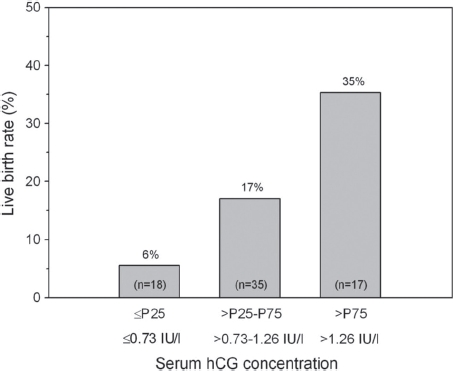
Results: Serum LH concentrations at baseline or end of stimulation were not predictive of live birth rate in the rFSH group (n = 79) or HP-hMG group (n = 76). Serum hCG concentration at end of stimulation was a significant positive predictor in HP-hMG-treated women. Other variables were not independently predictive of live birth in either of the groups, except for a negative association between serum FSH concentrations at the start of stimulation and live birth in the rFSH-treated group.
Conclusions: Endogenous LH concentrations are not predictive of live birth in anovulatory WHO group II patients undergoing ovulation induction with rFSH or HP-hMG. On the other hand, exogenous hCG activity during HP-hMG stimulation is positively associated with treatment outcome.
Figures
References
-
- Acevedo B., Sanchez M., Gomez J. L., Cuadros J., Ricciarelli E., Hernández E. R. Luteinizing hormone supplementation increases pregnancy rates in gonadotropin-releasing hormone antagonist donor cycles. Fertility & Sterility. 2004;82:343–347. - PubMed
-
- Balasch J. In: The role of FSH and LH in ovulation induction: current concepts and the contribution of recombinant gonadotropins. Textbook of assisted reproductive techniques: laboratory and clinical perspectives. 2nd. Gardner D. K., Weissman A., Howies C. M., Shoham Z., editors. edLondonTaylor and Francis; 2004. pp. 541–565.
-
- Balasch J., Fábregues F, Casamitjana R., Penarrubia J., Vanrell J. A. A pharmacokinetic and endocrine comparison of recombinant follicle-stimulating hormone and human menopausal gonadotrophin in polycystic ovary syndrome. Reproductive Biomedicine Online. 2003;6:296–301. - PubMed
-
- Balen A. H., Braat D.D., West C., Patel A., Jacobs H.S. Cumulative conception and live birth rates after the treatment of anovulatory infertility: safety and efficacy of ovulation induction in 200 patients. Human Reproduction. 1994;9:1563–1570. - PubMed
-
- Balen A. H., Conway G. S., Kaltsas G., Techatrasak K., Manning P. J., West C., Jacobs H. S. Polycystic ovary syndrome: the spectrum of the disorder in 1741 patients. Human Reproduction. 1995;10:2107–2111. - PubMed
Publication types
MeSH terms
Substances
LinkOut - more resources
Full Text Sources
Medical
Research Materials
Miscellaneous
