


An Early Cambrian stem polychaete with pygidial cirri
- PMID: 21733871
- PMCID: PMC3210688
- DOI: 10.1098/rsbl.2011.0592
An Early Cambrian stem polychaete with pygidial cirri
Abstract
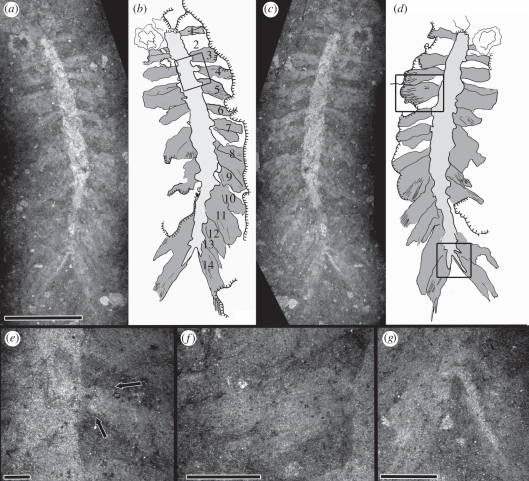
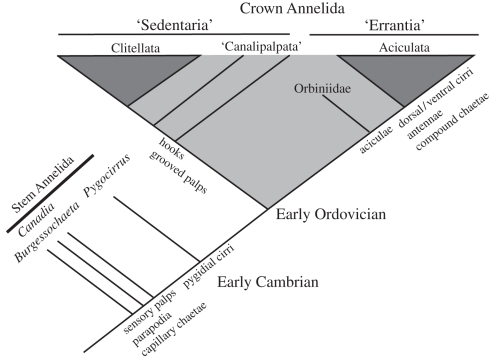
The oldest annelid fossils are polychaetes from the Cambrian Period. They are representatives of the annelid stem group and thus vital in any discussion of how we polarize the evolution of the crown group. Here, we describe a fossil polychaete from the Early Cambrian Sirius Passet fauna, Pygocirrus butyricampum gen. et sp. nov., with structures identified as pygidial cirri, which are recorded for the first time from Cambrian annelids. The body is slender and has biramous parapodia with chaetae organized in laterally oriented bundles. The presence of pygidial cirri is one of the characters that hitherto has defined the annelid crown group, which diversified during the Cambrian-Ordovician transition. The newly described fossil shows that this character had already developed within the total group by the Early Cambrian.
Figures
References
-
- Fauchald K., Rouse G. 1997. Polychaete systematics: past and present. Zool. Scripta 26, 71–138 10.1111/j.1463-6409.1997.tb00411.x (doi:10.1111/j.1463-6409.1997.tb00411.x) - DOI
-
- Hints O., Eriksson M. E. 2007. Diversification and biogeography of scolecodont-bearing polychaetes in the Ordovician. Palaeogeogr. Palaeoclimatol. Palaeoecol. 245, 95–114 10.1016/j.palaeo.2006.02.029 (doi:10.1016/j.palaeo.2006.02.029) - DOI
-
- Vinn O., Ten Hove H. A., Mutvei H. 2008. On the tube ultrastructure and origin of calcification in sabellids (Annelida, Polychaeta). Palaeontology 51, 295–301 10.1111/j.1475-4983.2008.00763.x (doi:10.1111/j.1475-4983.2008.00763.x) - DOI
-
- Vinn O., Jäger M., Kirsimäe K. 2008. Microscopic evidence of serpulid affinities of the problematic fossil tube ‘Serpula’ etalensis from the Lower Jurassic of Germany. Lethaia 41, 417–421 10.1111/j.1502-3931.2008.00093.x (doi:10.1111/j.1502-3931.2008.00093.x) - DOI
-
- Conway Morris S. 1979. Middle Cambrian polychaetes from the Burgess Shale of British Columbia. Phil. Trans. R. Soc. Lond. B 285, 227–274 10.1098/rstb.1979.0006 (doi:10.1098/rstb.1979.0006) - DOI
Publication types
MeSH terms
LinkOut - more resources
Full Text Sources
