


Long-term cleaner fish presence affects growth of a coral reef fish
- PMID: 21733872
- PMCID: PMC3210676
- DOI: 10.1098/rsbl.2011.0458
Long-term cleaner fish presence affects growth of a coral reef fish
Abstract
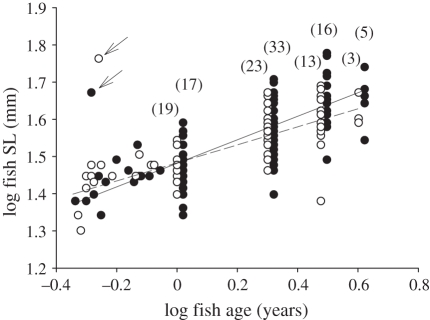
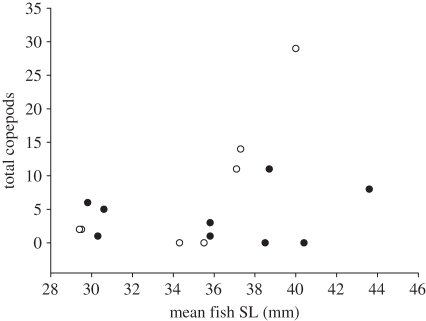
Cleaning behaviour is considered to be a classical example of mutualism. However, no studies, to our knowledge, have measured the benefits to clients in terms of growth. In the longest experimental study of its kind, over an 8 year period, cleaner fish Labroides dimidiatus were consistently removed from seven patch reefs (61-285 m(2)) and left undisturbed on nine control reefs, and the growth and parasite load of the damselfish Pomacentrus moluccensis determined. After 8 years, growth was reduced and parasitic copepod abundance was higher on fish from removal reefs compared with controls, but only in larger individuals. Behavioural observations revealed that P. moluccensis cleaned by L. dimidiatus were 27 per cent larger than nearby conspecifics. The selective cleaning by L. dimidiatus probably explains why only larger P. moluccensis individuals benefited from cleaning. This is the first demonstration, to our knowledge, that cleaners affect the growth rate of client individuals; a greater size for a given age should result in increased fecundity at a given time. The effect of the removal of so few small fish on the size of another fish species is unprecedented on coral reefs.
Figures
References
-
- Stachowicz J. J. 2001. Mutualism, facilitation, and the structure of ecological communities. BioScience 51, 235–246 10.1641/0006-3568(2001)051[0235:MFATSO]2.0.CO;2 (doi:10.1641/0006-3568(2001)051[0235:MFATSO]2.0.CO;2) - DOI
-
- Grutter A. S., Irving A. D. 2007. Positive interactions in marine communities. In Marine ecology (eds Connell S. D., Gillanders B. M.), pp. 110–137 Oxford, UK: Oxford University Press
-
- Bshary R., Grutter A. S. 2006. Image scoring and cooperation in a cleaner fish mutualism. Nature 441, 975–978 10.1038/nature04755 (doi:10.1038/nature04755) - DOI - PubMed
-
- Grutter A. S. 1997. Spatiotemporal variation and feeding selectivity in the diet of the cleaner fish Labroides dimidiatus. Copeia 1997, 346–355 10.2307/1447754 (doi:10.2307/1447754) - DOI
-
- Grutter A. S. 1996. Experimental demonstration of no effect by the cleaner wrasse Labroides dimidiatus (Cuvier and Valenciennes) on the host fish Pomacentrus moluccensis (Bleeker). J. Exp. Mar. Biol. Ecol. 196, 285–298 10.1016/0022-0981(95)00135-2 (doi:10.1016/0022-0981(95)00135-2) - DOI
Publication types
MeSH terms
LinkOut - more resources
Full Text Sources
