


Matrix-assisted laser desorption ionization-time of flight mass spectrometry-based single nucleotide polymorphism genotyping assay using iPLEX gold technology for identification of Mycobacterium tuberculosis complex species and lineages
- PMID: 21734028
- PMCID: PMC3165613
- DOI: 10.1128/JCM.00744-11
Matrix-assisted laser desorption ionization-time of flight mass spectrometry-based single nucleotide polymorphism genotyping assay using iPLEX gold technology for identification of Mycobacterium tuberculosis complex species and lineages
Abstract
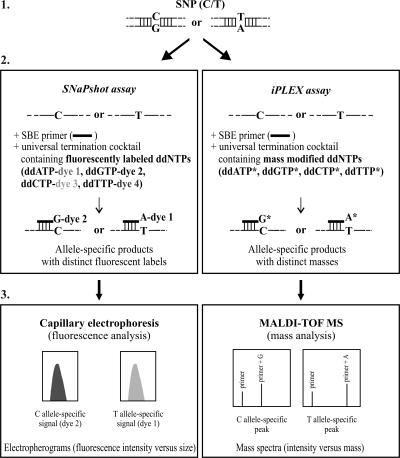
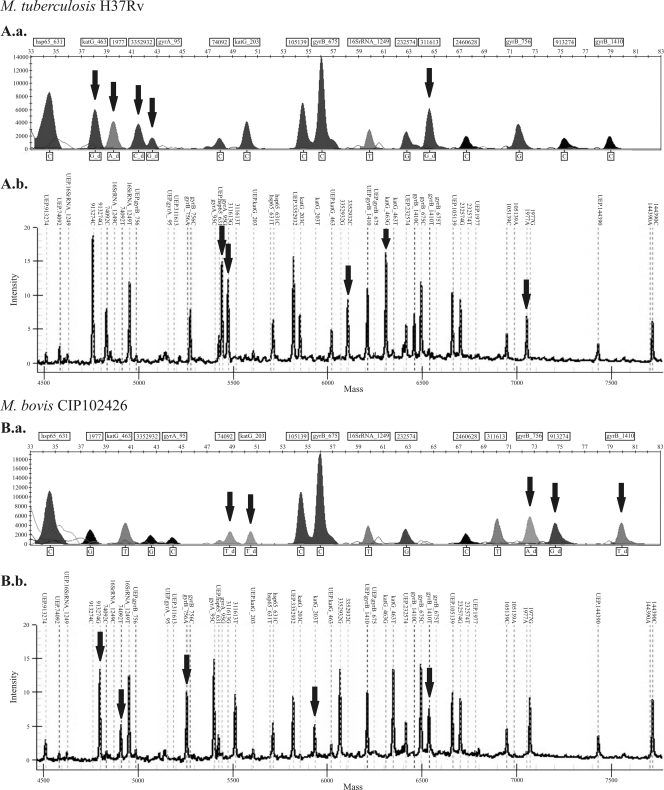
The major goal of the present study was to investigate the potential use of a novel single nucleotide polymorphism (SNP) genotyping technology, called iPLEX Gold (Sequenom), for the simultaneous analysis of 16 SNPs that have been previously validated as useful for identification of Mycobacterium tuberculosis complex (MTBC) species and classification of MTBC isolates into distinct genetic lineages, known as principal genetic groups (PGGs) and SNP cluster groups (SCGs). In this context, we developed a 16-plex iPLEX assay based on an allele-specific-primer single-base-extension reaction using the iPLEX Gold kit (Sequenom), followed by matrix-assisted laser desorption ionization-time of flight mass spectrometry (MALDI-TOF MS) analysis on the commercially available Sequenom MassARRAY platform. This assay was tested on a panel of 55 well-characterized MTBC strains that were also genotyped for the same loci using the previously reported SNaPshot assay, as well as 10 non-MTBC mycobacteria and 4 bacteria not belonging to the genus Mycobacterium. All MTBC samples were successfully analyzed with the iPLEX assay, which yielded clear allelic data for 99.9% of the SNPs (879 out of 880). No false-positive results were obtained with the negative controls. Compared to the SNaPshot assay, the newly developed 16-plex iPLEX assay produced fully concordant results that allowed reliable differentiation of MTBC species and recognition of lineages, thus demonstrating its potential value in diagnostic, epidemiological, and evolutionary applications. Compared to the SNaPshot approach, the implementation of the iPLEX technology could offer a higher throughput and could be a more flexible and cost-effective option for microbiology laboratories.
Figures
References
-
- Allix-Beguec C., Harmsen D., Weniger T., Supply P., Niemann S. 2008. Evaluation and strategy for use of MIRU-VNTRplus, a multifunctional database for online analysis of genotyping data and phylogenetic identification of Mycobacterium tuberculosis complex isolates. J. Clin. Microbiol. 46: 2692–2699 - PMC - PubMed
-
- Arnold C., et al. 2005. Single-nucleotide polymorphism-based differentiation and drug resistance detection in Mycobacterium tuberculosis from isolates or directly from sputum. Clin. Microbiol. Infect. 11: 122–130 - PubMed
Publication types
MeSH terms
LinkOut - more resources
Full Text Sources
Other Literature Sources
Medical
Molecular Biology Databases
