. 2011 Sep;157(1):188-99.
doi: 10.1104/pp.111.177311. Epub 2011 Jul 6.

Abscisic acid plays an important role in the regulation of strawberry fruit ripening

Affiliations

Abscisic acid plays an important role in the regulation of strawberry fruit ripening

Hai-Feng Jia et al. Plant Physiol. 2011 Sep.

Abstract

The plant hormone abscisic acid (ABA) has been suggested to play a role in fruit development, but supporting genetic evidence has been lacking. Here, we report that ABA promotes strawberry (Fragaria ananassa) fruit ripening. Using a newly established Tobacco rattle virus-induced gene silencing technique in strawberry fruit, the expression of a 9-cis-epoxycarotenoid dioxygenase gene (FaNCED1), which is key to ABA biosynthesis, was down-regulated, resulting in a significant decrease in ABA levels and uncolored fruits. Interestingly, a similar uncolored phenotype was observed in the transgenic RNA interference (RNAi) fruits, in which the expression of a putative ABA receptor gene encoding the magnesium chelatase H subunit (FaCHLH/ABAR) was down-regulated by virus-induced gene silencing. More importantly, the uncolored phenotype of the FaNCED1-down-regulated RNAi fruits could be rescued by exogenous ABA, but the ABA treatment could not reverse the uncolored phenotype of the FaCHLH/ABAR-down-regulated RNAi fruits. We observed that down-regulation of the FaCHLH/ABAR gene in the RNAi fruit altered both ABA levels and sugar content as well as a set of ABA- and/or sugar-responsive genes. Additionally, we showed that exogenous sugars, particularly sucrose, can significantly promote ripening while stimulating ABA accumulation. These data provide evidence that ABA is a signal molecule that promotes strawberry ripening and that the putative ABA receptor, FaCHLH/ABAR, is a positive regulator of ripening in response to ABA.


Figures
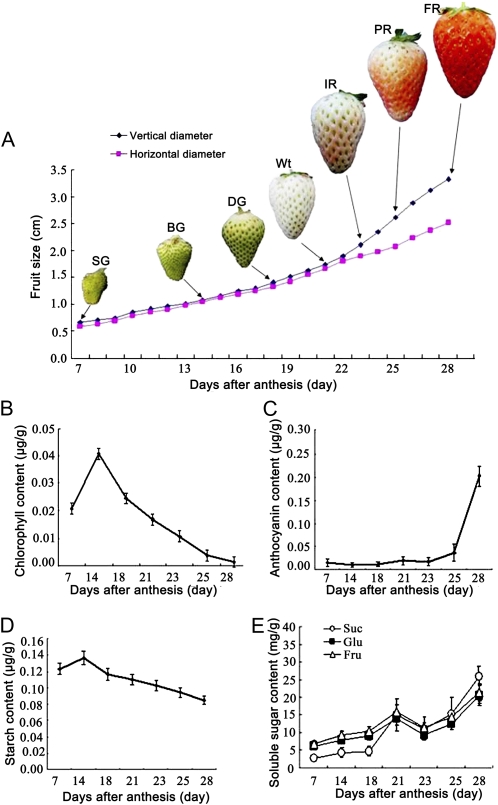
Figure 1.
Figure 1.
Morphological and physiological changes in the receptacle of strawberry fruit during developmental processes divided into the following seven stages: SG, BG, DG, Wt, IR, PR, and FR. A, Changes in fruit size and color. B, Changes in chlorophyll content. C, Changes in anthocyanin content. D, Changes in starch content. E, Changes in soluble sugar contents (Suc, Glc, and Fru). Error bars represent se (n = 3).
Figure 2.
Figure 2.
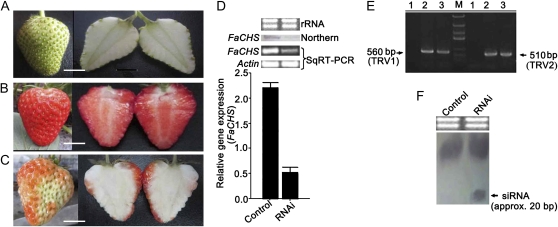
VIGS for the FaCHS reporter gene in strawberry fruit. A, Two-week-old BG fruits still attached to a plant were used for inoculation. B, The control fruit phenotype inoculated with Agrobacterium containing the TRV only. C, The RNAi fruit phenotype inoculated with Agrobacterium containing TRV carrying a FaCHS fragment. D, FaCHS transcription levels in the control and RNAi fruits by semiquantitative (Sq) RT-PCR, real-time PCR, and northern-blot analyses. E, Analysis of the transcripts of the 560-bp TRV1 and 510-bp TRV2 vectors by RT-PCR in fruits inoculated with Agrobacterium alone (lane 1), control fruits (lane 2), and RNAi fruits (lane 3). F, Detection of siRNA (approximately 20 bp) specific to the FaCHS gene in the control and RNAi fruits. rRNA was the loading control for the RNA samples stained with ethidium bromide. Actin mRNA was used as the internal control. Error bars represent se (n = 3). Bars = 0.4 cm.
Figure 3.
Figure 3.
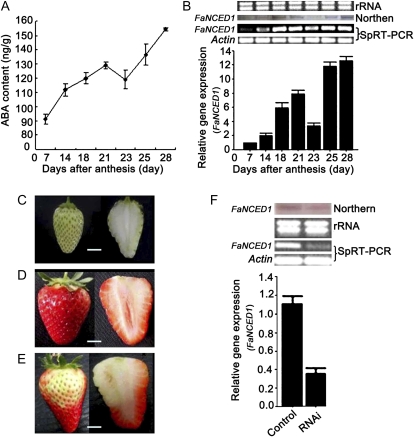
ABA positively regulates strawberry fruit ripening. A, Changes in ABA levels in the receptacles of the fruits during developmental stages. B, Semiquantitative (Sq) RT-PCR, real-time PCR, and northern-blot analyses of the FaNCED1 mRNA levels in the receptacles of fruits during developmental stages. C to F, VIGS for FaNCED1 in strawberry fruit: 2-week-old fruit (C) still attached to the plant were inoculated with Agrobacterium containing TRV alone (control) or TRV carrying an NCED1 fragment (RNAi); 2 weeks after inoculation, phenotypes were investigated for the control fruit (D) and RNAi fruit (E); semiquantitative RT-PCR, real-time PCR, and northern-blot analyses of the FaNCED1 transcripts in receptacles of the control or RNAi fruit (F) were conducted. rRNA indicates the loading control of the RNA samples stained with ethidium bromide. Actin was used as the internal control. Error bars represent se (n = 3). Bars = 0.4 cm.
Figure 4.
Figure 4.
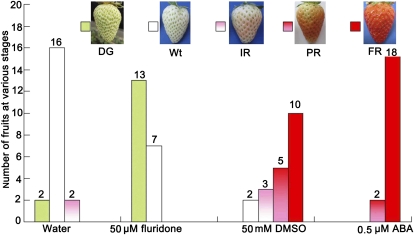
Effects of ABA, DMSO, and fluridone on strawberry fruit development. ABA at 0.5 μm, fluridone at 50 μm, or DMSO at 50 mm was injected into 2-week-old BG fruits on alternate days for 6 d (three times) using a 0.2-mL syringe. Control fruits were injected with distilled water, and phenotypes were investigated 1 week after treatment. Twenty fruits still attached to plants were selected for each treatment (n = 20).
Figure 5.
Figure 5.
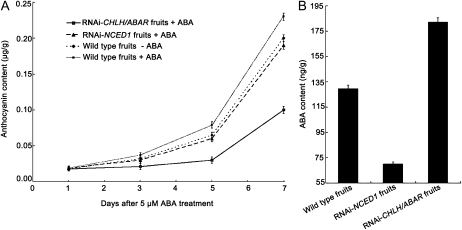
Effects of the ABA treatments on anthocyanin contents of the FaNCED1- and FaCHLH/ABAR-RNAi fruits during development. A, ABA at 0.5 μm was injected into FaNCED1- or FaCHLH/ABAR-RNAi fruits still attached to strawberry plants (n = 20). Control fruits were injected with distilled water. Anthocyanin content was detected after the first treatment. B, Prior to the treatments, ABA contents in the control fruits, FaNCED1-RNAi fruits, and FaCHLH/ABAR-RNAi fruits were assayed. Error bars represent se (n = 20).
Figure 6.
Figure 6.
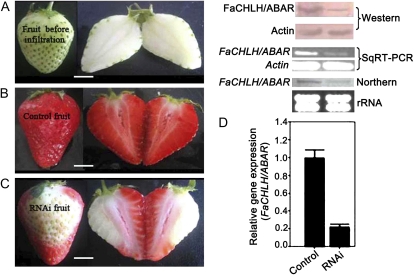
Down-regulation of FaCHLH/ABAR expression inhibits strawberry fruit ripening. A, Two-week-old fruits attached to strawberry plants were inoculated with Agrobacterium containing TRV alone (control fruit) or TRV carrying a FaCHLH fragment (RNAi fruit) 2 weeks after anthesis. B, Phenotypes of the control fruit 2 weeks after inoculation. C, Phenotypes of the FaCHLH/ABAR-RNAi fruit 2 weeks after inoculation. D, Semiquantitative (Sq) RT-PCR, real-time PCR (bottom columns), and northern-blot and western-blot analyses of the FaCHLH/ABAR transcription and translation levels in the receptacles of the control (left) and RNAi (right) fruit. rRNA was the loading control for the RNA samples stained with ethidium bromide. Both the Actin protein and Actin mRNA were used as internal controls. Error bars represent se (n = 3). Bars = 0.4 cm.
Figure 7.
Figure 7.
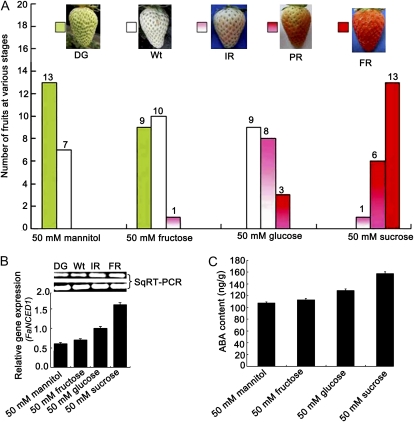
Sugars promote strawberry fruit ripening while stimulating ABA accumulation. A, Effects of the sugar treatments on fruit ripening. Suc, Glc, Fru, or mannitol (as a control sugar) was injected into 2-week-old BG fruits. Phenotypes were investigated 1 week after treatment. Twenty fruits still attached to strawberry plants were used for each treatment. B, Semiquantitative (Sq) RT-PCR and real-time PCR (columns) analyses of FaNCED1 mRNA levels in the receptacles of mannitol-treated DG, Fru-treated Wt, Glc-treated IR, and Suc-treated FR fruits 1 week after the treatments. C, The corresponding ABA contents in the sugar-treated fruits from B. Error bars represent se (n = 3).
Figure 8.
Figure 8.
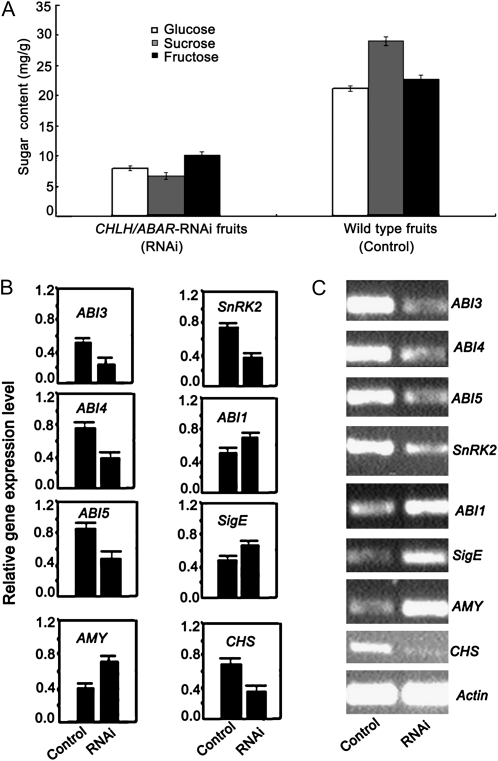
Changes in both sugar contents and mRNA expression levels of ABA-responsive genes in the FaCHLH/ABAR-RNAi fruits. A, Sugar contents. B and C, Real-time PCR (B) and semiquantitative RT-PCR (C) analyses of the expression levels of ABA-responsive genes in the control fruit and RNAi fruit.

References

    1. Abeles FB, Takeda F. (1990) Cellulase activity and ethylene in ripening strawberry and apple fruits. Sci Hortic (Amsterdam) 42: 269–275
    1. Adams-Phillips L, Barry C, Giovannoni J. (2004) Signal transduction systems regulating fruit ripening. Trends Plant Sci 9: 331–338 - PubMed
    1. Alexander L, Grierson D. (2002) Ethylene biosynthesis and action in tomato: a model for climacteric fruit ripening. J Exp Bot 53: 2039–2055 - PubMed
    1. Archbold DD, Dennis FG. (1984) Quantification of free ABA and free and conjugated IAA in strawberry achene and receptacle tissue during fruit development. J Am Soc Hortic Sci 109: 330–335
    1. Baguma Y, Sun C, Borén M, Olsson H, Rosenqvist S, Mutisya J, Rubaihayo PR, Jansson C. (2008) Sugar-mediated semidian oscillation of gene expression in the cassava storage root regulates starch synthesis. Plant Signal Behav 3: 439–445 - PMC - PubMed

Publication types

LinkOut - more resources