. 2011 Aug 24;22(12):623-7.
doi: 10.1097/WNR.0b013e3283497334.

Retinal amyloid peptides and complement factor H in transgenic models of Alzheimer's disease

Affiliations

Retinal amyloid peptides and complement factor H in transgenic models of Alzheimer's disease

Peter N Alexandrov et al. Neuroreport. .

Abstract

Murine transgenic models of Alzheimer's disease (Tg-AD) have been useful to analyze the contribution of β-amyloid precursor protein (βAPP), Aβ42 peptide deposition, and the proinflammatory mechanisms that characterize Alzheimer-type neuropathology. In this report, we have studied the levels of βAPP, Aβ40 and Aβ42 peptide, as well as the innate immune and inflammatory response-regulator complement factor H in the brain and retina in four different Tg-AD models including Tg2576, PSAPP, 3xTg-AD, and 5xFAD. Aged, symptomatic 5xFAD mice showed the highest retinal abundance of Aβ42 peptides and the highest deficits in complement factor H. This may be a useful model to study the mechanisms of amyloid-mediated inflammatory degeneration. The superior colliculus and retina obtained from late-stage Alzheimer's disease revealed upregulated amyloidogenic and inflammatory signaling along the anteroposterior axis of the retinal-primary visual cortex pathway.


Figures
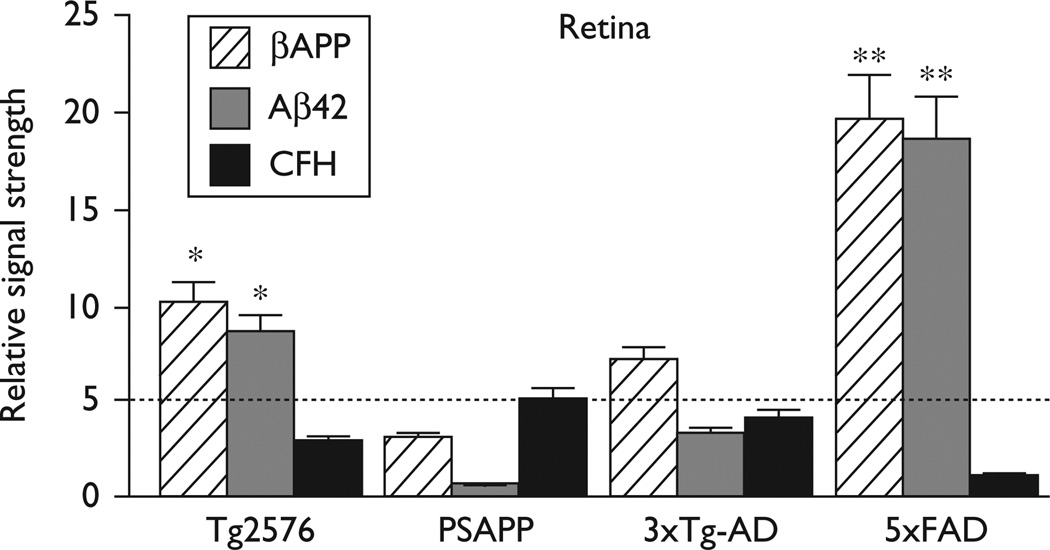
Fig. 1
Fig. 1
βAPP, Aβ42, and complement factor H (CFH) levels in transgenic murine models of Alzheimer’s disease (Tg-AD) mouse retina compared with the age-matched controls. The presence of βAPP and Aβ42 peptides suggests a common and functional secretase-mediated processing of βAPP in the Tg-AD retina [8,12,13]; other βAPP-derived peptide fragments in Tg-AD retina have been described [13]. As further discussed in the text, highest relative βAPP, Aβ42, and the lowest relative CFH levels were found in 5xFAD retina. A dashed horizontal line at 5.0 indicates relative CFH levels in PSAPP mice for ease of comparison; N=5; *P<0.05; **P<0.01 (analysis of variance).
Fig. 2
Fig. 2
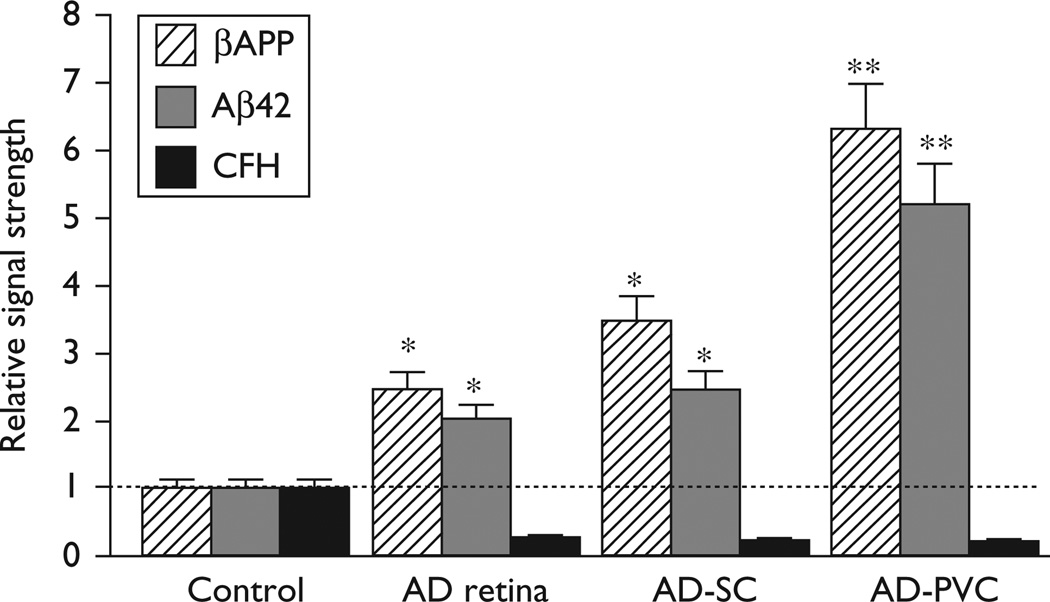
βAPP, Aβ42, and complement factor H (CFH) levels in the Alzheimer visual pathway. Data are shown for control, Alzheimer’s disease retina (AD retina), Alzheimer’s disease superior colliculus (AD-SC), and Alzheimer’s disease primary visual cortex (AD-PVC; Brodmann area A17). The highest βAPP and Aβ42 peptide levels, averaging 19.1-fold to 15.5-fold over age-matched controls respectively, were found in the AD-PVC. A dashed horizontal line at 1.0 indicates relative βAPP, Aβ42 peptides, and CFH levels in age-matched control retina for ease of comparison; N=5; *P<0.05; **P<0.01 (analysis of variance).

References

    1. O’Brien RJ, Wong PC. Amyloid precursor protein processing and Alzheimer’s disease. Annu Rev Neurosci. 2010 [Epub ahead of print] - PMC - PubMed
    1. Philipson O, Lord A, Gumucio A, O’Callaghan P, Lannfelt L, Nilsson LN. Animal models of amyloid-beta-related pathologies in Alzheimer’s disease. FEBS J. 2010;277:1389–1409. - PubMed
    1. Lukiw WJ, Zhao Y, Cui JG. An NF-κB-sensitive micro RNA-146a-mediated inflammatory circuit in Alzheimer disease and in stressed human brain cells. J Biol Chem. 2008;283:31315–31322. - PMC - PubMed
    1. Veerhuis R. Histological and direct evidence for the role of complement in the neuroinflammation of Alzheimer’s disease. Curr Alzheimer Res. 2011;8:34–58. - PubMed
    1. Cui JG, Li YY, Zhao Y, Bhattacharjee S, Lukiw WJ. Differential regulation of interleukin-1 receptor-associated kinase-1 (IRAK-1) and IRAK-2 by miRNA- 146a and NF-kB in stressed human astroglial cells and in Alzheimer’s disease. J Biol Chem. 2010;285:38951–38960. - PMC - PubMed

Publication types