. 2011 Jul 7:12:351.
doi: 10.1186/1471-2164-12-351.

Generating libraries of iTol2-end insertions at BAC ends using loxP and lox511 Tn10 transposons

Affiliations

Generating libraries of iTol2-end insertions at BAC ends using loxP and lox511 Tn10 transposons

Leighcraft A Shakes et al. BMC Genomics. .

Abstract

Background: Bacterial Artificial Chromosomes (BACs) have been widely used as transgenes in vertebrate model systems such as mice and zebrafish, for a variety of studies. BAC transgenesis has been a powerful tool to study the function of the genome, and gene regulation by distal cis-regulatory elements. Recently, BAC transgenesis in both mice and zebrafish was further facilitated by development of the transposon-mediated method using the Tol2 element. Tol2 ends, in the inverted orientation and flanking a 1 kb spacer DNA (iTol2), were introduced into the BAC DNA within the bacterial host using recombination of homologous sequences. Here we describe experiments designed to determine if a simpler and more flexible system could modify BACs so that they would be suitable for transgenesis into zebrafish or mouse embryos using the Tol2 transposase.

Results: A new technique was developed to introduce recognition sequences for the Tol2 transposase into BACs in E. coli using the Tn10 transposon vector system. We constructed pTnloxP-iTol2kan and pTnlox511-iTol2kan to introduce the loxP or lox511 site and iTol2 cassette, containing the Tol2 cis-sequences in the inverted orientation, into BACs that have loxP and lox511 sites flanking genomic DNA inserts by Tn10-mediated transposition. The procedure enables rapid generation of a large collection of BACs ready for transgenesis with the iTol2 cassette at the new end of a progressively truncated genomic insert via lox-Cre recombination. The iTol2 ends are efficiently recognized by the Tol2 transposase, and the BACs readily integrate into zebrafish chromosomes.

Conclusion: The new technology described here can rapidly introduce iTol2 ends at a BAC end of choice, and simultaneously generate a large collection of BACs with progressive deletions of the genomic DNA from that end in a single experiment. This procedure should be applicable to a wider variety of BACs containing lox sites flanking the genomic DNA insert, including those with sequence repeats. The libraries of iTol2 inserted BACs with truncations from an end should facilitate studies on the impact of distal cis-regulatory sequences on gene function, as well as standard BAC transgenesis with precisely trimmed genes in zebrafish or mouse embryos using Tol2 transposition.


Figures
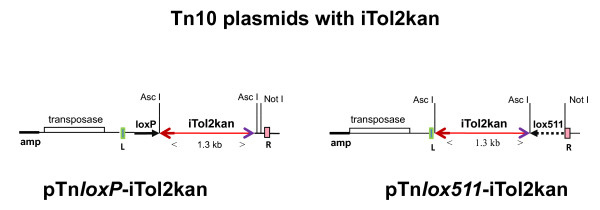
Figure 1
Figure 1
Schematic of pTnloxP-iTol2kan and pTnlox511-iTol2kan: The iTol2kan DNA cassette was inserted at the Asc I site in both pTnMarkerless2 and pTnlox511(B)markerless1 plasmids, in either orientation. Mixtures of plasmids containing both orientations of iTol2 kan in pTnMarkerless2, and pTnlox511(B)markerless1, were used for generating deletion libraries in BACs. Clones from the library represented both orientations of the iTol2kan in them. The vertical boxes marked R (pink) and L (green), adapted from reference [8], indicate the 70 bp inverted repeat ends of the Tn10 transposon. The genes coding for transposase and ampicillin (amp) resistance are located outside the 70 bp inverted repeat ends. The arrows, thick black and broken and not drawn to scale, represent sequences for loxP and lox511, respectively.
Figure 2
Figure 2
Schematic of deletion formation in APPb:EGFP-enhancer-trap BAC by pTnlox511-iTol2kan: Starting BAC APPb EGFP enhancer-trap was generated by inserting the enhancer-trap transposon (inverted triangle) is shown, along with the location of the APPb gene within the BAC clone (adapted from reference [9]). The insertion of the Tnlox511-iTol2kan transposon, and the resulting lox511-lox511 deletion mediated by Cre protein are shown in the lower half.
Figure 3
Figure 3
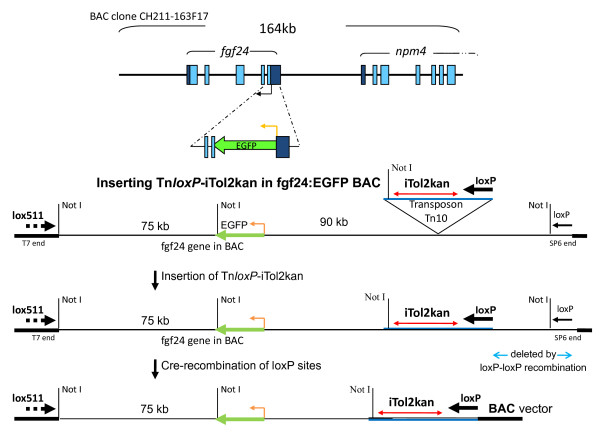
Schematic of deletion formation in fgf24:EGFP BAC by pTnloxP-iTol2kan: Layout of the fgf24 gene functionalized with the EGFP gene is shown. Below it is a schematic of the TnloxP-iTol2kan transposon insertion into the EGFP functionalized BAC DNA to place iTol2kan at the loxP end of BAC insert. The loxP-loxP deletion mediated by Cre protein is indicated.
Figure 4
Figure 4
FIGE analysis of clones from libraries generated with insertion of either pTnlox511-iTol2kan (panels A and B) or pTnloxP-iTol2kan (panel C). Deletion clone DNAs shown in FIGE Panels A and B were obtained from libraries made with different APPb BACs that contained the EGFP enhancer-trap located either 2.5 kb upstream (Panel A), or 4 kb upstream (Panel B) of the transcription start site of the APPb gene. Panel C shows clone DNA from the library generated with fgf24:EGFP using TnloxP-iTol2kan transposon. Only clones containing an intact 75 kb fragment are shown here. All clone DNAs were digested with Not I enzyme prior to FIGE analysis. The blue arrows indicate the BAC clones tested in zebrafish for expression and/or "excision assay" analyses. All clones are numbered according to the lanes in which their DNA appears, and are referred to as such throughout the text. Lanes 1, 26 and 34 are marker lanes containing the 5 kb ladder, and BAC 24 (in lane 24) is the starting APPb BAC used to generate the deletions in panel B. The arrow at the side and bottom of Panel B indicates the position of the BAC vector DNA band, which in this case is ~7 kb. Size of DNA bands in kb is indicated on the side of each panel.
Figure 5
Figure 5
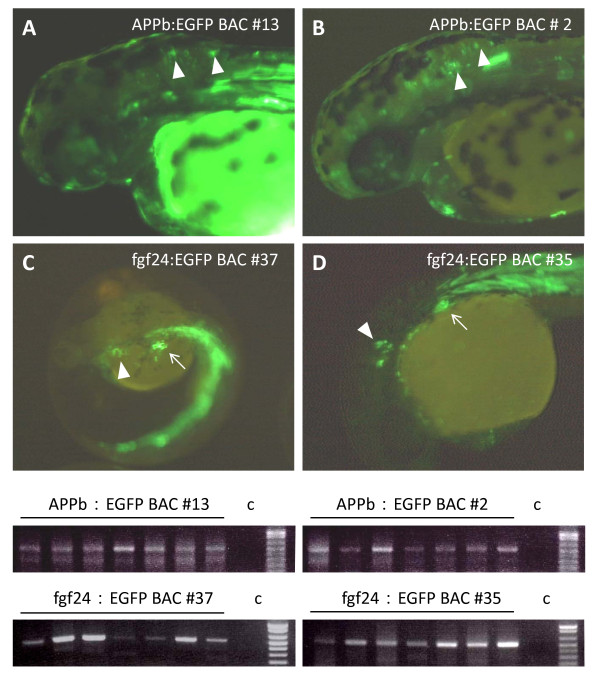
"Excision assay" performed with genomic DNA isolated from 2-day old zebrafish embryos: GFP expression in the embryos injected with iTol2-BACs were observed between 28 and 48 hours post fertilization (hpf) (upper panels). APPb:EGFP BAC 13 (panel 5A), APPb:EGFP BAC 2 (panel 5B), fgf24:EGFP BAC 37 (panel 5C) and fgf24:EGFP BAC 35 (panel 5D) display green fluorescence. The white arrowheads indicate the expected tissue-specific expressions of GFP in these embryos. The iTol2-BAC injected embryos were analyzed using the "excision assay" (lower panels) [16,4].
Figure 6
Figure 6
EGFP fluorescence in transgenic F1 zebrafish: Panel A: Germline expression of EGFP fluorescence in zebrafish embryos with DNA from APPb:EGFP BAC clone 15. Panel B shows the germline expression of EGFP fluorescence with DNA from APPb:EGFP BAC 27, and Panel C shows germline expression from fgf24:EGFP BAC clone 37.

References

    1. Kawakami K, Shima A, Kawakami N. Identification of a functional transposase of the Tol2 element, an Ac-like element from the Japanese medaka fish, and its transposition in the zebrafish germ lineage. Proc Natl Acad Sci USA. 2000;97:11403–11408. - PMC - PubMed
    1. Kawakami K, Takeda H, Kawakami N, Kobayashi M, Matsuda N, Mishina M. A transposon-mediated gene trap approach identifies developmentally regulated genes in zebrafish. Developmental Cell. 2004;7:133–144. - PubMed
    1. Urasaki A, Morvan G, Kawakami K. Functional dissection of the Tol2 Transposable Element Identified the Minimal cis- Sequence and a Highly Repetitive Sequence in the Subterminal Region Essential for Transposition. Genetics. 2006;174:639–649. - PMC - PubMed
    1. Suster ML, Sumiyama K, Kawakami K. Transposon-mediated BAC transgenesis in zebrafish and mice. BMC Genomics. 2009;10:477. - PMC - PubMed
    1. Warming S, Costantino N, Court DL, Jenkins NA, Copeland NG. Simple and highly efficient BAC recombineering using galK selection. Nucleic Acids Res. 2005;33:e36. - PMC - PubMed

Publication types

Substances