


Ancient hybridization and an Irish origin for the modern polar bear matriline
- PMID: 21737280
- PMCID: PMC4677796
- DOI: 10.1016/j.cub.2011.05.058
Ancient hybridization and an Irish origin for the modern polar bear matriline
Abstract
Background: Polar bears (Ursus maritimus) are among those species most susceptible to the rapidly changing arctic climate, and their survival is of global concern. Despite this, little is known about polar bear species history. Future conservation strategies would significantly benefit from an understanding of basic evolutionary information, such as the timing and conditions of their initial divergence from brown bears (U. arctos) or their response to previous environmental change.
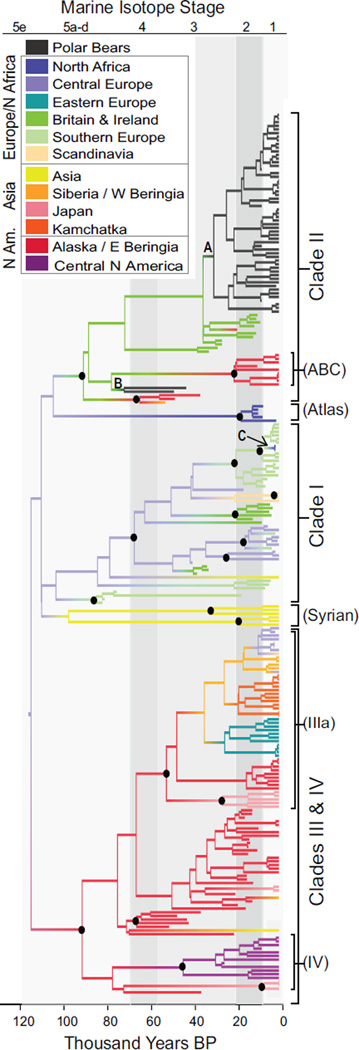
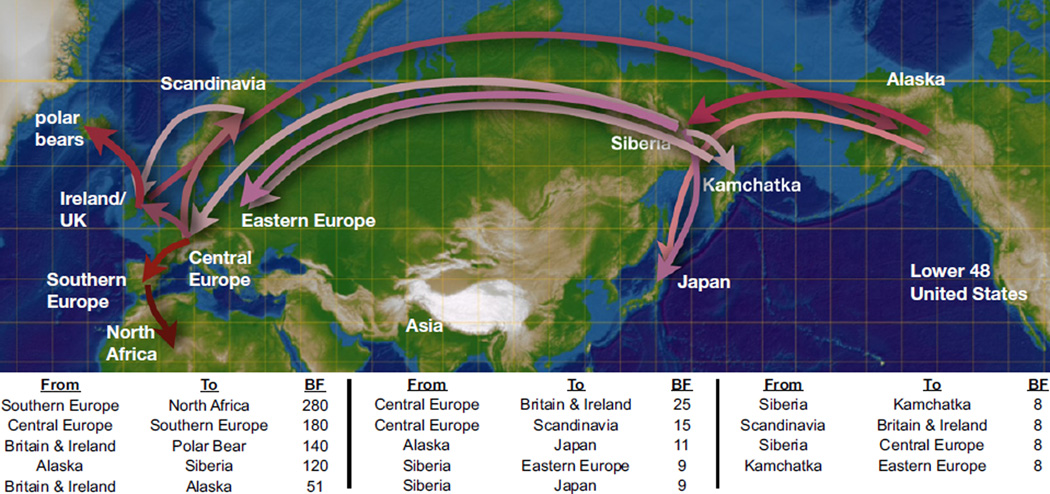
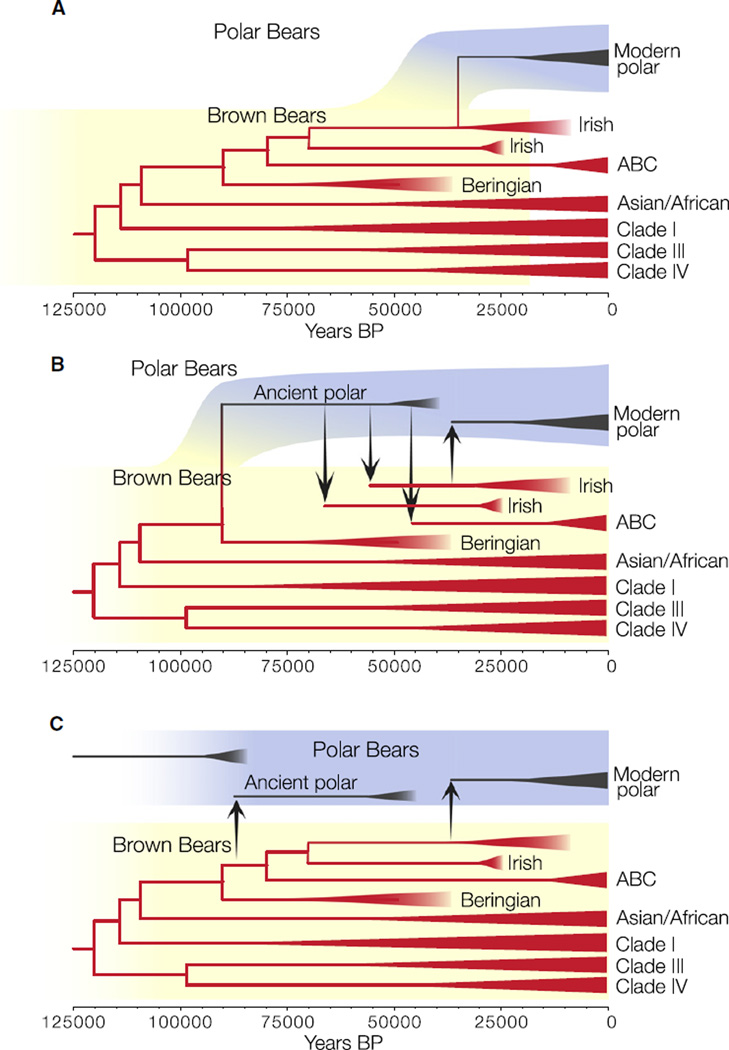
Results: We used a spatially explicit phylogeographic model to estimate the dynamics of 242 brown bear and polar bear matrilines sampled throughout the last 120,000 years and across their present and past geographic ranges. Our results show that the present distribution of these matrilines was shaped by a combination of regional stability and rapid, long-distance dispersal from ice-age refugia. In addition, hybridization between polar bears and brown bears may have occurred multiple times throughout the Late Pleistocene.
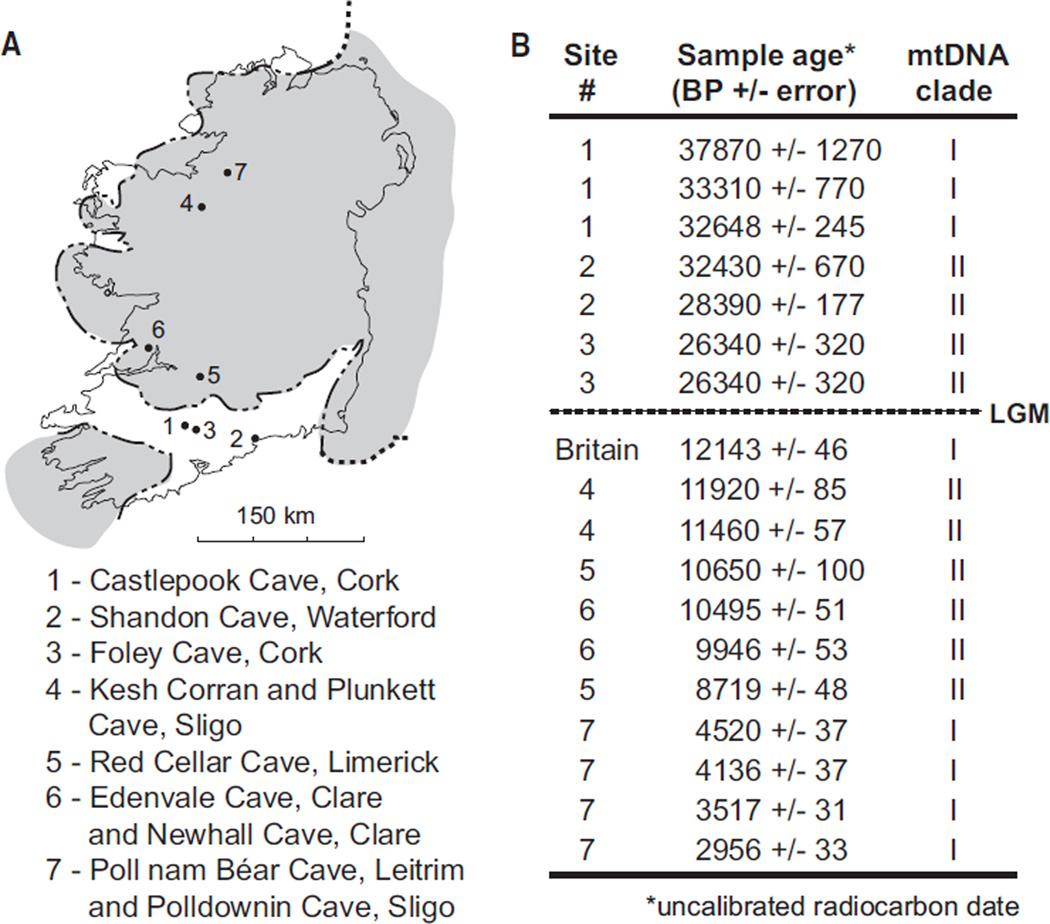
Conclusions: The reconstructed matrilineal history of brown and polar bears has two striking features. First, it is punctuated by dramatic and discrete climate-driven dispersal events. Second, opportunistic mating between these two species as their ranges overlapped has left a strong genetic imprint. In particular, a likely genetic exchange with extinct Irish brown bears forms the origin of the modern polar bear matriline. This suggests that interspecific hybridization not only may be more common than previously considered but may be a mechanism by which species deal with marginal habitats during periods of environmental deterioration.
Copyright © 2011 Elsevier Ltd. All rights reserved.
Figures
References
-
- Amstrup SC, Marcot BG, Davis DC. Forecasting the Range-wide Status of Polar Bears at Selected Times in the 21st Century. Reston, VA: US Geological Survey Administrative Report; 2007.
-
- Derocher AE, Lunn NJ, Stirling I. Polar bears in a warming climate. Integr. Comp. Biol. 2004;44:163–176. - PubMed
-
- Stirling I, Richardson E, Thiemann GW, Derocher AE. Unusual predation attempts of polar bears on ringed seals in the southern Beaufort Sea: Possible significance of changing spring ice conditions. Arctic. 2008;61:14–22.
-
- Kelly BP, Whiteley A, Tallmon D. The Arctic melting pot. Nature. 2010;468:891. - PubMed
-
- Kurtén B. The evolution of the polar bear, Ursus maritimus (Phipps) Acta Zool. Fenn. 1964;108:1–30.
Publication types
MeSH terms
Associated data
- Actions
- Actions
- Actions
- Actions
- Actions
- Actions
- Actions
- Actions
- Actions
- Actions
- Actions
- Actions
- Actions
- Actions
- Actions
- Actions
- Actions
- Actions
- Actions
- Actions
- Actions
- Actions
- Actions
- Actions
- Actions
- Actions
- Actions
- Actions
- Actions
- Actions
- Actions
- Actions
- Actions
- Actions
- Actions
- Actions
- Actions
- Actions
- Actions
- Actions
- Actions
- Actions
- Actions
- Actions
- Actions
- Actions
- Actions
- Actions
- Actions
- Actions
- Actions
- Actions
- Actions
- Actions
- Actions
- Actions
- Actions
- Actions
- Actions
- Actions
- Actions
- Actions
- Actions
- Actions
- Actions
- Actions
- Actions
- Actions
- Actions
- Actions
- Actions
- Actions
- Actions
- Actions
- Actions
- Actions
- Actions
- Actions
Grants and funding
LinkOut - more resources
Full Text Sources
Miscellaneous
