Review
. 2011 Sep;63(3):684-99.
doi: 10.1124/pr.110.003525. Epub 2011 Jul 7.

Orphans in the human cytochrome P450 superfamily: approaches to discovering functions and relevance in pharmacology

Affiliations
Review

Orphans in the human cytochrome P450 superfamily: approaches to discovering functions and relevance in pharmacology

F Peter Guengerich et al. Pharmacol Rev. 2011 Sep.

Abstract

As a result of technical advances in recombinant DNA technology and nucleotide sequencing, entire genome sequences have become available in the past decade and offer potential in understanding diseases. However, a central problem in the biochemical sciences is that the functions of only a fraction of the genes/proteins are known, and this is also an issue in pharmacology. This review is focused on issues related to the functions of cytochrome P450 (P450) enzymes. P450 functions can be categorized in several groups: 1) Some P450s have critical roles in the metabolism of endogenous substrates (e.g., sterols and fat-soluble vitamins). 2) Some P450s are not generally critical to normal physiology but function in relatively nonselective protection from the many xenobiotic chemicals to which mammals (including humans) are exposed in their diets [as well as more anthropomorphic chemicals (e.g., drugs, pesticides)]. 3) Some P450s have not been extensively studied and are termed "orphans" here. With regard to elucidation of any physiological functions of the orphan P450s, the major subject of this review, it is clear that simple trial-and-error approaches with individual substrate candidates will not be very productive in addressing questions about function. A series of liquid chromatography/mass spectrometry/informatics approaches are discussed, along with some successes with both human and bacterial P450s. Current information on what are still considered "orphan" P450s is presented. The potential for application of some of these approaches to other enzyme systems is also discussed.


Figures
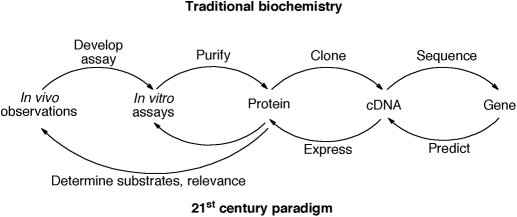
Fig. 1.
Fig. 1.
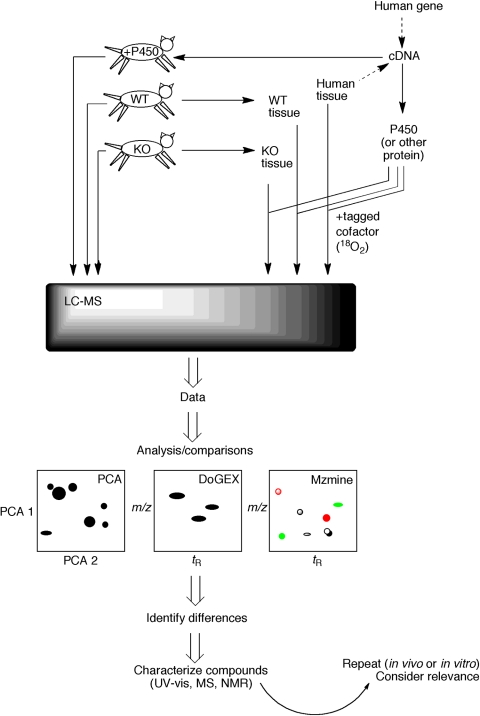
Classic (upper sequence) and “reversed” (lower sequence) approaches to understanding biochemical functions of enzymes (Guengerich et al., 2010, 2011).
Fig. 2.
Fig. 2.
LC-MS based strategies for elucidating substrates of human enzymes (Guengerich et al., 2010, 2011). One approach (in vivo) involves either expressing the human protein or deleting its apparent ortholog in a transgenic animal model. LC-MS metabolomic analysis can be done with body fluids from the animals or by removing tissues and using the in vitro incubations. Alternatively, a total in vitro approach can be used in which the protein is heterologously expressed and used with extracts of human tissue (with or without isotopically labeled cofactor). Data from the LC-MS analysis are used in comparisons (e.g., wild-type versus transgenic mice, in vitro enzyme incubations versus controls) made with one or more programs (e.g., PCA, DoGEX, MZmine, XCMS). The goal is to identify differences. In some cases, the mass spectrum (i.e., molecular formula) may be sufficient to identify possible matches of candidates, and the authentic materials may be available for comparison. However, if unknown compounds are involved, then not only the high-resolution MS spectra but also UV visible and NMR spectra may be needed. Ultimately, more experiments will be needed to assess the biological relevance of any findings.
Fig. 3.
Fig. 3.
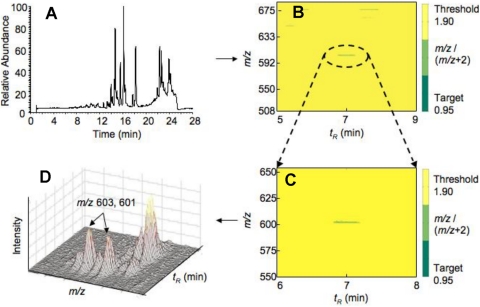
Use of the program DoGEX in screening for candidate substrates. Raw LC-MS data from an incubation of a P450, NADPH-P450 reductase, NADPH, a tissue extract, and a 1:1 mixture of 6O2/18O2 is shown in A. B shows the analysis of mass-to-charge ratio versus retention time, with a green positive spot on a yellow background for a ratio of ∼1.0 and Δ atomic mass units = 2.0, with the positive zone expanded in part C. The data from C are produced as a plot of relative ion intensity versus mass-to-charge ratio in part D. In this case the P450 uses P450 7A1, and the product was (the succinate ester of) 7α-hydroxycholesterol (Guengerich et al., 2010, 2011; Tang et al., 2010).
Fig. 4.
Fig. 4.
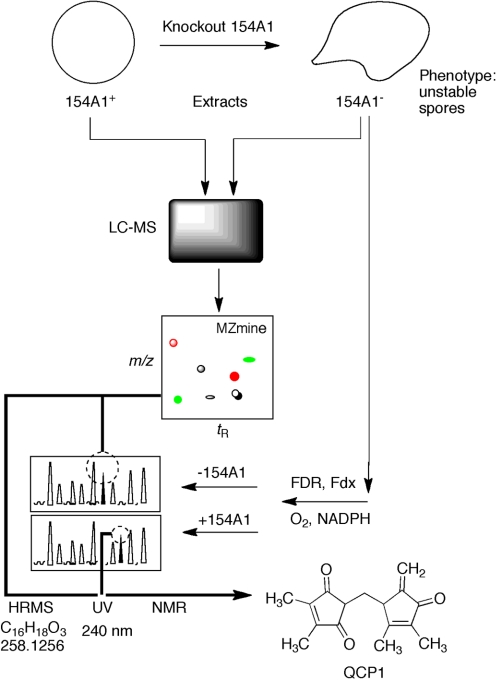
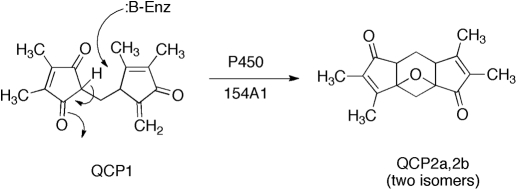
Use of an MZmine approach to identification of a substrate and product for S. coelicolor P450 154A1. LC-MS data were obtained for wild-type and P450 154AA1-knockout bacteria. Comparison of the LC-MS data by LC-MS using MZmine suggested a compound with MH+ 259. Extracts of the P450 154A1 bacteria (in which a substrate would be expected to accumulate) with P450 154A1 indicated that the candidate compound disappeared during incubation and a new peak appeared. Subsequent analytical work showed 1) the structures of the substrate QCP1 and product QCP2a,b (2 isomers) and 2) that no redox function was related to the change (Fig. 5) (Cheng et al., 2010).
Fig. 5.
Fig. 5.
Conversion of an endogeneous compund found in S. coelicolor to products without net oxidation-reduction (Cheng et al., 2010).

References

    1. Agarwal V, Kommaddi RP, Valli K, Ryder D, Hyde TM, Kleinman JE, Strobel HW, Ravindranath V. (2008) Drug metabolism in human brain: high levels of cytochrome P4503A43 in brain and metabolism of anti-anxiety drug alprazolam to its active metabolite. PLos One 3:e2337. - PMC - PubMed
    1. Bollard ME, Stanley EG, Lindon JC, Nicholson JK, Holmes E. (2005) NMR-based metabonomic approaches for evaluating physiological influences on biofluid composition. NMR Biomed 18:143–162 - PubMed
    1. Bui PH, Hankinson O. (2009) Functional characterization of human cytochrome P450 2S1 using a synthetic gene-expressed protein in Escherichia coli. Mol Pharmacol 76:1031–1043 - PMC - PubMed
    1. Bui PH, Hsu EL, Hankinson O. (2009) Fatty acid hydroperoxides support cytochrome P450 2S1-mediated bioactivation of benzo[a]pyrene-7,8-dihydrodiol. Mol Pharmacol 76:1044–1052 - PMC - PubMed
    1. Bui P, Imaizumi S, Beedanagari SR, Reddy ST, Hankinson O. (2010) Human CYP2S1 metabolizes cyclooxygenase- and lipoxygenase-derived eicosanoids. Drug Metab Dispos 39:180–190 - PMC - PubMed

Publication types