Cardiac survival after pre-emptive coronary angiography in transplant patients and those awaiting transplantation
- PMID: 21737845
- PMCID: PMC3359544
- DOI: 10.2215/CJN.08680910
Cardiac survival after pre-emptive coronary angiography in transplant patients and those awaiting transplantation
Abstract
Background and objectives: Recent interest has focused on wait listing patients without pretreating coronary artery disease to expedite transplantation. Our practice is to offer coronary revascularization before transplantation if indicated.
Design, setting, participants, & measurements: Between 2006 and 2009, 657 patients (427 men, 230 women; ages, 56.5 ± 9.94 years) underwent pretransplant assessment with coronary angiography. 573 of 657 (87.2%) patients were wait listed; 247 of 573 (43.1%) patients were transplanted during the follow-up period, 30.09 ± 11.67 months.
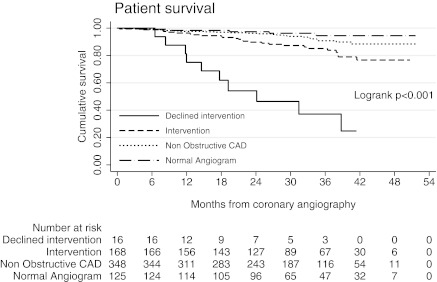
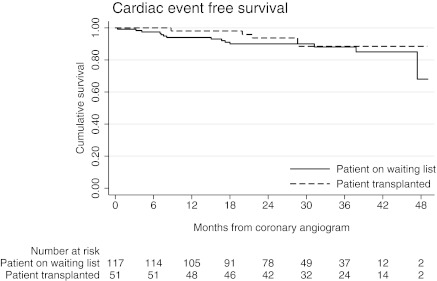
Results: Patient survival for those not wait listed was poor, 83.2% and 45.7% at 1 and 3 years, respectively. In wait-listed patients, survival was 98.9% and 95.3% at 1 and 3 years, respectively. 184 of 657 (28.0%) patients were offered revascularization. Survival in patients (n = 16) declining revascularization was poor: 75% survived 1 year and 37.1% survived 3 years. Patients undergoing revascularization followed by transplantation (n = 51) had a 98.0% and 88.4% cardiac event-free survival at 1 and 3 years, respectively. Cardiac event-free survival for patients revascularized and awaiting deceased donor transplantation was similar: 94.0% and 90.0% at 1 and 3 years, respectively.
Conclusions: Our data suggest pre-emptive coronary revascularization is not only associated with excellent survival rates in patients subsequently transplanted, but also in those patients waiting on dialysis for a deceased donor transplant.
Figures
Comment in
-
Cardiovascular evaluation before renal transplantation: to cath or not to cath?Clin J Am Soc Nephrol. 2011 Aug;6(8):1807-9. doi: 10.2215/CJN.06420611. Epub 2011 Jul 22. Clin J Am Soc Nephrol. 2011. PMID: 21784833 No abstract available.
References
-
- Herzog CA: How to manage the renal patient with coronary heart disease: The agony and the ecstasy of opinion-based medicine. J Am Soc Nephrol 14: 2556–2572, 2003 - PubMed
-
- Fishbane S: Cardiovascular risk evaluation before transplantation. J Am Soc Nephrol 16: 843–845, 2005 - PubMed
-
- Ohtake T, Kobayashi S, Moriya H, Negishi K, Okamoto K, Maesato K, Saito S: High prevalence of occult coronary artery stenosis in patients with chronic kidney disease at the initiation of renal replacement therapy: An angiographic examination. J Am Soc Nephrol 16: 1141–1148, 2005 - PubMed
-
- Hayashi T, Obi Y, Kimura T, Iio K, Sumitsuji S, Takeda Y, Nagai Y, Imai E: Cardiac troponin T predicts occult coronary artery stenosis in patients with chronic kidney disease at the start of renal replacement therapy. Nephrology Dialysis Transplantation 23: 2936–2942, 2008 - PubMed
-
- McFalls EO, Ward HB, Moritz TE, Goldman S, Krupski WC, Littooy F, Pierpont G, Santilli S, Rapp J, Hattler B, Shunk K, Jaenicke C, Thottapurathu, Ellis N, Reda DJ, Henderson WG: Coronary-artery revascularization before elective major vascular surgery. N Engl J Med 351: 2795–2804, 2004 - PubMed
MeSH terms
LinkOut - more resources
Full Text Sources
Medical