


Exposure to sublethal doses of fipronil and thiacloprid highly increases mortality of honeybees previously infected by Nosema ceranae
- PMID: 21738706
- PMCID: PMC3125288
- DOI: 10.1371/journal.pone.0021550
Exposure to sublethal doses of fipronil and thiacloprid highly increases mortality of honeybees previously infected by Nosema ceranae
Abstract
Background: The honeybee, Apis mellifera, is undergoing a worldwide decline whose origin is still in debate. Studies performed for twenty years suggest that this decline may involve both infectious diseases and exposure to pesticides. Joint action of pathogens and chemicals are known to threaten several organisms but the combined effects of these stressors were poorly investigated in honeybees. Our study was designed to explore the effect of Nosema ceranae infection on honeybee sensitivity to sublethal doses of the insecticides fipronil and thiacloprid.
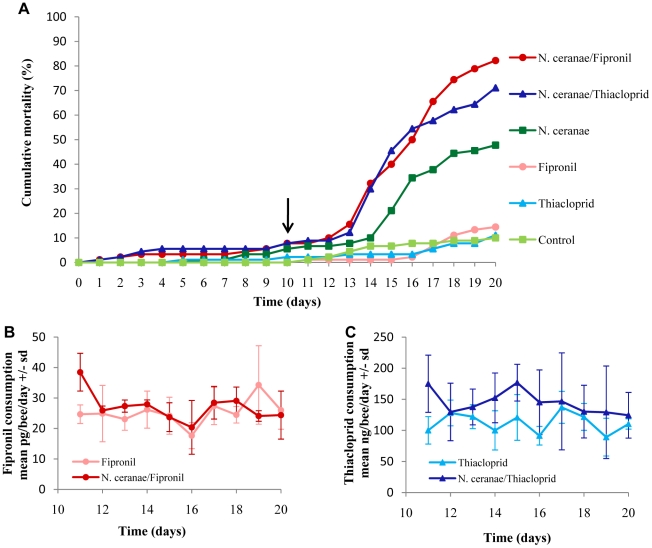
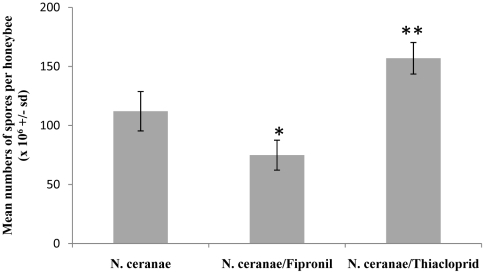
Methodology/finding: Five days after their emergence, honeybees were divided in 6 experimental groups: (i) uninfected controls, (ii) infected with N. ceranae, (iii) uninfected and exposed to fipronil, (iv) uninfected and exposed to thiacloprid, (v) infected with N. ceranae and exposed 10 days post-infection (p.i.) to fipronil, and (vi) infected with N. ceranae and exposed 10 days p.i. to thiacloprid. Honeybee mortality and insecticide consumption were analyzed daily and the intestinal spore content was evaluated 20 days after infection. A significant increase in honeybee mortality was observed when N. ceranae-infected honeybees were exposed to sublethal doses of insecticides. Surprisingly, exposures to fipronil and thiacloprid had opposite effects on microsporidian spore production. Analysis of the honeybee detoxification system 10 days p.i. showed that N. ceranae infection induced an increase in glutathione-S-transferase activity in midgut and fat body but not in 7-ethoxycoumarin-O-deethylase activity.
Conclusions/significance: After exposure to sublethal doses of fipronil or thiacloprid a higher mortality was observed in N. ceranae-infected honeybees than in uninfected ones. The synergistic effect of N. ceranae and insecticide on honeybee mortality, however, did not appear strongly linked to a decrease of the insect detoxification system. These data support the hypothesis that the combination of the increasing prevalence of N. ceranae with high pesticide content in beehives may contribute to colony depopulation.
Conflict of interest statement
Figures

References
-
- Gallai N, Salles J-M, Settele J, Vaissière BE. Economic valuation of the vulnerability of world agriculture confronted with pollinator decline. Ecological Economics. 2009;68:810–821.
-
- Ratnieks FL, Carreck NL. Ecology. Clarity on honey bee collapse? Science. 2010;327:152–153. - PubMed
-
- Maxim L, van der Sluijs JP. Uncertainty: Cause or effect of stakeholders' debates?: Analysis of a case study: The risk for honeybees of the insecticide Gaucho®. Science of The Total Environment. 2007;376:1–17. - PubMed
-
- OEPP/EPPO. Environmental risk assessment scheme for plant protection products. . Bull OEPP/EPPO. 2003;33:141–145.
Publication types
MeSH terms
Substances
LinkOut - more resources
Full Text Sources
