. 2011;6(6):e21553.
doi: 10.1371/journal.pone.0021553. Epub 2011 Jun 29.

Gain, loss and divergence in primate zinc-finger genes: a rich resource for evolution of gene regulatory differences between species

Affiliations

Gain, loss and divergence in primate zinc-finger genes: a rich resource for evolution of gene regulatory differences between species

Katja Nowick et al. PLoS One. 2011.

Abstract

The molecular changes underlying major phenotypic differences between humans and other primates are not well understood, but alterations in gene regulation are likely to play a major role. Here we performed a thorough evolutionary analysis of the largest family of primate transcription factors, the Krüppel-type zinc finger (KZNF) gene family. We identified and curated gene and pseudogene models for KZNFs in three primate species, chimpanzee, orangutan and rhesus macaque, to allow for a comparison with the curated set of human KZNFs. We show that the recent evolutionary history of primate KZNFs has been complex, including many lineage-specific duplications and deletions. We found 213 species-specific KZNFs, among them 7 human-specific and 23 chimpanzee-specific genes. Two human-specific genes were validated experimentally. Ten genes have been lost in humans and 13 in chimpanzees, either through deletion or pseudogenization. We also identified 30 KZNF orthologs with human-specific and 42 with chimpanzee-specific sequence changes that are predicted to affect DNA binding properties of the proteins. Eleven of these genes show signatures of accelerated evolution, suggesting positive selection between humans and chimpanzees. During primate evolution the most extensive re-shaping of the KZNF repertoire, including most gene additions, pseudogenizations, and structural changes occurred within the subfamily homininae. Using zinc finger (ZNF) binding predictions, we suggest potential impact these changes have had on human gene regulatory networks. The large species differences in this family of TFs stands in stark contrast to the overall high conservation of primate genomes and potentially represents a potent driver of primate evolution.


Conflict of interest statement

Competing Interests: The authors have declared that no competing interests exist.

Figures

Figure 1
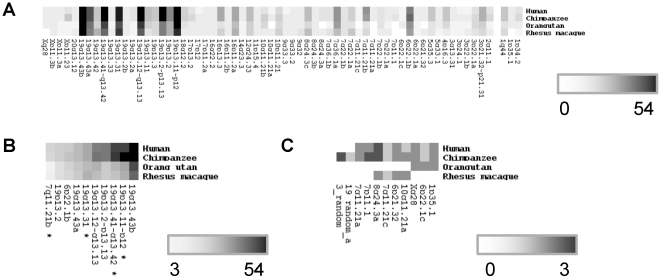
Figure 1. Number of KZNF genes per cluster for the four investigated primates.
The legend indicates the number of genes – the darker the fields the more genes are in the cluster. A: All clusters. B: The ten largest clusters. C: Lineage-specific clusters. The asterisk indicates clusters that had orthologs located on random or unknown chromosomes.
Figure 2
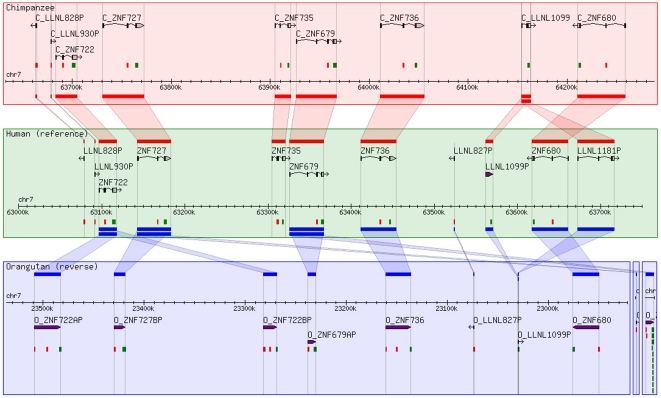
Figure 2. An example of a gene cluster with species-specific loci.
Human (cluster chr7q11.21b, region, human chromosome 7∶63000000–63750000) was chosen as the reference for this Gbrowse display. Loci are depicted by rectangles. Orthologous loci are connected by lines. Colors indicate the species comparison: Red for human-chimpanzee and blue for human-orangutan. The human-rhesus macaque comparison is not shown, but can be viewed on our synteny browser (http://znf.igb.illinois.edu/cgi-bin/gbrowse_syn/znf_synteny/). Continuous stretches of chromosomes are shown in a box; orthologs located on other chromosomes (e.g. random chromosomes) are shown in separate boxes. Note the paralogs LLNL1099P and LLNL1181, an example for a human specific duplication, and ZNF722, an example for a gene duplicated in orangutan. Further note that for orangutan the reverse is shown, indicating an inversion on the lineage to humans and chimpanzees; the orangutan gene order is likely to be ancestral because it is shared by rhesus macaque (not shown).
Figure 3
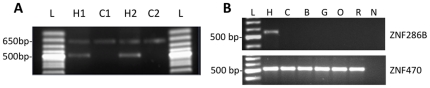
Figure 3. Confirming the human specificity of ZNF492 and ZNF286B genes.
A. ZNF492 is predicted to be a human specific duplication of ZNF98 and can be distinguished from ZNF98 by several sequence differences, including one mutation that creates a BsmI restriction site in the human-specific gene. We generated PCR products from two independent human (H1, H2) and chimpanzee (C1, C2) genomic DNA samples using primers that would amplify 650 bp regions from both genes and digested the products with BsmI (L = size standard ladder). As predicted, the chimpanzee DNA was not cut by BsmI. By contrast, the human sequence gives rise to three BsmI bands, including the undigested 600 bp ZNF98 sequence along with 500 bp and 150 bp fragments corresponding to the digested ZNF492 paralog. The gel shown here was run maximize separation of the 600 and 450 bp bands; the 150 bp fragment is not shown. B: ZNF286B is predicted to be a human-specific duplicate of ZNF286A. We used PCR with the forward primer targeting the first finger that distinguishes the two paralogs to amplify the 286B gene sequences in genomic DNA from six primates: human (H), Chimpanzee (c), Bonobo (B), Gorilla (G), Orangutan (O), and rhesus macaque (R). A size standard ladder (L) and no-template negative control (N) are also included. A ZNF286B-specific PCR product was generated only in human DNA. These same DNA preparations were tested with control PCR primer sets designed against several other genes including ZNF470, which is known to be present in all species (lower panel). The production of clear PCR products for this and other shared genes confirmed the quality of the non-human primate DNA.
Figure 4
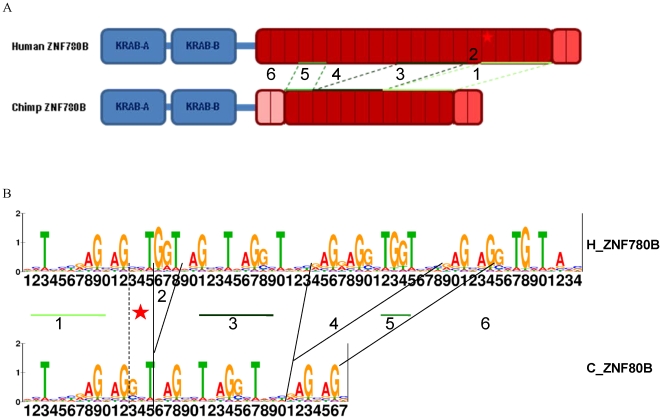
Figure 4. Sequence and predicted binding motif differences between human and chimpanzee ZNF780B.
A. Both proteins contain a KRAB-A, a KRAB-B, and a polydactyl ZNF domain. The last two ZNF motifs are not functional in both species due to mutations of the Histidine residues preventing the correct folding of the binding domain. The first two ZNF motifs of the chimpanzee gene are not included in the protein. Homologous ZNF motifs are indicated by green lines. The first three, the 6th to 10th, as well as the 16th ZNF motif are deleted in chimpanzee ZNF780B. The human ZNF780B protein is characterized by a human-specific amino acid at position 6 in the 17th ZNF motif, indicated by a star. B: Binding motifs for human and chimpanzee ZNF780B as predicted by the tool developed by Kaplan and colleagues (28). Corresponding stretches of the binding motif and ZNF domains are indicated by numbers, the star, and green lines, respectively.

References

    1. Oliver PL, Goodstadt L, Bayes JJ, Birtle Z, Roach KC, et al. Accelerated evolution of the Prdm9 speciation gene across diverse metazoan taxa. PLoS Genet. 2009;5:e1000753. - PMC - PubMed
    1. Nowick K, Stubbs L. Lineage-specific transcription factors and the evolution of gene regulatory networks. Brief Funct Genomics. 2010;9:65–78. - PMC - PubMed
    1. Hecht J, Stricker S, Wiecha U, Stiege A, Panopoulou G, et al. Evolution of a core gene network for skeletogenesis in chordates. PLoS Genet. 2008;4:e1000025. - PMC - PubMed
    1. Enard W, Przeworski M, Fisher SE, Lai CS, Wiebe V, et al. Molecular evolution of FOXP2, a gene involved in speech and language. Nature. 2002;418:869–872. - PubMed
    1. Vaquerizas JM, Kummerfeld SK, Teichmann SA, Luscombe NM. A census of human transcription factors: function, expression and evolution. Nat Rev Genet. 2009;10:252–263. - PubMed

Publication types