Review
. 2011 Mar-Apr;2(2):87-91.
doi: 10.4161/nucl.2.2.14637.

Traversing the NPC along the pore membrane: targeting of membrane proteins to the INM

Affiliations
Review

Traversing the NPC along the pore membrane: targeting of membrane proteins to the INM

Wolfram Antonin et al. Nucleus. 2011 Mar-Apr.

Abstract

The inner nuclear membrane (INM) accommodates a specific set of integral membrane proteins many of which interact with chromatin and/or in metazoan cells with the lamina network. The localization of these proteins characterizes this membrane area of the nuclear envelope (NE) despite the fact that the INM forms a membrane continuum with the outer nuclear membrane (ONM) and the remaining endoplasmic reticulum (ER). In fact, the INM can be regarded as a highly specialized membrane subdomain of the ER. How the specific protein composition of the INM is established and maintained and whether this is achieved via a single unifying mechanism is by and large unclear. Recent experiments shed light on some aspects of the process.

Keywords: Nup188; SUN2; inner nuclear membrane; membrane targeting; nuclear envelope; nuclear localization signal; nuclear pore complex.


Figures
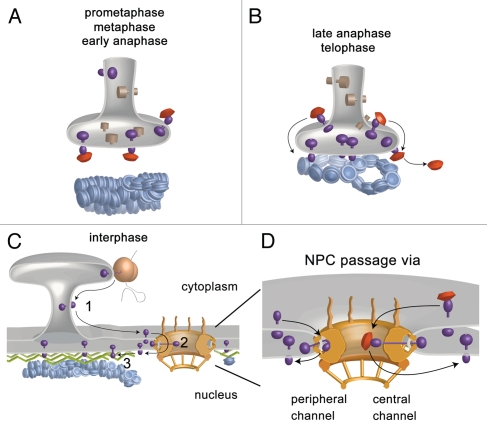
Figure 1
Figure 1
Model for the targeting of transmembrane proteins to the INM at the end of mitosis (A and B) and in interphase (C and D). (A) During mitosis INM proteins (violet) are dispersed throughout the ER and their basic domains are shielded by nuclear import receptors (red). (B) At the end of mitosis, binding of RanGTP to the transport receptors releases them from INM proteins in the vicinity of chromatin. This probably together with dephosphorylation (not shown) allows INM proteins to interact with chromatin and segregates them from bulk ER proteins (brown). (C) In interphase, integral INM proteins are synthesized at the rough ER, translocate in the plane of the ER and ONM membrane to the NPC (1). After passage through the NPC (2), INM proteins reach their site of destination (3). (D) The nucleoplasmic domains of integral INM proteins could pass the NPC either via the peripheral channels in proximity to the pore membrane or via the central channel, possibly by the action of transport receptors (red).
Figure 2
Figure 2
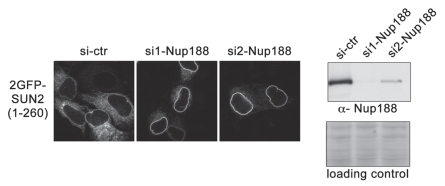
Depletion of Nup188 promotes targeting of a reporter protein to the INM in human cells. HeLa cells were transfected with either a control siRNA or two different siRNAs to Nup188 (9 nM siRNA, 2 × 48 hrs). After 72 hrs, cells were transiently transfected with 2GFP-SUN2(1-260) (Turgay et al. 2010). Cells were either fixed in 1% PFA and analyzed by confocal microscopy or cell extracts were analyzed by immunoblotting using an antibody against Nup188. Loading control: Ponceau S staining of nitrocellulose membrane used for antibody detection of Nup188.

References

    1. Ellenberg J, Siggia ED, Moreira JE, Smith CL, Presley JF, Worman HJ, et al. Nuclear membrane dynamics and reassembly in living cells: targeting of an inner nuclear membrane protein in interphase and mitosis. J Cell Biol. 1997;138:1193–1206. - PMC - PubMed
    1. Yang L, Guan T, Gerace L. Integral membrane proteins of the nuclear envelope are dispersed throughout the endoplasmic reticulum during mitosis. J Cell Biol. 1997;137:1199–1210. - PMC - PubMed
    1. Pyrpasopoulou A, Meier J, Maison C, Simos G, Georgatos SD. The lamin B receptor (LBR) provides essential chromatin docking sites at the nuclear envelope. EMBO J. 1996;15:7108–7119. - PMC - PubMed
    1. Ulbert S, Platani M, Boue S, Mattaj IW. Direct membrane protein-DNA interactions required early in nuclear envelope assembly. J Cell Biol. 2006;173:469–476. - PMC - PubMed
    1. Anderson DJ, Vargas JD, Hsiao JP, Hetzer MW. Recruitment of functionally distinct membrane proteins to chromatin mediates nuclear envelope formation in vivo. J Cell Biol. 2009;186:183–191. - PMC - PubMed

Publication types

Substances

LinkOut - more resources