


Cortical thickness is linked to executive functioning in adulthood and aging
- PMID: 21739526
- PMCID: PMC6869850
- DOI: 10.1002/hbm.21311
Cortical thickness is linked to executive functioning in adulthood and aging
Abstract
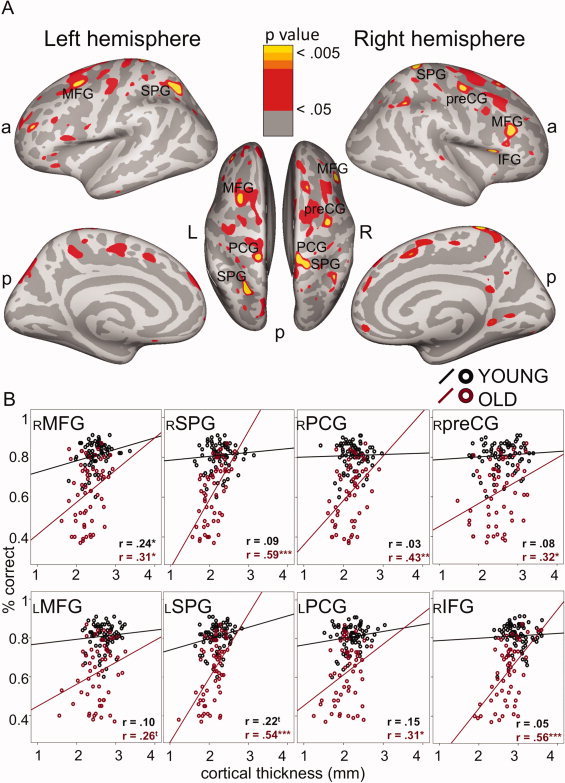
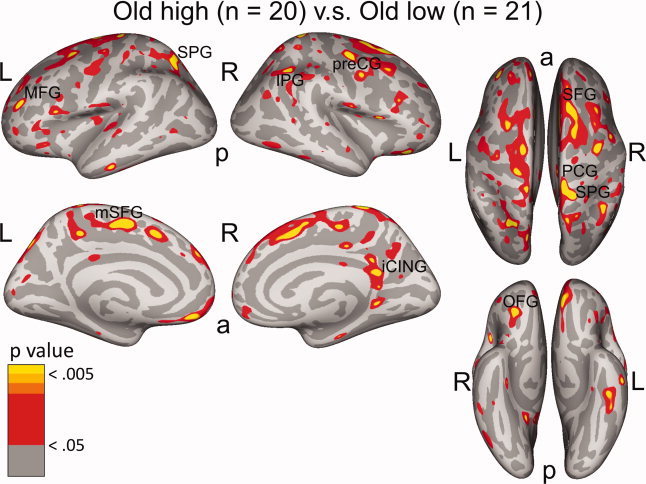
Executive functions that are dependent upon the frontal-parietal network decline considerably during the course of normal aging. To delineate neuroanatomical correlates of age-related executive impairment, we investigated the relation between cortical thickness and executive functioning in 73 younger (20-32 years) and 56 older (60-71 years) healthy adults. Executive functioning was assessed using the Wisconsin Card Sorting Test (WCST). Cortical thickness was measured at each location of the cortical mantle using surface-based segmentation procedures on high-resolution T1-weighted magnetic resonance images. For regions involved in WCST performance, such as the lateral prefrontal and parietal cortices, we found that thicker cortex was related to higher accuracy. Follow-up ROI-based analyses revealed that these associations were stronger in older than in younger adults. Moreover, among older adults, high and low performers differed in cortical thickness within regions generally linked to WCST performance. Our results indicate that the structural cortical correlates of executive functioning largely overlap with previously identified functional patterns. We conclude that structural preservation of relevant brain regions is associated with higher levels of executive performance in old age, and underscore the need to consider the heterogeneity of brain aging in relation to cognitive functioning.
Copyright © 2011 Wiley-Liss, Inc.
Figures
References
-
- Ardila A ( 2007): Normal aging increases cognitive heterogeneity: Analysis of dispersion in WAIS‐III scores across age. Arch Clin Neuropsych 22: 1003–1011. - PubMed
-
- Bäckman L, Small BJ, Wahlin A, Larsson A ( 2000): Cognitive functioning in very old age In: Craik FI, Salthouse T, editors. Handbook of Aging and Cognition. Mahwah: Erlbaum; p 499–558.
-
- Baloh RW, Vinters HV ( 1995): White matter lesions and disequilibrium in older people. II. Clinicopathologic correlation. Arch Neurol 52: 975–981. - PubMed
-
- Baltes PB ( 1987): Theoretical propositions of lifespan developmental psychology: On the dynamics between growth and decline. Dev Psychol 23: 611–626.
Publication types
MeSH terms
LinkOut - more resources
Full Text Sources
Medical
