. 2011 Aug 16;50(32):7002-14.
doi: 10.1021/bi200437q. Epub 2011 Jul 21.

RNA transcript 3'-proximal sequence affects translocation bias of RNA polymerase

Affiliations

RNA transcript 3'-proximal sequence affects translocation bias of RNA polymerase

Pyae P Hein et al. Biochemistry. .

Abstract

Translocation of RNA polymerase on DNA is thought to involve oscillations between pretranslocated and posttranslocated states that are rectified by nucleotide addition or pyrophosphorolysis. The pretranslocated register is also a precursor to transcriptional pause states that mediate regulation of transcript elongation. However, the determinants of bias between the pretranslocated and posttranslocated states are incompletely understood. To investigate translocation bias in multisubunit RNA polymerases, we measured rates of pyrophosphorolysis, which occurs in the pretranslocated register, in minimal elongation complexes containing T. thermophilus or E. coli RNA polymerase. Our results suggest that the identity of RNA:DNA nucleotides in the active site are strong determinants of susceptibility to pyrophosphorolysis, and thus translocation bias, with the 3' RNA nucleotide favoring the pretranslocated state in the order U > C > A > G. The preference of 3' U vs G for the pretranslocated register appeared to be universal among both bacterial and eukaryotic RNA polymerases and was confirmed by exonuclease III footprinting of defined elongation complexes. However, the relationship of pyrophosphate concentration to the rate of pyrophosphorolysis of 3' U-containing versus 3' G-containing elongation complexes did not match predictions of a simple mechanism in which 3'-RNA seqeunce affects only translocation bias and pyrophosphate (PPi) binds only to the pretranslocated state.


Figures

FIGURE 1
FIGURE 1
Nucleotide addition and pyrophosphorolysis cycle. Template DNA is shown in black, non-template DNA in blue, RNA in red, incoming nucleotide triphosphate and pyrophosphate in green, and Mg2+ in yellow. One template/nontemplate position is colored orange to illustrate translocation. The EC alternates between pre and posttranslocated states with the RNA 3′ nt in the i or i+1 subsites, prior to NTP binding (step 1). NTPs enter the active site when the EC is posttranslocated (step 2). Catalysis (step 3) requires a rate-limiting conformational change in which the trigger loop folds into the trigger helices (not shown). Release of PPi (step 4) completes the nucleotide addition cycle. Pyrophosphorolysis is the reverse reaction of nucleotide addition. Since catalysis itself is reversible, net pyrophosphorolysis requires that the thermodynamic driving force of PPi conversion to NTP+RNA−1 exceed the conversion of NTP to PPi+RNA+1. Pyrophosphorolysis requires the EC be in the pretranslocated register, but whether PPi binding/release and translocation occur with obligate order is not established.
FIGURE 2
FIGURE 2
Pyrophosphorolysis by TthRNAP on a minimal scaffold. (A) A representative example of a minimal nucleic acid scaffold used in this study (yields EC8AU). *, 5′ 32P. The color scheme for RNA and DNA is the same as in Figure 1A. The posttranslocated state is resistant to pyrophosphorolysis; the pretranslocated state is competent for pyrophosphorolysis, yielding UTP in this case. (B) ECs containing TthRNAP were assembled on four minimal nucleic acid scaffolds that differ only in the sequence shown above the gel panels. The time course of pyrophosphorolysis (0.5 mM PPi) at 60°C is shown, with the sizes of RNAs indicated.
FIGURE 3
FIGURE 3
Identity of RNA 3′ terminal nucleotide affects translocation register of TthRNAP. (A) Quantitative analysis of pyrophosphorolysis of EC9CU, which favors the pretranslocated state. TthEC9CU was reconstituted from tDNA #6059, ntDNA #5848, and RNA #6042 (Table S1). ECs (50 nM) were incubated with 0.5 mM pyrophosphate at 60°C and disappearance of the 9 nt RNA measured at the times indicated in the inset. +NTP, UTP (1mM) was added at the end of the time course to confirm that the unreacted EC9CU remained active and could extend the RNA 1 nt by UMP incorporation. Errors are SD from three independent experiments. Data were fit to a simple reversible mechanism of pyrophosphorolysis (equation 3; see Materials and Methods). A value for k1 that approximated the initial rate of pyrophosphorolysis (0.29 ± 0.04 min-1) and a final fraction of pyrophosphorolysed transcript (PPi-sensitive fraction, remaining 9-nt RNA/total RNA = 0.74 ± 0.03) were determined by nonlinear regression. (B) Quantitative analysis of pyrophosphorolysis of EC9CG, which favors the posttranslcated state. The experiment was performed identically to that shown in panel A except that TthEC9CG was reconstituted from tDNA #6062, ntDNA #5848, and RNA #6045 (Table S1). (C) A plot of fraction of EC susceptible to pyrophosphorolysis (PPi-sensitive fraction) with 0.5 mM PPi versus the rate of pyrophosphorolysis for 16 combinations of 3′-proximal dinucleotide sequence.
FIGURE 4
FIGURE 4
Incomplete pyrophosphorolysis by EcoRNAP is caused by NTP accumulation. (A) Rates of pyrophosphorolysis of EcoEC9GU. EcoEC9GU reconstituted using E. coli RNAP and the pre-translocation favoring scaffold (#6063, #5848, #6046; Table S1). EcoEC9GU (50 nM) was incubated at 37°C with 0.5 mM PPi alone (red), in the presence of 0.5 U apyrase/ml (blue), or with addition of apyrase to 0.5 U/ml 60 min after the reaction was initiated (green) for the time indicated. Samples were removed at the times indicated and the fraction EC9GU remaining was plotted as a function of time. The error bars represent standard deviations obtained from 4 different experiments. The data from reaction without apyrase (red) are fit to a simple reversible mechanism of pyrophosphorolysis (equation 3; see Materials and Methods), whereas data from reaction with apyrase (blue) are fit to a single exponential for a pseudo-first-order reaction. (B) The fraction of EcoEC9GU and EcoEC9UG resistant to pyrophosphorolysis at 0.5 mM PPi in the absence (gray) or presence (black) of apyrase.
FIGURE 5
FIGURE 5
ExoIII footprints of TthEC9GU (pretranslocated) and TthEC9UG (posttranslocated). (A) Schematic of the complete scaffold used for exoIII footprinting experiments. The sizes of the template DNA (upstream) and the nontemplate DNA (downstream) fragments protected by RNAP from digestion by ExoIII are illustrated. For the nontemplate strand assay, the nontemplate strand contained a 5′ 32P label and the template strand contained a 3′ phosphorothioate bond. For template strand assay, the template strand contained a 5′ 32P label and the nontemplate strand containing a 3′ phosphorothioate bond. (B) Pyrophosphorolysis results of EC9GU and EC9UG on complete scaffolds used for ExoIII footprinting experiments. The RNA and template DNA (GU: #6046, #6355, and UG: #6053, #6357; Table S1) were first annealed, then mixed with TthRNAP, then annealed to the nontemplate strand (GU: #6354 and UG: #6356; Table S1; see Materials and Methods). ECs (50 nM) were incubated with 0.5 mM PPi at 60 C. The initial rate of pyrophosphorolysis (k1) and the fraction resistant to pyrophosphorolysis were determined as described in Materials and Methods. (C) Upstream ExoIII footprinting (left) and downstream ExoIII footprinting (right) of EC9GU and EC9UG. Plot on the left depicts the appearance of the nontemplate DNA 14 band, which should be faster when the pretranslocated register is favored. Plot on the right depicts the appearance of the template DNA +12 band, which should be faster when the posttranslocated register is favored.
FIGURE 6
FIGURE 6
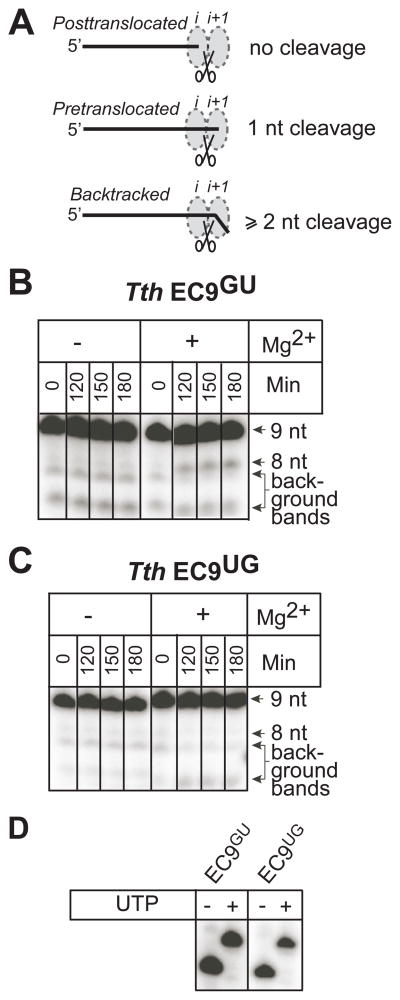
The pyrophosphorolysis-resistant TthEC9UG is not backtracked. (A) Predicted outcomes for intrinsic cleavage reactions of pretranslocated, posttranslocated, and backtracked ECs. Posttranslocated ECs does not generate cleavage products, whereas pretranslocated and backtracked complexes produce 1-nt cleavage products, and 2 or more cleavage products, respectively. (B) Intrinsic cleavage reaction of TthEC9GU. TthEC9GU was reconstituted using TthRNAP and the pretranslocation-favoring scaffold (#6063, #5848, #6046; Table S1) containing 5′ end 32P-labeled RNA at pH 9 without Mg2+. Intrinsic cleavage reaction was initiated by the addition of 20 mM Mg2+ and samples were removed and separated by electrophoresis at the times indicated (see Materials and Methods). (C) Intrinsic cleavage reaction of TthEC9UG. TthEC9UG was reconstituted and assayed as in panel A except with the postranslocation-favoring scaffold (#6070, #5848, #6053: Table S1). (D) EC9GU and EC9UG were incubated with 100 ?M UTP to extend their respective RNAs by one nucleotide, thus showing the ECs were active and not arrested.
FIGURE 7
FIGURE 7
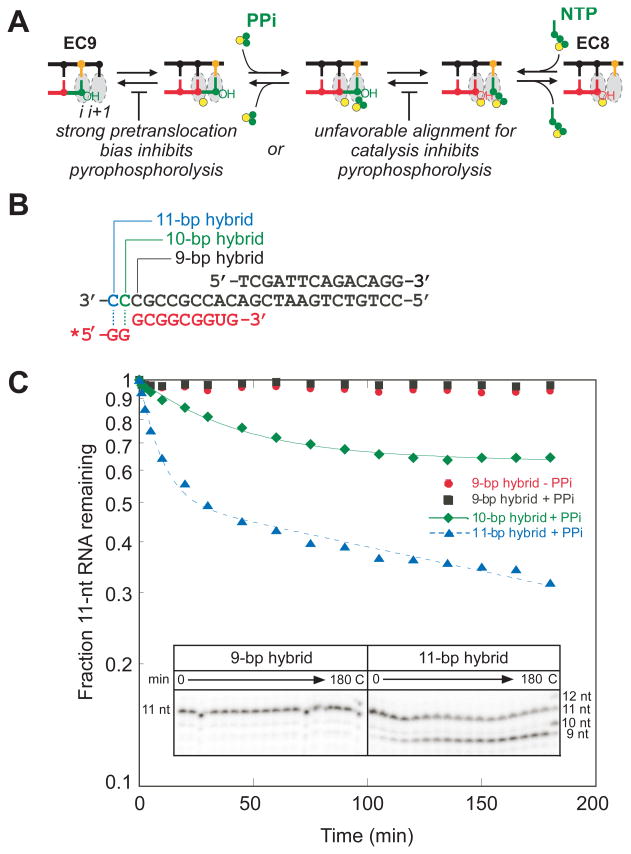
The RNA 3′ dinucleotide UG is not intrinsically resistant to pyrophosphorolysis by EcoRNAP. (A) translocation bias towards posttranslocated state or a slow catalysis could account for the insensitivity of EC9UG. (B) Nucleic acid scaffolds with different potential RNA:DNA hybrid length. RNA is shown in red, template and nontemplate DNA strands are in black. The 9-bp, 10-bp, and 11-bp potential RNA:DNA hybrid are created by varying the length of template DNA without changing the length of the 11-nt RNA (the template DNAs in 9-bp, 10-bp, and 11-bp hybrids end at the positions marked with a black line, a green, or a blue line, respectively. RNA was labeled with 32P at its 5′ end (*). (C) Plot of pyrophosphorolysis of ECs reconstituted with EcoRNAP and different scaffolds shown in Figure 6B. ECs were incubated with 0.5 mM PPi, 0.5 U apyrase/ml at 37°C for the times indicated. Representative gel panels for EC9UG (9-bp hybrid) and EC11UG (11-bp hybrid) are shown in the inset. “C”, chase lane in which ECs were chased with 1 mM UTP at the end of pyrophosphorolysis time course (after 3 hours).
FIGURE 8
FIGURE 8
PPi-concentration dependence of pyrophosphorolysis in EcoEC9GU and EcoEC9UG. (A) A predicted relationship for the rate of pyrophosphorolysis vs. [PPi] for the ordered translocation/PPi binding mechanism shown in Figure 6A and Figure 1. The difference in apparent KPPi (~75x) between EC9GU and EC9UG and in rate at 0.5 mM PPi concentration are indicated on the plot. (B) Kinetic analysis of [PPi]-dependence of pyrophosphorolysis in EC9GU and EC9UG. Rate of pyrophosphorolysis for EcoEC9GU and EcoEC9UG over a wide range of PPi concentrations. (C) Approximate, apparent kinetic constants of EC9GU and EC9UG are calculated from the plot shown in Figure 8B (see Materials and Methods).
FIGURE 9
FIGURE 9
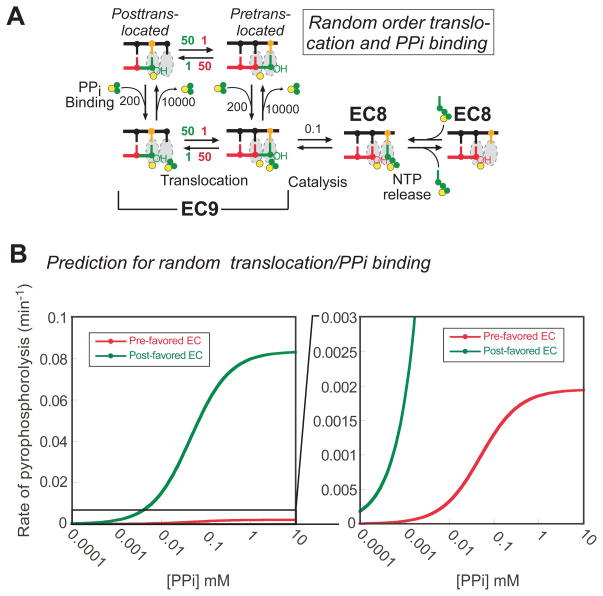
A random-order of translocation of PPi binding/release can explain differences in pyrophosphorolysis of EC9UG and EC9GU. (A) A random-order translocation and PPi binding/release mechanism. With the arbitrarily chosen rate constants shown in the figure, the mechanism can account for a Vmax difference with little effect on apparent KPPi. Translocation rates were assigned based on translocation bias of a particular EC. Forward and backward translocation rate constants for pre-favored ECs are shown in green (50 and 1 s-1, respectively), whereas those for post-favored ECs are in red (1 s-1; forward rate constant and 50 s-1; reverse rate constant). (B) A kinetic simulation graph of pretranslocation-favoring EC9GU (green) and posttranslocation favoring EC9UG (red) ECs was generated using the reaction scheme shown in Figure 9A using the program KinTek Global Kinetic Explorer (see Materials and Methods).

References

    1. Zhang JaLR. Substrate loading, nucleotide addition, and translocation by RNA Polymerase. In: Buc HaST., editor. RNA Polymerase as Molecular Motors. 1. Royal Society of Chemistry; Cambridge, UK: 2009. pp. 206–235.
    1. Kireeva M, Kashlev M, Burton ZF. Translocation by multi-subunit RNA polymerases. Biochim Biophys Acta 2010 - PubMed
    1. Sosunov V, Sosunova E, Mustaev A, Bass I, Nikiforov V, Goldfarb A. Unified two-metal mechanism of RNA synthesis and degradation by RNA polymerase. Embo J. 2003;22:2234–2244. - PMC - PubMed
    1. Guajardo R, Sousa R. A model for the mechanism of polymerase translocation. J Mol Biol. 1997;265:8–19. - PubMed
    1. Abbondanzieri EA, Greenleaf WJ, Shaevitz JW, Landick R, Block SM. Direct observation of base-pair stepping by RNA polymerase. Nature. 2005;438:460–465. - PMC - PubMed

Publication types

MeSH terms

Substances