Review
. 2011 Oct 15;179(1):43-7.
doi: 10.1016/j.resp.2011.06.023. Epub 2011 Jul 2.

Respiratory related control of hypoglossal motoneurons--knowing what we do not know

Affiliations
Review

Respiratory related control of hypoglossal motoneurons--knowing what we do not know

Ralph F Fregosi. Respir Physiol Neurobiol. .

Abstract

Because tongue position and stiffness help insure that the pharyngeal airspace is sufficiently open during breathing, the respiration-related behavior of the tongue muscles has been studied in detail, particularly during the last two decades. Although eight different muscles act upon the mammal tongue, we know very little about the respiration-related control of the majority of these, and almost nothing about how they work together as a complex electro-mechanical system. Other significant gaps include how hypoglossal motoneuron axons find their appropriate muscle target during development, whether the biophysical properties of hypoglossal motoneurons driving different muscles are the same, and how afferent information from cardiorespiratory reflex systems is transmitted from major brainstem integrating centers to the hypoglossal motoneuron pool. This brief review outlines some of these issues, with the hope that this will spur research in the field, ultimately leading to an improved understanding of the respiration-related control of the mammalian tongue musculature.


Figures

Figure 1
Figure 1
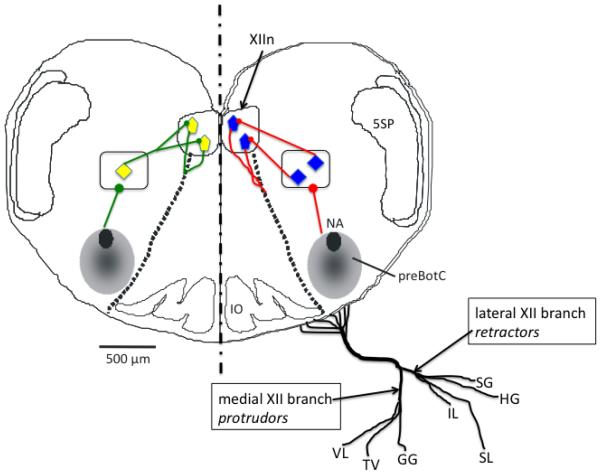
Schematic diagram showing the preBotzinger complex (preBotC), the hypoglossal motor nucleus (XIIn, blue and yellow pentagons) and the “premotor” interneuron population (blue and yellow diamonds within the rectangles) that conveys synaptic input from the preBotzinger complex to the motoneuron pool. The diagram also shows the nerve supply to the seven tongue muscles innervated by hypoglossal motoneurons in the mammal (please see Footnote 1), with the medial hypoglossal nerve branch activating extrinsic and intrinsic protrudor muscles, and the lateral branch intrinsic and extrinsic retractor muscles. The left-hand half of the diagram shows divergent input from a single interneuron to two hypoglossal motoneurons. The right half shows unique input from interneurons to motoneurons (see text for detailed explanation). VL, intrinsic verticalis muscle; TV, intrinsic transversus muscle; GG, extrinsic genioglossus muscle; IL, intrinsic inferior longitudinalis muscle; SL, intrinsic superior longitudinalis muscle; HG, extrinsic hyoglossus muscle; SG, extrinsic styloglosssus muscle. 5SP, spinal trigeminal tract.
Figure 2
Figure 2
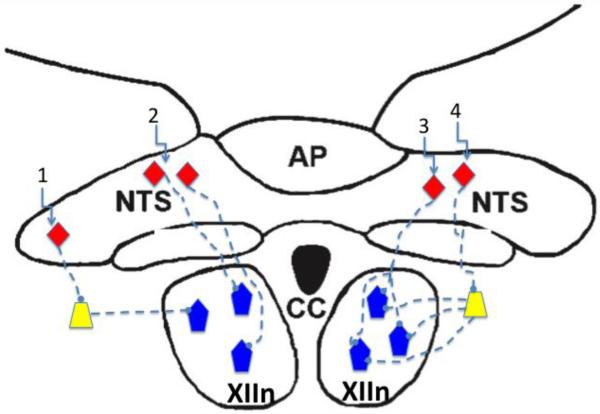
Schematic diagram showing interneurons of the nucleus of the solitary tract (NTS, orange diamonds), interneurons in the intermediate reticular formation (yellow trapezoids) and hypoglossal motoneurons (blue pentagons). Scenario 1 suggests that NTS sensory interneurons project to interneurons in the intermediate reticular formation, which in turn project to hypoglossal motoneurons; Scenario 2 depicts directs connections from NTS interneurons to hypoglossal motoneurons, bypassing the interneuron pool; Scenario 3 is similar to scenario 2, inasmuch as synaptic connections from the NTS bypass the interneuron pool, but in this case a single NTS interneuron branches to provide divergent input to multiple motoneurons; Scenario 4 is similar to scenario 1, but in this case the interneurons receiving input from the NTS diverge, activating multiple motoneurons. See text for detailed description. XIIn, hypoglossal motor nucleus; AP, area postrema; CC, central canal.

References

    1. Altman J, Bayer SA. Development of the brain stem in the rat. I. Thymidine-radiographic study of the time of origin of neurons of the lower medulla. J Comp Neurol. 1980;194:1–35. - PubMed
    1. Bailey EF, Fregosi RF. Coordination of intrinsic and extrinsic tongue muscles during spontaneous breathing in the rat. J Appl Physiol. 2004;96:440–9. - PubMed
    1. Bailey EF, Fregosi RF. Modulation of upper airway muscle activities by bronchopulmonary afferents. J Appl Physiol. 2006;101:609–17. - PubMed
    1. Bailey EF, et al. The Anatomic Consequences Of Intrinsic Tongue Muscle Activation. J Appl Physiol. 2006 - PubMed
    1. Bailey EF, et al. PO2-dependent changes in intrinsic and extrinsic tongue muscle activities in the rat. Am J Respir Crit Care Med. 2005;171:1403–7. - PMC - PubMed