


Pharmacokinetic optimization of 4-substituted methoxybenzoyl-aryl-thiazole and 2-aryl-4-benzoyl-imidazole for improving oral bioavailability
- PMID: 21742898
- PMCID: PMC3186212
- DOI: 10.1124/dmd.110.036616
Pharmacokinetic optimization of 4-substituted methoxybenzoyl-aryl-thiazole and 2-aryl-4-benzoyl-imidazole for improving oral bioavailability
Abstract
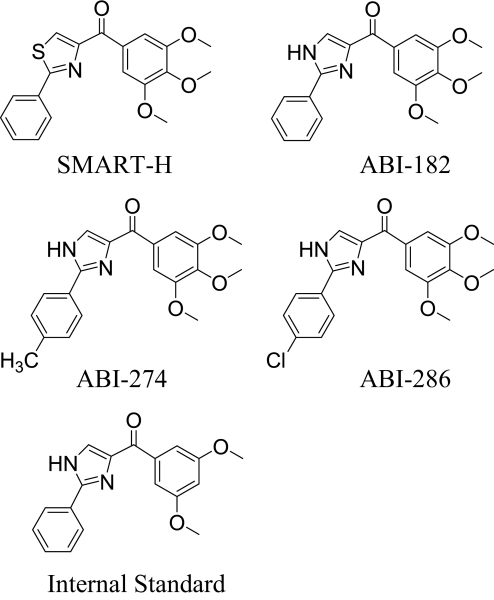
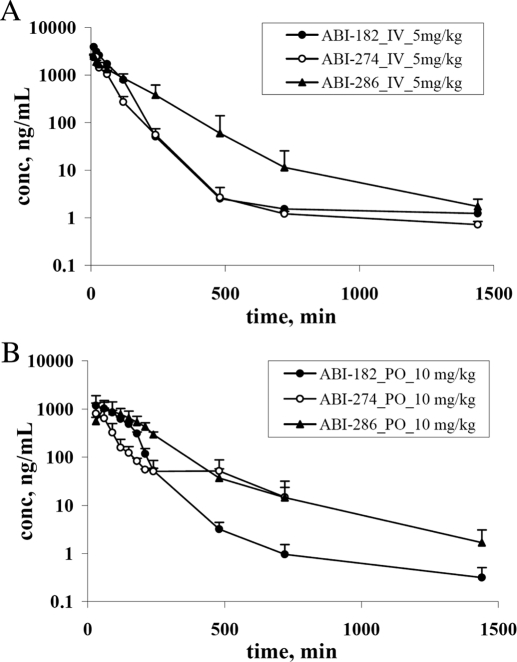
Microtubules are critical components of the cytoskeleton. Perturbing their function arrests the growth of a broad spectrum of cancer cell lines, making microtubules an excellent and established target for chemotherapy. All of the U.S. Food and Drug Administration-approved antitubulin agents bind to paclitaxel or vinblastine binding sites in tubulin. Because of the complexity of their structures, it is difficult to structurally modify the vinca alkaloids and taxanes and develop orally bioavailable agents. Antitubulin agents that target the colchicine-binding site in tubulin may provide a better opportunity to be developed for oral use because of their relatively simple structures and physicochemical properties. A potent antitubulin agent, 4-(3,4,5-trimethoxybenzoyl)-2-phenyl-thiazole (SMART-H), binding to the colchicine-binding site, was discovered in our laboratory. However, the bioavailability of SMART-H was low because of its poor solubility. Structural modification of SMART-H led to the development of 2-aryl-4-benzoyl-imidazole analog (ABI-274), with improved bioavailability and potency but still considerable first-pass metabolism. A chlorine derivative (ABI-286), replacing the methyl site of ABI-274, resulted in 1.5-fold higher metabolic stability in vitro and 1.8-fold lower clearance in rats in vivo, indicating that metabolic stability of ABI-274 can be extended by blocking benzylic hydroxylation. Overall, ABI-274 and ABI-286 provided 2.4- and 5.5-fold increases in exposure (area under the curve) after oral dosing in rats compared with SMART-H. Most importantly, the structural modifications did not compromise potency. ABI-286 exhibited moderate clearance, moderate volume of distribution, and acceptable oral bioavailability. This study provided the first evidence that ABI-286 may be the first member of a new class of orally bioavailable antitubulin agents.
Figures
References
-
- Baranczewski P, Stańczak A, Kautiainen A, Sandin P, Edlund PO. (2006) Introduction to early in vitro identification of metabolites of new chemical entities in drug discovery and development. Pharmacol Rep 58:341–352 - PubMed
-
- Bollag DM, McQueney PA, Zhu J, Hensens O, Koupal L, Liesch J, Goetz M, Lazarides E, Woods CM. (1995) Epothilones, a new class of microtubule-stabilizing agents with a taxol-like mechanism of action. Cancer Res 55:2325–2333 - PubMed
-
- Gigant B, Wang C, Ravelli RB, Roussi F, Steinmetz MO, Curmi PA, Sobel A, Knossow M. (2005) Structural basis for the regulation of tubulin by vinblastine. Nature 435:519–522 - PubMed
Publication types
MeSH terms
Substances
Grants and funding
LinkOut - more resources
Full Text Sources
