. 2011 Jul 8;30(16):3274-84.
doi: 10.1038/emboj.2011.227.

Control of Ubp3 ubiquitin protease activity by the Hog1 SAPK modulates transcription upon osmostress

Affiliations

Control of Ubp3 ubiquitin protease activity by the Hog1 SAPK modulates transcription upon osmostress

Carme Solé et al. EMBO J. .

Abstract

Protein ubiquitylation is a key process in the regulation of many cellular processes. The balance between the activity of ubiquitin ligases and that of proteases controls the level of ubiquitylation. In response to extracellular stimuli, stress-activated protein kinases (SAPK) modulate gene expression to maximize cell survival. In yeast, the Hog1 SAPK has a key role in reprogramming the gene expression pattern required for cell survival upon osmostress. Here, we show that the Ubp3 ubiquitin protease is a target for the Hog1 SAPK to modulate gene expression. ubp3 mutant cells are defective in expression of osmoresponsive genes. Hog1 interacts with and phosphorylates Ubp3 at serine 695, which is essential to determine the extent of transcriptional activation in response to osmostress. Furthermore, Ubp3 is recruited to osmoresponsive genes to modulate transcriptional initiation as well as elongation. Therefore, Ubp3 activity responds to external stimuli and is required for transcriptional activation upon osmostress.


Conflict of interest statement

The authors declare that they have no conflict of interest.

Figures
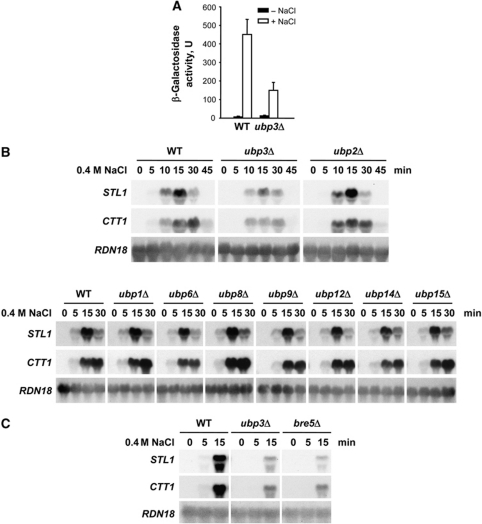
Figure 1
Figure 1
The Ubp3–Bre5 de-ubiquitylase complex is essential for the transcriptional response upon osmostress. (A) Activation of the STL1∷LacZ reporter upon stress is impaired in cells deficient in UBP3. WT and ubp3 mutant strains carrying a multicopy STL1∷LacZ reporter construct were assayed for β-galactosidase activity (expressed in nmol/min per mg) in cells grown to mid-log phase before (filled bars) or after (open bars) a brief osmotic stress (0.4 M NaCl for 30 min). The results are presented as the mean±s.d. of three independent experiments. (B) Impaired gene expression in a ubp3 mutant strain upon osmostress. WT and the indicated mutant strains were grown to mid-log phase in rich medium and then subjected to osmotic stress (0.4 M NaCl) for the indicated length of time. Total RNA was assayed by northern blot for transcript levels of STL1, CTT1 and RDN18 (as a loading control). (C) Osmostress-impaired gene expression of cells lacking BRE5. Northern blot of WT, ubp3 and bre5 strains was done as described for (B).
Figure 2
Figure 2
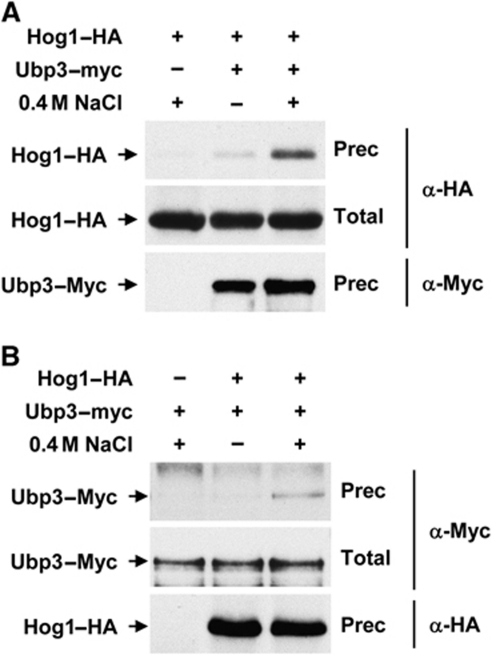
In vivo binding of Hog1 and Ubp3. Hog1–HA and Ubp3–Myc-tagged proteins were expressed from the WT locus. Samples were taken before (−) or 10 min after (+) the addition of 0.4 M NaCl. (A) Ubp3–Myc was immunoprecipitated by monoclonal antibodies against Myc and the Ubp3–Myc (bottom) and Hog1–HA (top) proteins were detected by western blotting against Myc and HA epitopes, respectively. Total represents 2.5% of total input protein (middle). (B) Hog1–HA was immunoprecipitated by monoclonal antibodies against HA and proteins were detected as described for (A).
Figure 3
Figure 3
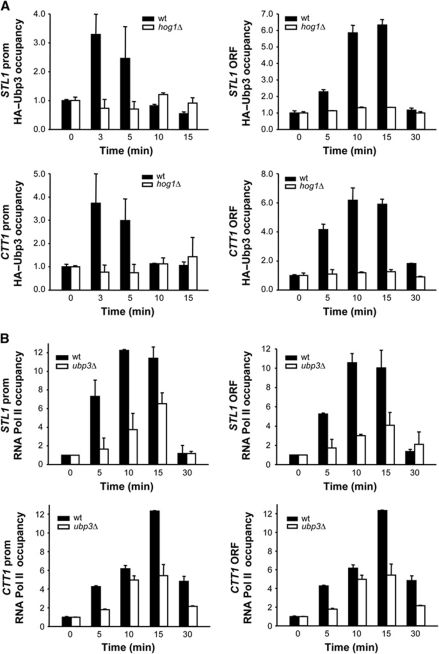
In response to osmostress, Ubp3 binds to stress-dependent genes through the Hog1 SAPK and it is required for recruitment of RNA Pol II. (A) Hog1 mediates the recruitment of Ubp3 to stress-responsive genes in response to osmotic shock. WT (filled bars) and hog1 (open bars) strains carrying HA-tagged Ubp3 were grown to mid-log phase and subjected to osmostress (0.4 M NaCl for the indicated length of time). Proteins were immunoprecipitated with anti-HA monoclonal antibodies and binding to the promoter (left-hand panels) and ORF (right-hand panels) regions of STL1 and CTT1 loci was analysed. The real-time PCR results are shown as the fold induction of treated relative to non-treated (time zero) samples normalized to a telomere internal control. Data are the mean and s.d. of three independent experiments. (B) Ubp3 is required for proper RNA Pol II occupancy at stress-responsive genes. WT (filled bars) and ubp3 (open bars) strains were analysed by ChIP as described for (A) using anti-Rpb1 antibody (8WG16, Covance).
Figure 4
Figure 4
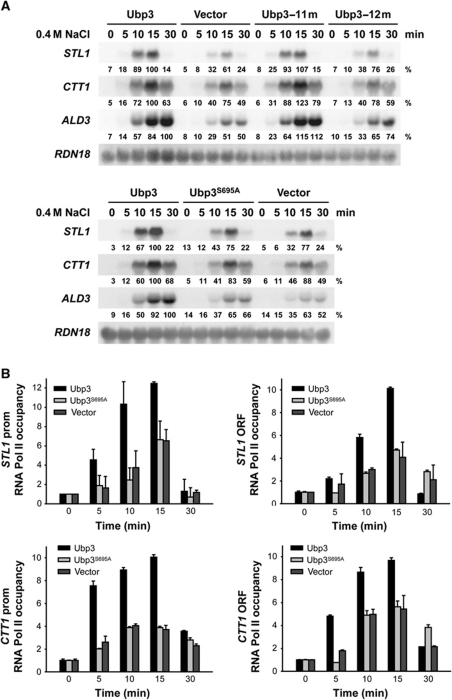
Phosphorylation modulates Ubp3-mediated transcriptional activation in vivo. (A) Impaired gene expression in an unphosphorylatable Ubp3 version upon osmostress. The ubp3 yeast strain was transformed with the indicated plasmids, grown to mid-log phase and subjected to osmotic stress (0.4 M NaCl) for the indicated length of time. Total RNA was assayed by northern blot for transcript levels of STL1, CTT1, ALD3 and RDN18 (as a loading control). Quantification data came from the same original blot and it was normalized to the loading control. The values of maximum gene expression of the WT strain were used as 100% reference. (B) The phosphorylation site of Ubp3 is required for proper RNA Pol II occupancy at stress-responsive genes. The ubp3 strain was transformed with an empty vector as a control (grey bars), a WT Ubp3 (dark bars) and the unphosphorylatable Ubp3S695A proteins (light grey bars). Cells were subjected to osmostress (0.4 M NaCl) for the indicated length of time and binding of Rpb1 to the promoter (left-hand panels) and ORF (right-hand panels) regions of STL1 and CTT1 was analysed by ChIP as described for Figure 3B.
Figure 5
Figure 5
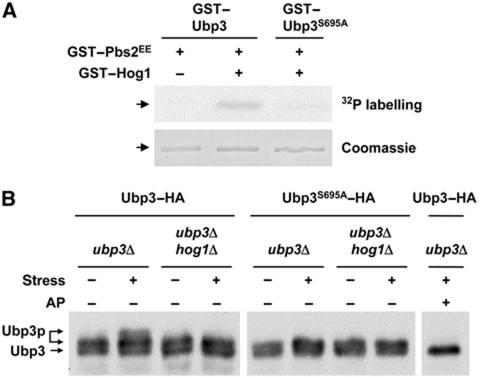
Ubp3 is phosphorylated by the Hog1 SAPK at Ser695 in vitro and in vivo. (A) In vitro phosphorylation of Ubp3 by Hog1. Recombinant GST-fused proteins were purified from E. coli. Hog1 and the constitutively activated Pbs2EE allele were incubated (when indicated) in kinase buffer containing ATP. Ubp3 or Ubp3S695A was then added in the presence of radioactive ATP. Phosphorylated proteins were resolved by SDS–PAGE and detected by autoradiography (upper panel). GST-tagged Ubp3 proteins were detected by staining with Coomassie brilliant blue (lower panel). (B) In vivo phosphorylation of Ubp3 upon osmotic stress depends on Hog1. Ubp3–HA and Ubp3S695A–HA were expressed in a low-copy vector in ubp3 and ubp3 hog1 cells. Samples were taken in mid-log phase and fixed in 20% TCA for SDS–PAGE and immunoblotting with monoclonal HA-specific antibodies (12CA5). Cells were subjected or not subjected to brief osmotic shock (0.4 M NaCl for 10 min) and treated or not treated with alkaline phosphatase (AP).
Figure 6
Figure 6
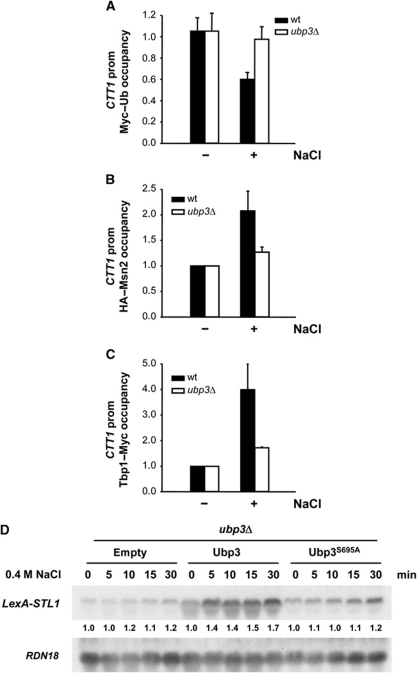
Ubp3 regulates transcriptional initiation and elongation of stress-responsive genes. (A) Ubp3 affects the ubiquitylation state of the recruited proteins to osmoresponsive promoters. WT (filled bars) and ubp3 (open bars) strains expressing Myc-tagged ubiquitin were grown to the mid-log phase and subjected (+) or not subjected (−) to osmostress (0.4 M NaCl for 10 min). Proteins were immunoprecipitated with anti-Myc monoclonal antibodies and binding to the promoter region of CTT1 loci was analysed. For simplicity of presentation, the level of ubiquitin binding normalized to a telomere internal control in the absence of stress was set to 1, and the level of stressed cells was expressed relative to that. The data represent the mean and s.d. of three independent experiments. (B) Msn2 occupancy of osmostress promoters depends on Ubp3. WT (filled bars) and ubp3 (open bars) strains expressing HA-tagged Msn2 under the control of the ADH1 promoter were grown to mid-log phase and subjected (+) or not subjected (−) to osmostress (0.4 M NaCl for 5 min.). Proteins were immunoprecipitated with anti-HA monoclonal antibodies and binding to the promoter region of CTT1 loci was analysed. The results are shown as the fold induction of treated relative to non-treated (time zero) samples normalized to a telomere internal control. Data represent the mean and s.d. of three independent experiments. (C) Tbp1/Spt15 occupancy to osmostress promoters is reduced in ubp3 mutant cells. WT (filled bars) and ubp3 (open bars) strains expressing Myc-tagged Tbp1/Spt15 were grown and stressed as described for (B). Proteins were immunoprecipitated with anti-Myc monoclonal antibodies and binding to the promoter region of CTT1 loci was analysed. The results are shown as in (B). (D) Ubp3 is required for STL1 mRNA production when expressed by the LexA-VP16 activator. ubp3 cells lacking endogenous STL1 and expressing an empty vector, a single copy of WT Ubp3 or the unphosphorylatable mutant Ubp3S695A were transformed with a vector carrying STL1 under the LexA promoter and with a plasmid containing the LexA-binding domain fused to the VP16 transcriptional activator. Cells were treated with 0.4 M NaCl for the indicated length of time and transcript levels of STL1 and RDN18 (as loading control) were measured. Quantification data came from the same original blot for each strain and referenced to that at 0 time point.
Figure 7
Figure 7
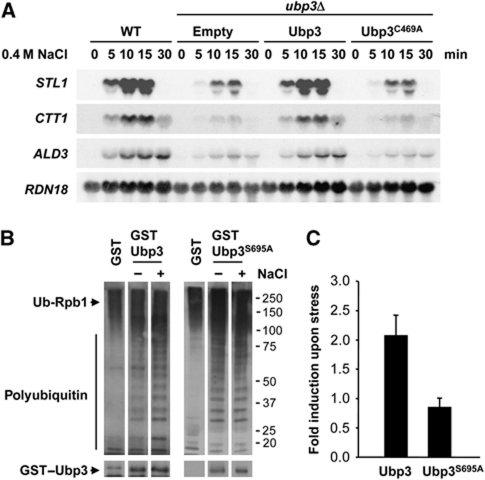
Ubp3 de-ubiquitylase activity is required for adaptation to osmostress. (A) The catalytic activity of Ubp3 is essential for osmostress gene activation. ubp3 mutant cells were transformed with a centromeric plasmid containing the WT Ubp3, a catalytically inactive allele (Ubp3C469A) or an empty vector as a control, grown to mid-log phase and subjected to osmostress (0.4 M NaCl) for the indicated length of time. Total RNA was assayed by northern blot analysis for transcript levels of STL1, CTT1, ALD3 and RDN18 as a loading control. (B) Ubp3 phosphorylated by Hog1 in response to osmostress is more active in vitro. Highly purified RNA Pol II, ubiquitylated using pure ubiquitylation factors, was de-ubiquitylated with purified WT or S695A mutant Ubp3 fractions isolated from control or osmostressed yeast. The fractions were separated by SDS–PAGE and western blotted with anti-ubiquitin and anti-GST antibodies. (C) Quantification of the results in (B), adjusting for loading of GST–Ubp3. The results are shown as the fold induction of treated relative to non-treated samples normalized to GST–Ubp3 protein levels. Error bars indicate the s.d. among experiments.

References

    1. Alepuz PM, de Nadal E, Zapater M, Ammerer G, Posas F (2003) Osmostress-induced transcription by Hot1 depends on a Hog1-mediated recruitment of the RNA Pol II. EMBO J 22: 2433–2442 - PMC - PubMed
    1. Alepuz PM, Jovanovic A, Reiser V, Ammerer G (2001) Stress-induced map kinase Hog1 is part of transcription activation complexes. Mol Cell 7: 767–777 - PubMed
    1. Amerik AY, Hochstrasser M (2004) Mechanism and function of deubiquitinating enzymes. Biochim Biophys Acta 1695: 189–207 - PubMed
    1. Auty R, Steen H, Myers LC, Persinger J, Bartholomew B, Gygi SP, Buratowski S (2004) Purification of active TFIID from Saccharomyces cerevisiae. Extensive promoter contacts and co-activator function. J Biol Chem 279: 49973–49981 - PubMed
    1. Baker RT, Tobias JW, Varshavsky A (1992) Ubiquitin-specific proteases of Saccharomyces cerevisiae. Cloning of UBP2 and UBP3, and functional analysis of the UBP gene family. J Biol Chem 267: 23364–23375 - PubMed

Publication types

MeSH terms