


Small-molecule thyrotropin receptor agonist activates naturally occurring thyrotropin-insensitive mutants and reveals their distinct cyclic adenosine monophosphate signal persistence
- PMID: 21745101
- PMCID: PMC3148121
- DOI: 10.1089/thy.2011.0025
Small-molecule thyrotropin receptor agonist activates naturally occurring thyrotropin-insensitive mutants and reveals their distinct cyclic adenosine monophosphate signal persistence
Abstract
Background: Subclinical hypothyroidism (SHT), characterized by normal thyroid hormone levels maintained by elevated thyrotropin (TSH), predisposes patients to health problems as they age. Some cases arise from mutations of the TSH receptor (TSHR) that confer TSH resistance. This resistance might be circumvented by TSHR agonists with different modes of binding compared with TSH. We hypothesized that the recently discovered small-molecule TSHR agonist C2, with its unique mode of receptor binding, would activate mutant TSHRs associated with SHT, facilitating their study.
Materials and methods: HEK-EM293 cells transiently expressing TSHR variants-wild-type TSHR or mutants C41S, L252P, L467P, or C600R-were analyzed for TSH or C2-induced cyclic adenosine monophosphate (cAMP) signaling to establish C2 as a mutant TSHR agonist. These cells were also pretreated with TSH or C2 to characterize each mutant receptor's ability to maintain and desensitize cAMP signaling.
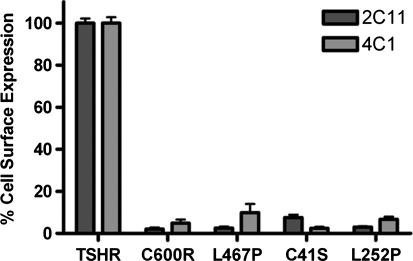
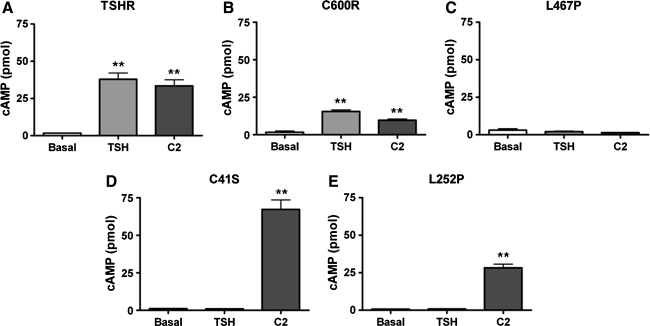
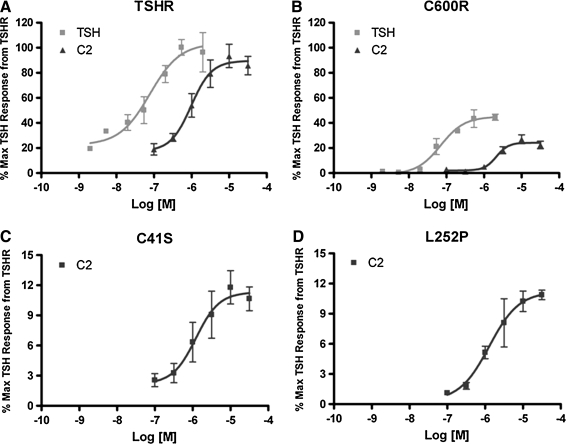
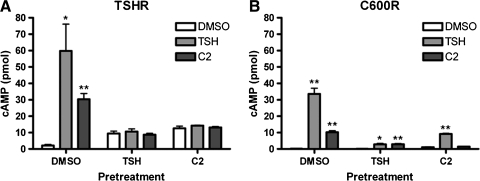
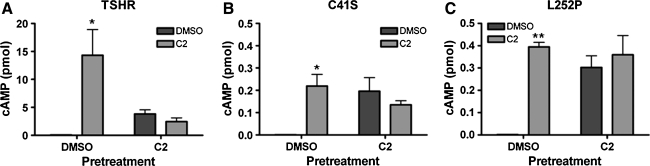
Results: We showed that C2 could activate the TSH-unresponsive TSHR ectodomain mutants C41S and L252P but had no effect on the serpentine mutant L467P. We found that TSH and C2 could acutely activate the serpentine mutant C600R. Preincubation with C2 caused persistent cAMP signaling and receptor desensitization in wild-type TSHR and cAMP signal persistence with no detectable desensitization in the cases of C41S and L252P.
Conclusions: The small-molecule agonist C2 is a useful pharmacological tool for the study of mutant TSHRs. It revealed that some naturally occurring TSH-insensitive mutants can mediate induction of cAMP elevation upon stimulation with C2 and that this signal is differentially maintained within cells.
Figures
Comment in
-
When will thyrotropin receptor antagonists and inverse thyrotropin receptor agonists become available for clinical use?Thyroid. 2011 Aug;21(8):817-9. doi: 10.1089/thy.2011.2108.ed. Thyroid. 2011. PMID: 21809913 No abstract available.
References
-
- Wilson B. Raghupat E. Tonoue T. Tong W. Tsh-like actions of dibutyryl-camp on isolated bovine thyroid cells. Endocrinology. 1968;83:877–884. - PubMed
-
- Nagayama Y. Chazenbalk GD. Takeshita A. Kimura H. Ashizawa K. Yokoyama N. Rapoport B. Nagataki S. Studies on homologous desensitization of the thyrotropin receptor in 293 human embryonal kidney cells. Endocrinology. 1994;135:1060–1065. - PubMed
-
- Neumann S. Huang W. Titus S. Krause G. Kleinau G. Alberobello AT. Zheng W. Southall NT. Inglese J. Austin CP. Celi FS. Gavrilova O. Thomas CJ. Raaka BM. Gershengorn MC. Small-molecule agonists for the thyrotropin receptor stimulate thyroid function in human thyrocytes and mice. Proc Natl Acad Sci U S A. 2009;106:12471–12476. - PMC - PubMed
-
- Vlaeminck-Guillem V. Ho SC. Rodien P. Vassart G. Costagliola S. Activation of the cAMP pathway by the TSH receptor involves switching of the ectodomain from a tethered inverse agonist to an agonist. Mol Endocrinol. 2002;16:736–746. - PubMed
Publication types
MeSH terms
Substances
Grants and funding
LinkOut - more resources
Full Text Sources
Miscellaneous
