


Correlation between CD4 T cell counts and virus compartmentalization in genital and systemic compartments of HIV-infected females
- PMID: 21745672
- PMCID: PMC3204360
- DOI: 10.1016/j.virol.2011.06.018
Correlation between CD4 T cell counts and virus compartmentalization in genital and systemic compartments of HIV-infected females
Abstract
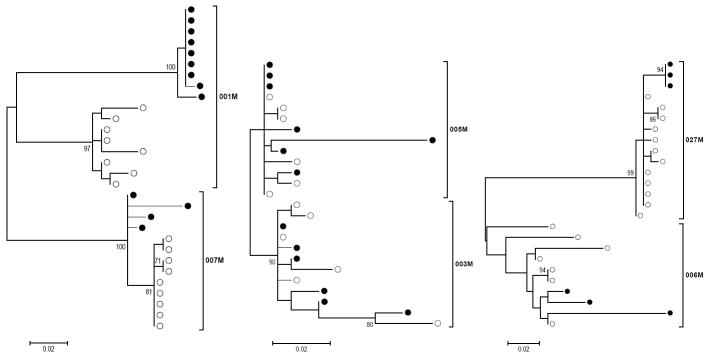
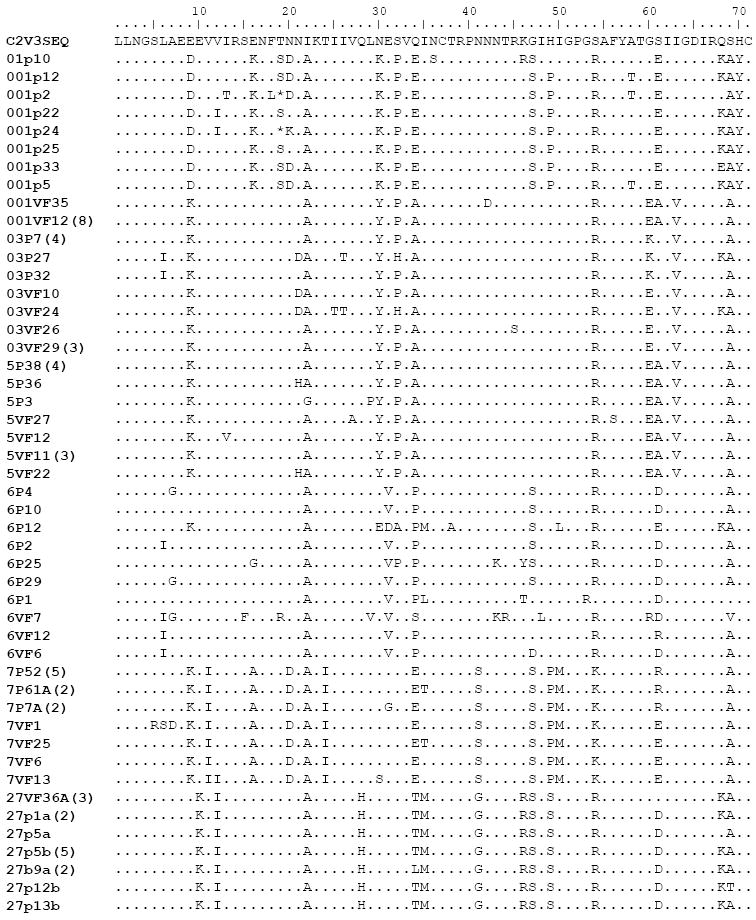
The majority of infection by the human immunodeficiency virus (HIV-1) across the world occurs by heterosexual transmission and is likely mediated by virus present in genital secretions. In spite of this, infection is followed by clinical markers of the virus present in blood, which may not be representative of the virus involved in transmission. In fact, several studies have demonstrated that the genital tract represents a unique compartment for the virus. We assessed the relationship between immune system integrity, represented by CD4+ T cell counts, and the maintenance of viral compartmentalization between plasma and vaginal fluid virus in treatment naïve women from the Dominican Republic infected by the heterosexual transmission route. We cloned and sequenced cell free virus from plasma and genital fluid samples from six women to assess viral evolution, phylogenetic relatedness, and calculated co-receptor use for the C2V3 region of the envelope. Our analyses demonstrated plasma and vaginal fluid virus compartments remained intact only in samples from women with CD4+ T cell counts over 350 cells/μl. The majority of viral forms were predicted to use the CCR5 co-receptor, although several dual tropic forms were also identified. None of the clones were found to use the CXCR4 co-receptor even though many of the patients showed severe disease. Our findings lend further support to the role of an intact immune system in maintaining compartmentalization across blood and genital quasispecies and provide a compelling rationale to specifically consider genital tract viral forms in therapeutic and vaccine research.
Copyright © 2011 Elsevier Inc. All rights reserved.
Figures
References
-
- Andreoletti L, Skrabal K, Perrin V, Chomont N, Saragosti S, Gresenguet G, Moret H, Jacques J, Longo JdD, Matta M, Mammano F, Belec L. Genetic and Phenotypic Features of Blood and Genital Viral Populations of Clinically Asymptomatic and Antiretroviral-Treatment-Naive Clade A Human Immunodeficiency Virus Type 1-Infected Women. J Clin Microbiol. 2007;45:1838–1842. - PMC - PubMed
-
- Barnett SW, Barboza A, Wilcox CM, Forsmark CE, Levy JA. Characterization of human immunodeficiency virus type 1 strains recovered from the bowel of infected individuals. Virology. 1991;182:802–809. - PubMed
-
- CDC. 1993 revised classification system for HIV infection and expanded surveillance case definition for AIDS among adolescents and adults. MMWR Recomm Rep. 1992;41:1–19. - PubMed
Publication types
MeSH terms
Substances
Associated data
- Actions
- Actions
- Actions
- Actions
- Actions
- Actions
- Actions
- Actions
- Actions
- Actions
- Actions
- Actions
- Actions
- Actions
- Actions
- Actions
- Actions
- Actions
- Actions
- Actions
- Actions
- Actions
- Actions
- Actions
- Actions
- Actions
- Actions
- Actions
- Actions
- Actions
- Actions
- Actions
- Actions
- Actions
- Actions
- Actions
- Actions
- Actions
- Actions
- Actions
- Actions
- Actions
- Actions
- Actions
- Actions
- Actions
- Actions
- Actions
- Actions
- Actions
- Actions
- Actions
- Actions
- Actions
- Actions
- Actions
- Actions
- Actions
- Actions
- Actions
- Actions
- Actions
- Actions
- Actions
- Actions
- Actions
- Actions
- Actions
- Actions
- Actions
- Actions
- Actions
- Actions
- Actions
- Actions
- Actions
- Actions
- Actions
- Actions
- Actions
Grants and funding
LinkOut - more resources
Full Text Sources
Medical
Research Materials
