


SIRT-1 and vascular endothelial dysfunction with ageing in mice and humans
- PMID: 21746786
- PMCID: PMC3208223
- DOI: 10.1113/jphysiol.2011.211219
SIRT-1 and vascular endothelial dysfunction with ageing in mice and humans
Abstract
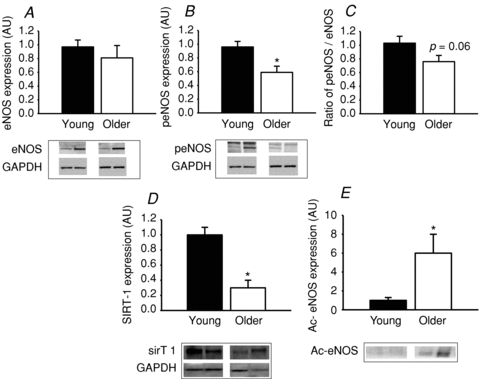
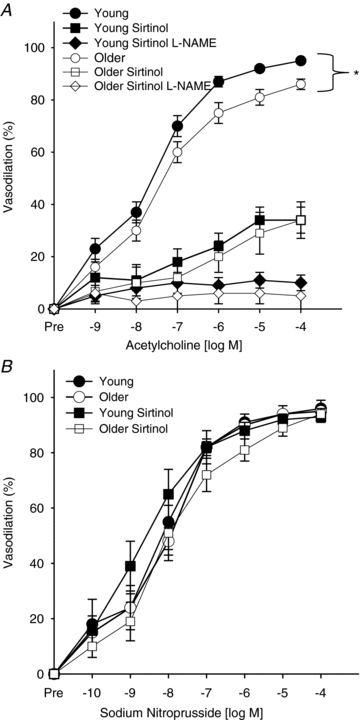
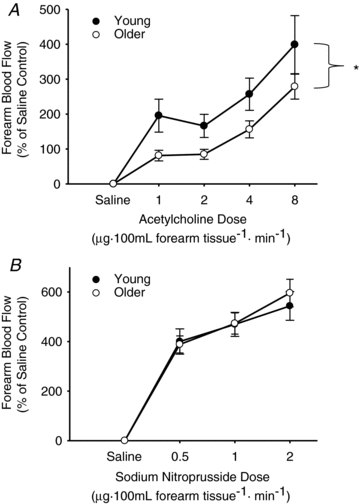
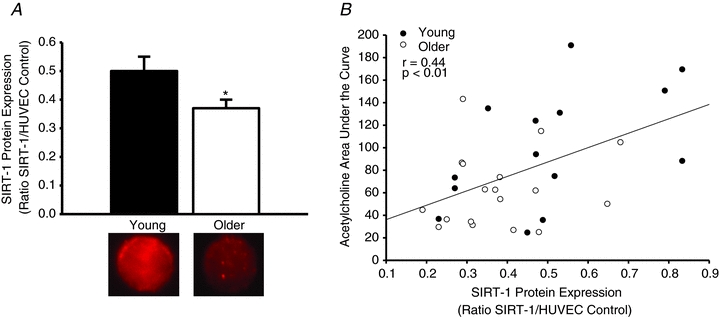
We tested the hypothesis that reductions in the cellular deacetylase, sirtuin-1 (SIRT-1), contribute to vascular endothelial dysfunction with ageing via modulation of endothelial nitric oxide synthase (eNOS) acetylation/activation-associated nitric oxide (NO) production. In older (30 months, n = 14) vs. young (5-7 months, n = 16) B6D2F1 mice, aortic protein expression of SIRT-1 and eNOS phosphorylated at serine 1177 were lower (both P < 0.05), and acetylated eNOS was 6-fold higher (P < 0.05), whereas total eNOS did not differ (P = 0.65). Acetylcholine (ACh)-induced peak endothelium-dependent dilatation (EDD) was lower in isolated femoral arteries with ageing (P < 0.001). Incubation with sirtinol, a SIRT-1 inhibitor, reduced EDD in both young and older mice, abolishing age-related differences, whereas co-administration with l-NAME, an eNOS inhibitor, further reduced EDD similarly in both groups. Endothelium-independent dilatation to sodium nitroprusside (EID), was not altered by age or sirtinol treatment. In older (64 ± 1 years, n = 22) vs. young (25 ± 1 years, n = 16) healthy humans, ACh-induced forearm EDD was impaired (P = 0.01) and SIRT-1 protein expression was 37% lower in endothelial cells obtained from the brachial artery (P < 0.05), whereas EID did not differ. In the overall group, EDD was positively related to endothelial cell SIRT-1 protein expression (r = 0.44, P < 0.01). Reductions in SIRT-1 may play an important role in vascular endothelial dysfunction with ageing. SIRT-1 may be a key therapeutic target to treat arterial ageing.
Figures
References
-
- Celermajer D, Sorensen K, Bull C, Robinson J, Deanfield J. Endothelium-dependent dilation in the systemic arteries of asymptomatic subjects relates to coronary risk factors and their interaction. J Am Coll Cardiol. 1994;24:1468–1474. - PubMed
-
- Cohen HY, Miller C, Bitterman KJ, Wall NR, Hekking B, Kessler B, Howitz KT, Gorospe M, de Cabo R, Sinclair DA. Calorie restriction promotes mammalian cell survival by inducing the SIRT1 deacetylase. Science. 2004;305:390–392. - PubMed
-
- Colombo PC, Ashton AW, Celaj S, Talreja A, Banchs JE, Dubois NB, Marinaccio M, Malla S, Lachmann J, Ware JA, Le Jemtel TH. Biopsy coupled to quantitative immunofluorescence: a new method to study the human vascular endothelium. J Appl Physiol. 2002;92:1331–1338. - PubMed
-
- Dali-Youcef N, Lagouge M, Froelich S, Koehl C, Schoonjans K, Auwerx J. Sirtuins: the ‘magnificent seven’, function, metabolism and longevity. Ann Med. 2007;39:335–345. - PubMed
Publication types
MeSH terms
Substances
Grants and funding
- K01 AG029337/AG/NIA NIH HHS/United States
- AG013038/AG/NIA NIH HHS/United States
- UL1 RR025780/RR/NCRR NIH HHS/United States
- RR00051/RR/NCRR NIH HHS/United States
- HL007851/HL/NHLBI NIH HHS/United States
- K01 AG033196/AG/NIA NIH HHS/United States
- AG033755/AG/NIA NIH HHS/United States
- R01 AG013038/AG/NIA NIH HHS/United States
- M01 RR000051/RR/NCRR NIH HHS/United States
- R01 AG040297/AG/NIA NIH HHS/United States
- AG033196/AG/NIA NIH HHS/United States
- R21 AG033755/AG/NIA NIH HHS/United States
- R37 AG013038/AG/NIA NIH HHS/United States
- T32 HL007851/HL/NHLBI NIH HHS/United States
- AG000279/AG/NIA NIH HHS/United States
- AG029337/AG/NIA NIH HHS/United States
- T32 AG000279/AG/NIA NIH HHS/United States
- AG040297/AG/NIA NIH HHS/United States
- RR025780/RR/NCRR NIH HHS/United States
LinkOut - more resources
Full Text Sources
Other Literature Sources
Medical
