


doi: 10.1128/AAC.00144-11.
Epub 2011 Jul 11.
Candida albicans adhesion to and invasion and damage of vaginal epithelial cells: stage-specific inhibition by clotrimazole and bifonazole
Affiliations
- PMID: 21746947
- PMCID: PMC3165311
- DOI: 10.1128/AAC.00144-11
Item in Clipboard
Candida albicans adhesion to and invasion and damage of vaginal epithelial cells: stage-specific inhibition by clotrimazole and bifonazole
Antimicrob Agents Chemother.
2011 Sep.
Abstract
Clotrimazole and bifonazole are highly effective antifungal agents against mucosal Candida albicans infections. Here we examined the effects of low levels of clotrimazole and bifonazole on the ability of C. albicans to adhere, invade, and damage vaginal epithelial cells. Although adhesion and invasion were not affected, damage was greatly reduced upon azole treatment. This clearly indicates that low levels of azoles influence specific activities of C. albicans during distinct stages of vaginal epithelium infections.
Figures
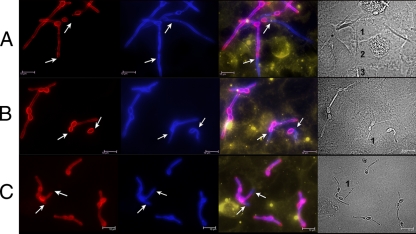
Representative fluorescent pictures of C. albicans invasion into epithelial cells. (A) Untreated; (B) treated with 1 μM bifonazole; (C) treated with 1 μM clotrimazole. C. albicans hyphae are stained differentially: first panel (stained red), extracellular part of C. albicans hyphae; second panel (stained blue), extracellular and internalized C. albicans hyphae; third panel, overlay of first and second panels (extracellular parts appear pink), epithelial cell membranes (stained yellow); fourth panel, differential interference contrast (DIC) images. Arrows mark internalized hyphae. Numbers indicate epithelial cells invaded by C. albicans. Note that all hyphae have the capacity to invade epithelial cells but that only untreated C. albicans hyphae penetrate through the first epithelial cell. Bar = 10 μm.
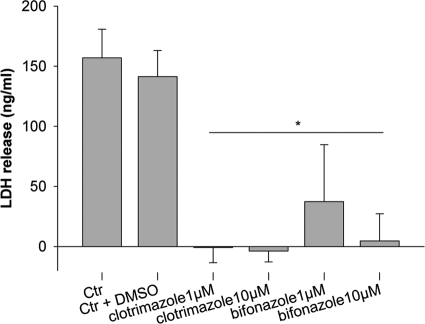
Damage of vaginal epithelial cells is inhibited by bifonazole and clotrimazole. Vaginal epithelial cell damage was determined by measuring the LDH release. Bifonazole at 1 μM inhibited damage compared to untreated infections (control [Ctr]) or infections with DMSO only (Ctr + DMSO); 10 μM bifonazole and 1 μM/10 μM clotrimazole blocked damage entirely. *, significant difference compared to the untreated control (P < 0.01).
References
-
- Berg D., Buchel K. H., Plempel M., Zywietz A. 1986. Action mechanisms of cell-division-arresting benzimidazoles and of sterol biosynthesis-inhibiting imidazoles, 1,2,4-triazoles, and pyrimidines. Mykosen 29:221–229 - PubMed
-
- Berg D., Regel E., Harenberg H. E., Plempel M. 1984. Bifonazole and clotrimazole. Their mode of action and the possible reason for the fungicidal behaviour of bifonazole. Arzneimittelforschung 34:139–146 - PubMed
-
- Bernhardt J., Bernhardt H., Knoke M., Ludwig K. 2004. Influence of voriconazole and fluconazole on reconstituted multilayered oesophageal epithelium infected by Candida albicans. Mycoses 47:330–337 - PubMed
-
- Edelman D. A., Grant S. 1999. One-day therapy for vaginal candidiasis. A review. J. Reprod. Med. 44:543–547 - PubMed
Publication types
MeSH terms
Substances
LinkOut - more resources
Full Text Sources
Other Literature Sources
