. 2012 Jun;17(6):642-9.
doi: 10.1038/mp.2011.82. Epub 2011 Jul 12.

Reversible and regionally selective downregulation of brain cannabinoid CB1 receptors in chronic daily cannabis smokers

Affiliations

Reversible and regionally selective downregulation of brain cannabinoid CB1 receptors in chronic daily cannabis smokers

J Hirvonen et al. Mol Psychiatry. 2012 Jun.

Abstract

Chronic cannabis (marijuana, hashish) smoking can result in dependence. Rodent studies show reversible downregulation of brain cannabinoid CB(1) (cannabinoid receptor type 1) receptors after chronic exposure to cannabis. However, whether downregulation occurs in humans who chronically smoke cannabis is unknown. Here we show, using positron emission tomography imaging, reversible and regionally selective downregulation of brain cannabinoid CB(1) receptors in human subjects who chronically smoke cannabis. Downregulation correlated with years of cannabis smoking and was selective to cortical brain regions. After ∼4 weeks of continuously monitored abstinence from cannabis on a secure research unit, CB(1) receptor density returned to normal levels. This is the first direct demonstration of cortical cannabinoid CB(1) receptor downregulation as a neuroadaptation that may promote cannabis dependence in human brain.


Conflict of interest statement

Conflict of interest The authors declare no conflict of interest.

Figures

Figure 1
Figure 1
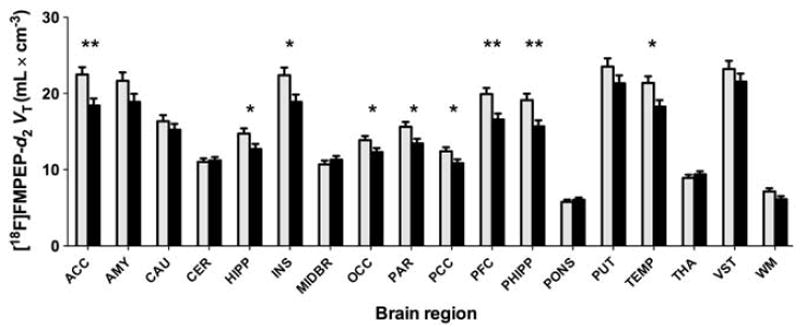
VT of [18F]FMPEP-d2 in cortical regions is lower at baseline in chronic daily cannabis smokers (black bars, n = 30) than in control subjects (gray bars, n = 28). Values are estimated marginal means from the repeated measures analysis variance that controls for BMI. Values are adjusted to an average BMI of 24.8 kg m−2. Error bars are s.e.m. Abbreviations: ACC, anterior cingulate cortex; AMY, amygdala; CAU, caudate nucleus; CER, cerebellum; HIPP, hippocampus; INS, insula; MIDBR, midbrain; OCC, occipital cortex; PAR, parietal cortex; PCC, posterior cingulate cortex; PFC, prefrontal cortex; PHIPP, parahippocampal gyrus; PUT, putamen; TEMP, lateral temporal cortex; THA, thalamus; VST, ventral striatum; WM, white matter; *P < 0.05; **P < 0.005, two-tailed t-test.
Figure 2
Figure 2
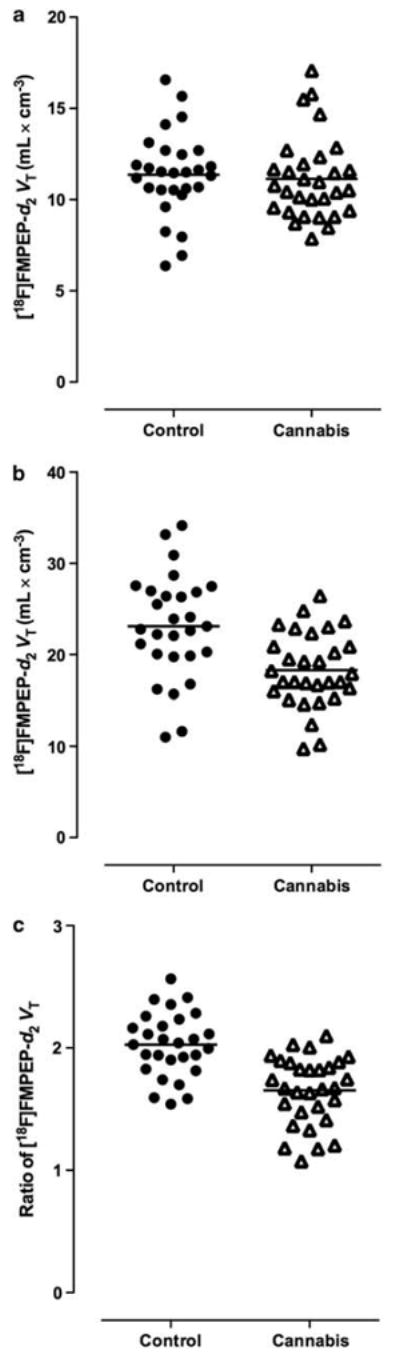
BMI-adjusted VT of [18F]FMPEP-d2 at baseline was unchanged in cerebellum (−2%, P = 0.703, two-tailed t-test; a), but decreased in anterior cingulate cortex (−21%, P = 0.0005, two-tailed t-test; b) in chronic daily cannabis smokers (n = 30) compared with control subjects (n = 28). Ratio of VT in anterior cingulate cortex to that in cerebellum decreased variance in both groups and showed a more significant reduction in cannabis smokers (−20%, P = 0.0000001, two-tailed t-test; c).
Figure 3
Figure 3
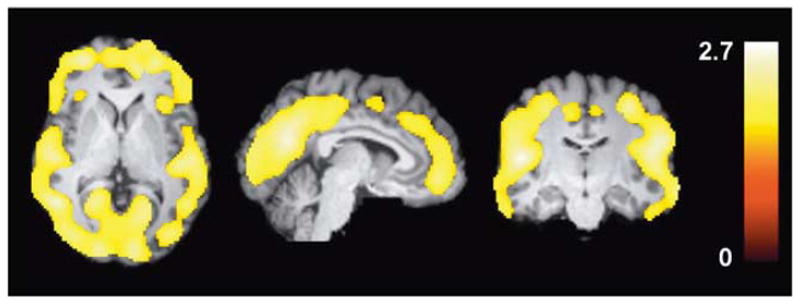
Statistical parametric mapping (SPM) analysis shows lower VT in chronic daily cannabis smokers (n = 30) than in control subjects (n = 28) at baseline as a large single cluster that includes only cortical regions. This cluster comprised 67 513 voxels, had a maximum t-value of 2.8 at [−34, −78, 16] and had a cluster-level corrected P-value of 0.043. Color bar represents t-value in each voxel within the significant cluster.
Figure 4
Figure 4
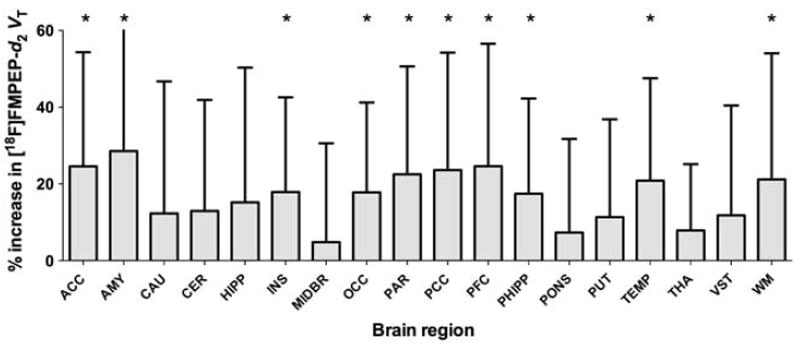
VT of [18F]FMPEP-d2 increased after abstinence in the 14 cannabis smokers who completed two PET scans before and after abstinence. Significant increases were mostly seen in regions with reduced VT at baseline. Error bars are s.d. of percent change. Abbreviations of brain regions are the same as those in Figure 1. *P < 0.05, two-tailed paired samples t-test.

References

    1. Degenhardt L, Chiu WT, Sampson N, Kessler RC, Anthony JC, Angermeyer M, et al. Toward a global view of alcohol, tobacco, cannabis, and cocaine use: findings from the WHO World Mental Health Surveys. PLoS Med. 2008;5:e141. - PMC - PubMed
    1. Hall W, Degenhardt L. Adverse health effects of non-medical cannabis use. Lancet. 2009;374:1383–1391. - PubMed
    1. Jones RT, Benowitz NL, Herning RI. Clinical relevance of cannabis tolerance and dependence. J Clin Pharmacol. 1981;21:143S–152S. - PubMed
    1. D’Souza DC, Ranganathan M, Braley G, Gueorguieva R, Zimolo Z, Cooper T, et al. Blunted psychotomimetic and amnestic effects of Δ-9-tetrahydrocannabinol in frequent users of cannabis. Neuropsychopharmacology. 2008;33:2505–2516. - PMC - PubMed
    1. Ramaekers JG, Kauert G, Theunissen EL, Toennes SW, Moeller MR. Neurocognitive performance during acute THC intoxication in heavy and occasional cannabis users. J Psychopharmacol. 2009;23:266–277. - PubMed

Publication types

Substances