. 2011 Apr 29:2:88.
doi: 10.3389/fmicb.2011.00088. eCollection 2011.

Salmonella Interaction with and Passage through the Intestinal Mucosa: Through the Lens of the Organism

Affiliations

Salmonella Interaction with and Passage through the Intestinal Mucosa: Through the Lens of the Organism

Kelly Hallstrom et al. Front Microbiol. .

Abstract

Salmonella enterica serotypes are invasive enteric pathogens spread through fecal contamination of food and water sources, and represent a constant public health threat around the world. The symptoms associated with salmonellosis and typhoid disease are largely due to the host response to invading Salmonella, and to the mechanisms these bacteria employ to survive in the presence of, and invade through the intestinal mucosal epithelia. Surmounting this barrier is required for survival within the host, as well as for further dissemination throughout the body, and subsequent systemic disease. In this review, we highlight some of the major hurdles Salmonella must overcome upon encountering the intestinal mucosal epithelial barrier, and examine how these bacteria surmount and exploit host defense mechanisms.

Keywords: Salmonella; intestinal mucosa; tight junctions.


Figures
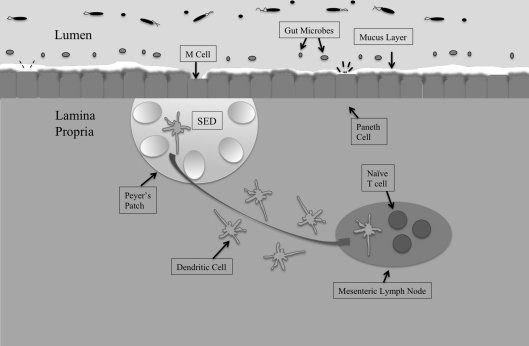
Figure 1
Figure 1
The intestinal mucosal epithelium is home to various interacting cell types that come together to maintain intestinal homeostasis and protect against invading pathogens. The first line of defense is the host microbiota, populations of commensal organisms that compete with invading pathogens for nutrients and space. The mucus layer protects against Salmonella invasion of epithelial cells, and the bacteria must adhere to mucus components in order to remain in the intestines. The epithelial monolayer underlying the mucus layer contains distinct cell types with different roles. M cells sample intestinal antigens and are the preferred route of entry by Salmonella. Underlying the M cells is the subepithelial dome (SED) that houses Peyer's patches. Peyer's patches contain germinal centers and have associated dendritic cells. Dendritic cells take whole bacteria to the mesenteric lymph node (MLN), from which Salmonella can escape to promote systemic disease.
Figure 2
Figure 2
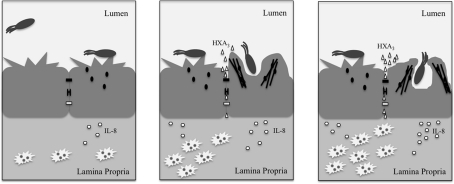
Upon interacting with the epithelial cell, Salmonella secrete effectors (small black ovals) that promote release of the neutrophil chemoattractant, HXA3 (small triangles), and membrane ruffling as a result of actin (black lines) re-organization. The release of HXA3 from the apical (mucosal) surface creates a concentration gradient across tight junctions (small black rectangle), desmosomes (small black bracket), and adherens junctions (small white rectangle) and through the paracellular space. Neutrophils (jagged white ovals) are recruited via basolateral secretion of IL-8, and subsequently migrate from the basolateral surface to the apical surface to the point of infection due to the HXA3 gradient. The actin re-organization alters the morphology of the cell membrane at the apical surface in a manner that promotes Salmonella uptake via macropinocytosis. Once inside the cell, Salmonella reside within a compartment termed the SCV that forms as a result of macropinocytosis.

References

    1. Aberle H., Bauer A., Stappert J., Kispert A., Kemler R. (1997). β-catenin is a target for the ubiquitin–proteasome pathway. EMBO J. 16, 3793–3804 - PMC - PubMed
    1. Abrahams G. L., Muller P., Hensel M. (2006). Functional dissection of SseF, a Type III Effector protein involved in positioning the Salmonella-containing vacuole. Traffic 7, 950–96510.1111/j.1600-0854.2006.00454.x - DOI - PubMed
    1. Adachi M., Inoko A., Hata M., Furuse K., Umeda K., Itoh M., Tsukita S. (2006). Normal establishment of epithelial tight junctions in mice and cultured cells lacking expression of ZO-3, a tight-junction MAGUK protein. Mol. Cell. Biol. 26, 9003–901510.1128/MCB.01811-05 - DOI - PMC - PubMed
    1. Adams C. L., Chen Y., Smith S. J., Nelson W. J. (1998). Mechanisms of epithelial cell–cell adhesion and cell compaction revealed by high-resolution tracking of E-cadherin–green fluorescent protein. J. Cell Biol. 142, 1105–111910.1083/jcb.142.4.1105 - DOI - PMC - PubMed
    1. Andreeva A. Y., Krause E., Müller E. C., Blasig I. E., Utepbergenov D. I. (2001). Protein kinase C regulates the phosphorylation and cellular localization of occludin. J. Biol. Chem. 42, 38480–3848610.1074/jbc.M104923200 - DOI - PubMed

LinkOut - more resources