


Significance of talin in cancer progression and metastasis
- PMID: 21749900
- PMCID: PMC5458740
- DOI: 10.1016/B978-0-12-386039-2.00004-3
Significance of talin in cancer progression and metastasis
Abstract
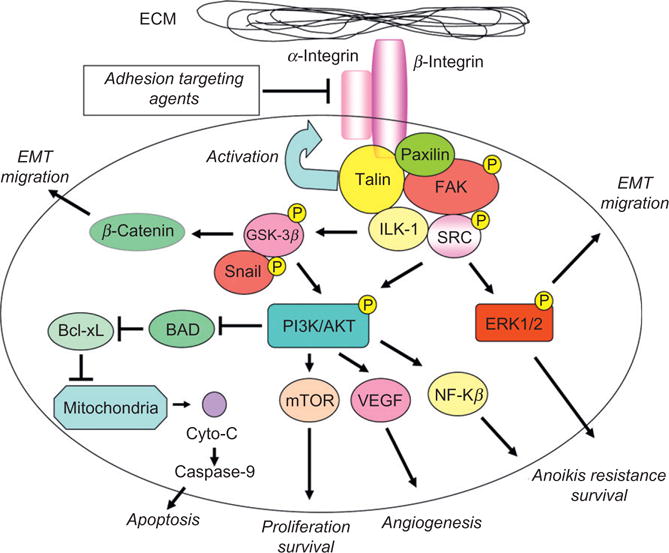
Upon detachment from the extracellular matrix, tumor epithelial cells and tumor-associated endothelial cells are capable of overcoming anoikis, gain survival benefits, and hence contribute to the process of metastasis. The focal-adhesion complex formation recruits the association of key adaptor proteins such as FAK (focal-adhesion kinase). Vimentin, paxillin, and talin are responsible for mediating the interaction between the actin cytoskeleton and integrins. Talin is an early-recruited focal-adhesion player that is of structural and functional significance in mediating interactions with integrin cytoplasmic tails leading to destabilization of the transmembrane complex and resulting in rearrangements in the extracellular integrin compartments that mediate integrin activation. Talin-mediated integrin activation plays a definitive role in integrin-mediated signaling and induction of downstream survival pathways leading to protection from anoikis and consequently resulting in cancer progression to metastasis. We recently reported that talin expression is significantly increased in prostate cancer compared with benign and normal prostate tissue and that this overexpression correlates with progression to metastatic disease implicating a prognostic value for talin during tumor progression. At the molecular level, talin is functionally associated with enhanced survival and proliferation pathways and confers anoikis resistance and metastatic spread of primary tumor cells via activation of the Akt survival pathway. In this review, we discuss the growing evidence surrounding the value of talin as a prognostic marker of cancer progression to metastasis and as therapeutic target in advanced prostate cancer, as well as the current understanding of mechanisms regulating its signaling activity in cancer.
Copyright © 2011 Elsevier Inc. All rights reserved.
Figures
References
-
- Acevedo VD, Gangula RD, et al. Inducible FGFR-1 activation leads to irreversible prostate adenocarcinoma and an epithelial-to-mesenchymal transition. Cancer Cell. 2007;12:559–571. - PubMed
-
- Aguirre-Ghiso JA, Estrada Y, et al. ERK(MAPK) activity as a determinant of tumor growth and dormancy; regulation by p38(SAPK) Cancer Res. 2003;63:1684–1695. - PubMed
-
- Albelda SM. Role of integrins and other cell adhesion molecules in tumor progression and metastasis. Lab Invest. 1993;68:4–17. - PubMed
-
- Arencibia JM, Del Rio M, et al. Doxazosin induces apoptosis in LNCaP prostate cancer cell line through DNA binding and DNA-dependent protein kinase down-regulation. Int J Oncol. 2005;27:1617–1623. - PubMed
Publication types
MeSH terms
Substances
Grants and funding
LinkOut - more resources
Full Text Sources
Other Literature Sources
Miscellaneous
