


Role of TLR signaling in Francisella tularensis-LPS-induced, antibody-mediated protection against Francisella tularensis challenge
- PMID: 21750122
- PMCID: PMC3177696
- DOI: 10.1189/jlb.0111014
Role of TLR signaling in Francisella tularensis-LPS-induced, antibody-mediated protection against Francisella tularensis challenge
Abstract
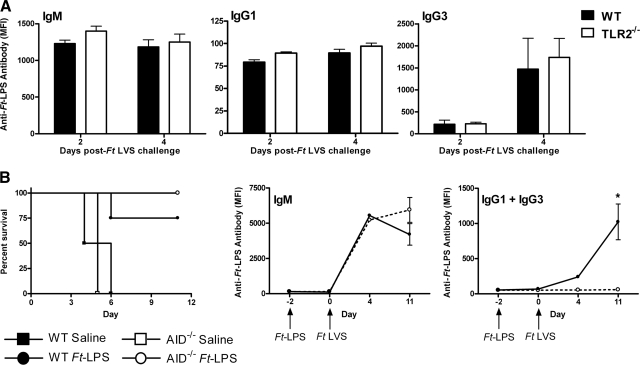
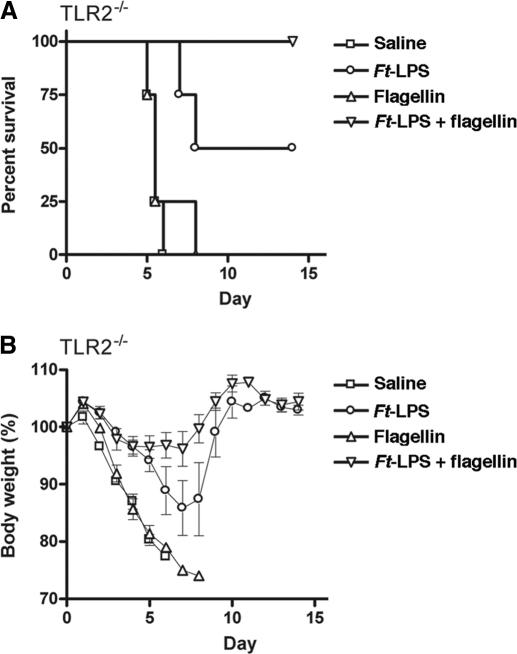
Immunization with Ft-LPS provokes an antigen-specific, B-1a cell-derived antibody response that protects WT mice against an otherwise lethal challenge with Ft LVS. However, this same regimen offers limited protection to TLR2(-/-) mice, despite production of WT levels of anti-Ft-LPS antibodies. As Ft-LPS exhibits no TLR2 agonist activity, and macrophage-induced cytokine production in response to Ft LVS is overwhelmingly TLR2-dependent, we hypothesized that treatment of TLR2(-/-) mice with an alternative, MyD88-dependent TLR agonist would compensate for reduced recognition of Ft LVS in TLR2(-/-) mice and thereby, restore Ft-LPS-mediated protection. Administration of the nontoxic TLR4 agonist, synthetic Escherichia coli MPL, at the time of Ft-LPS immunization or Ft LVS challenge, fully protected TLR2(-/-) mice, whereas treatment of WT or TLR2(-/-) mice with MPL alone conferred partial protection. The TLR5 agonist, flagellin, also synergized with Ft-LPS to protect TLR2(-/-) mice from lethal Ft LVS challenge. In contrast to Ft LVS, Ft-LPS pretreatment failed to protect mice against i.n. challenge with Ft Schu S4, whereas MPL, administered in the absence or presence of Ft-LPS, conferred significant, albeit partial, protection. MPL treatment of macrophages increased the uptake of Ft LVS and decreased intracellular bacterial survival while shifting the macrophage-differentiation phenotype from "alternatively activated" to "classically activated". Collectively, our data suggest that optimal, Ft-LPS-mediated protection against Ft LVS infection requires two discrete events, i.e., production of Ft-LPS-specific antibody, as well as TLR-mediated macrophage activation, to fully control Francisella infection.
Figures




References
-
- Saslaw S., Eigelsbach H. T., Wilson H. E., Prior J. A., Carhart S. (1961) Tularemia vaccine study. I. Intracutaneous challenge. Arch. Intern. Med. 107, 689–701 - PubMed
-
- Saslaw S., Eigelsbach H. T., Prior J. A., Wilson H. E., Carhart S. (1961) Tularemia vaccine study. II. Respiratory challenge. Arch. Intern. Med. 107, 702–714 - PubMed
-
- Christopher G. W., Cieslak T. J., Pavlin J. A., Eitzen E. M., Jr. (1997) Biological warfare. A historical perspective. JAMA 278, 412–417 - PubMed
-
- Dennis D. T., Inglesby T. V., Henderson D. A., Bartlett J. G., Ascher M. S., Eitzen E., Fine A. D., Friedlander A. M., Hauer J., Layton M., Lillibridge S. R., McDade J. E., Osterholm M. T., O′Toole T., Parker G., Perl T. M., Russell P. K., Tonat K. (2001) Tularemia as a biological weapon: medical and public health management. JAMA 285, 2763–2773 - PubMed
-
- Harris S. (1992) Japanese biological warfare research on humans: a case study of microbiology and ethics. Ann. N. Y. Acad. Sci. 666, 21–52 - PubMed
Publication types
MeSH terms
Substances
Grants and funding
LinkOut - more resources
Full Text Sources
Other Literature Sources
Research Materials
