


Normal adaptations to exercise despite protection against oxidative stress
- PMID: 21750271
- PMCID: PMC3214004
- DOI: 10.1152/ajpendo.00655.2010
Normal adaptations to exercise despite protection against oxidative stress
Abstract
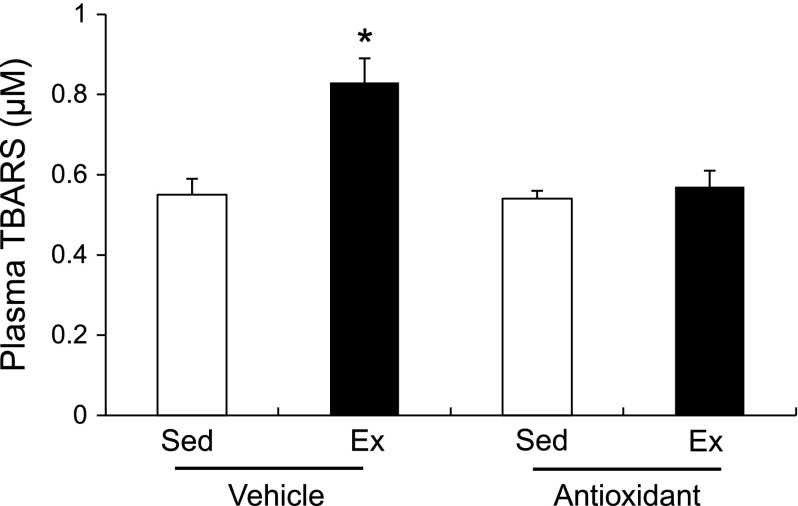
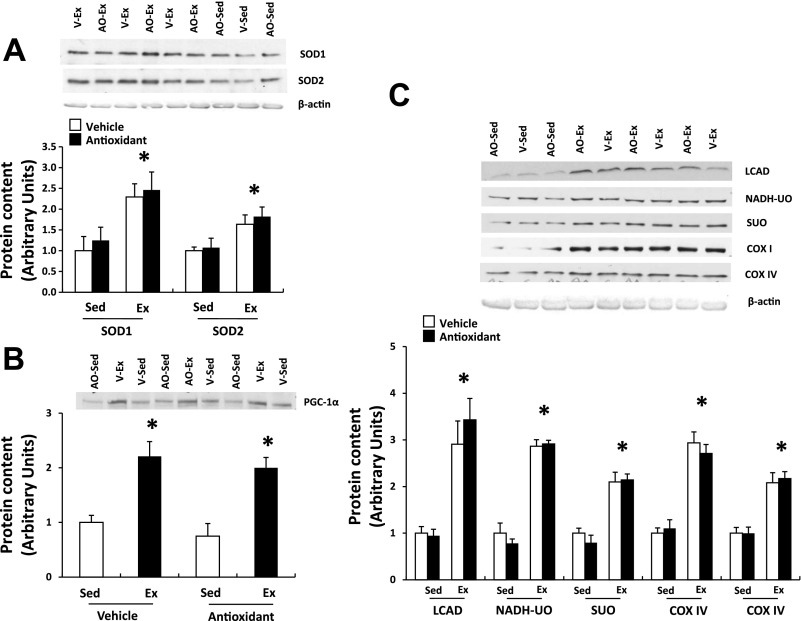
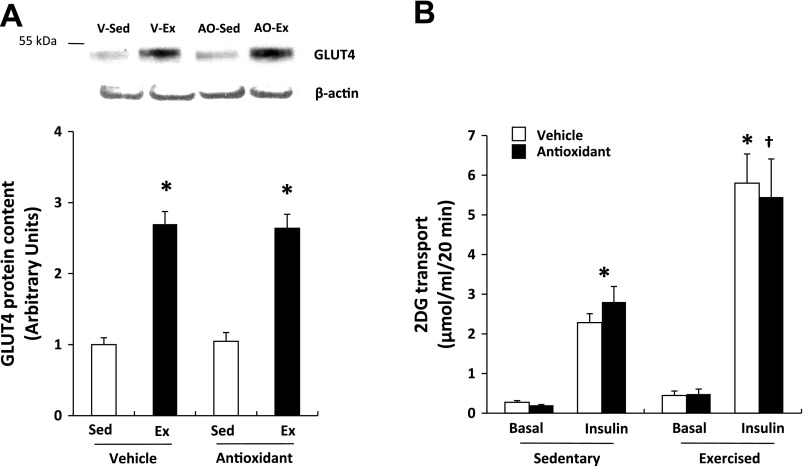
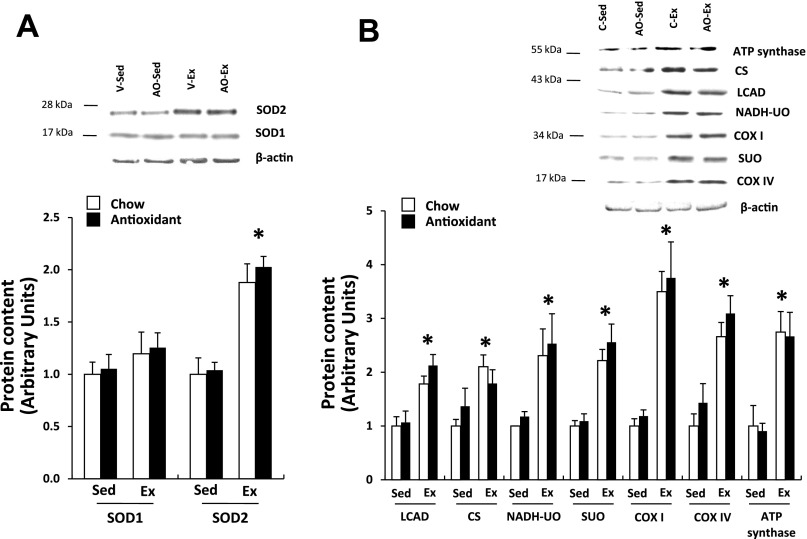
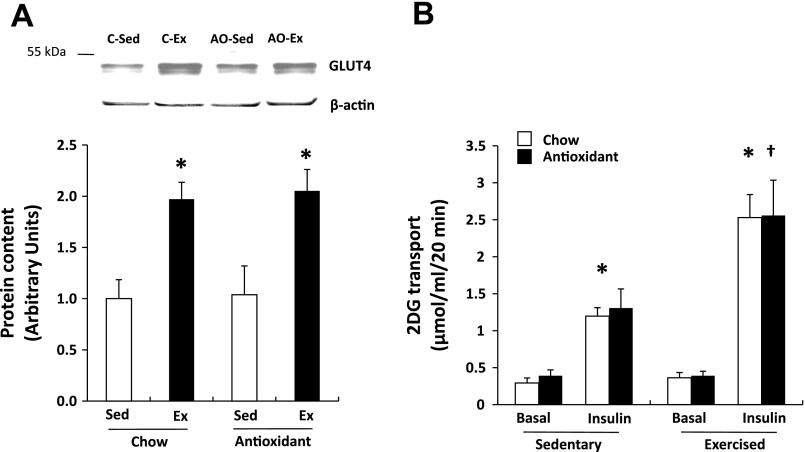
It has been reported that supplementation with the antioxidant vitamins C and E prevents the adaptive increases in mitochondrial biogenesis and GLUT4 expression induced by endurance exercise. We reevaluated the effects of these antioxidants on the adaptive responses of rat skeletal muscle to swimming in a short-term study consisting of 9 days of vitamins C and E with exercise during the last 3 days and a longer-term study consisting of 8 wk of antioxidant vitamins with exercise during the last 3 wk. The rats in the antioxidant groups were given 750 mg·kg body wt(-1)·day(-1) vitamin C and 150 mg·kg body wt(-1)·day(-1) vitamin E. In rats euthanized immediately after exercise, plasma TBARs were elevated in the control rats but not in the antioxidant-supplemented rats, providing evidence for an antioxidant effect. In rats euthanized 18 h after exercise there were large increases in insulin responsiveness of glucose transport in epitrochlearis muscles mediated by an approximately twofold increase in GLUT4 expression in both the short- and long-term treatment groups. The protein levels of a number of mitochondrial marker enzymes were also increased about twofold. Superoxide dismutases (SOD) 1 and 2 were increased about twofold in triceps muscle after 3 days of exercise, but only SOD2 was increased after 3 wk of exercise. There were no differences in the magnitudes of any of these adaptive responses between the control and antioxidant groups. These results show that very large doses of antioxidant vitamins do not prevent the exercise-induced adaptive responses of muscle mitochondria, GLUT4, and insulin action to exercise and have no effect on the level of these proteins in sedentary rats.
Figures
Comment in
-
Antioxidant supplements in exercise: worse than useless?Am J Physiol Endocrinol Metab. 2012 Feb 15;302(4):E476-7; author reply E478-9. doi: 10.1152/ajpendo.00567.2011. Am J Physiol Endocrinol Metab. 2012. PMID: 22307485 No abstract available.
References
-
- Akimoto T, Sorg BS, Yan Z. Real-time imaging of peroxisome proliferator-activated receptor-γ coactivator-1α promoter activity in skeletal muscles of living mice. Am J Physiol Cell Physiol 287: C790–C796, 2004 - PubMed
-
- Baar K, Wende AR, Jones TE, Marison M, Nolte LA, Chen M, Kelly DP, Holloszy JO. Adaptations of skeletal muscle to exercise: rapid increase in the transcriptional coactivator PGC-1. FASEB J 16: 1879–1886, 2002 - PubMed
-
- Cox JH, Cortright RN, Dohm GL, Houmard JA. Effect of aging on response to exercise training in humans: skeletal muscle GLUT-4 and insulin sensitivity. J Appl Physiol 86: 2019–2025, 1999 - PubMed
-
- Evans WJ. Vitamin E, vitamin C, and exercise. Am J Clin Nutr 72, Suppl: 647S–652S, 2000 - PubMed
-
- Garcia-Roves PM, Han DH, Song Z, Jones TE, Hucker KA, Holloszy JO. Prevention of glycogen supercompensation prolongs the increase in muscle GLUT4 after exercise. Am J Physiol Endocrinol Metab 285: E729–E736, 2003 - PubMed
Publication types
MeSH terms
Substances
Grants and funding
LinkOut - more resources
Full Text Sources
Medical
