


Long-term chronic opioid therapy discontinuation rates from the TROUP study
- PMID: 21751058
- PMCID: PMC3235603
- DOI: 10.1007/s11606-011-1771-0
Long-term chronic opioid therapy discontinuation rates from the TROUP study
Abstract
Objective: To report chronic opioid therapy discontinuation rates after five years and identify factors associated with discontinuation.
Methods: Medical and pharmacy claims records from January 2000 through December 2005 from a national private health network (HealthCore), and Arkansas (AR) Medicaid were used to identify ambulatory adult enrollees who had 90 days of opioids supplied. Recipients were followed until they discontinued opioid prescription fills or disenrolled. Kaplan Meier survival models and Cox proportional hazards models were estimated to identify factors associated with time until opioid discontinuation.
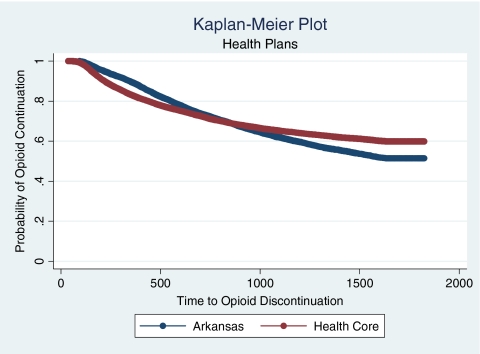
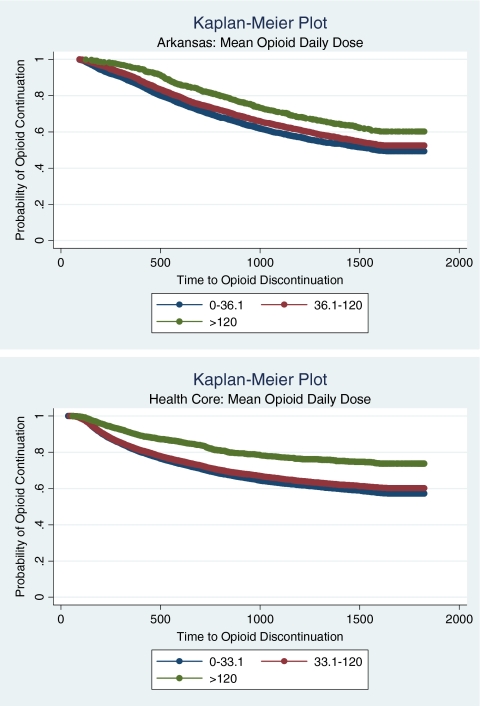
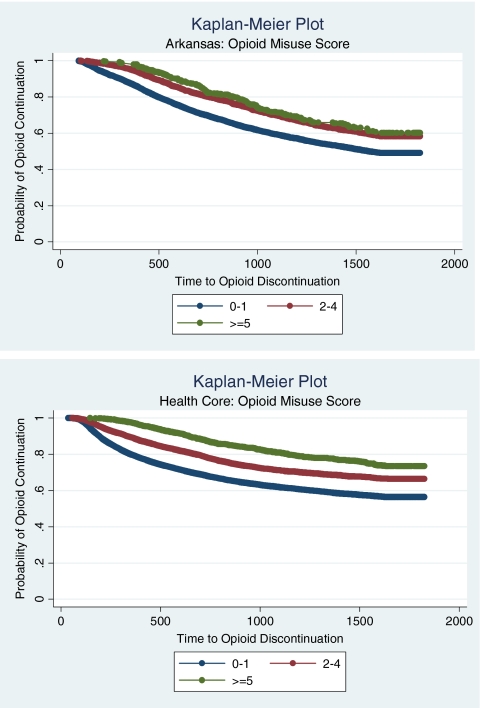
Results: There were 23,419 and 6,848 chronic opioid recipients followed for a mean of 1.9 and 2.3 years in the HealthCore and AR Medicaid samples. Over a maximum follow up of 4.8 years, 67.0% of HealthCore and 64.9% AR Medicaid recipients remained on opioids. Recipients on high daily opioid dose (greater than 120 milligrams morphine equivalent (MED)) were less likely to discontinue than recipients taking lower doses: HealthCore hazard ratio (HR) = 0.66 (95%CI: 0.57-0.76), AR Medicaid HR = 0.66 (95%CI: 0.50-0.82). Recipients with possible opioid misuse were also less likely to discontinue: HealthCore HR = 0.83 (95%CI: 0.78-0.89), AR Medicaid HR = 0.78 (95%CI: 0.67-0.90).
Conclusions: Over half of persons receiving 90 days of continuous opioid therapy remain on opioids years later. Factors most strongly associated with continuation were intermittent prior opioid exposure, daily opioid dose ≥ 120 mg MED, and possible opioid misuse. Since high dose and opioid misuse have been shown to increase the risk of adverse outcomes special caution is warranted when prescribing more than 90 days of opioid therapy in these patients.
Figures
References
-
- Trescot AM, Boswell MV, Atluri SL, et al. Opioid guidelines in the management of chronic non-cancer pain. Pain Physician. 2006;9(1):1–39. - PubMed
-
- Sandner-Kiesling A, Leyendecker P, Hopp M, Tarau L, Lejcko J, Meissner W, Sevcik P, Hakl M, Hrib R, Uhl R, Dürr H, Reimer K. Long-term efficacy and safety of combined prolonged-release oxycodone and naloxone in the management of non-cancer chronic pain. Int J Clin Pract. 2010;64(6):763–74. doi: 10.1111/j.1742-1241.2010.02360.x. - DOI - PMC - PubMed
-
- Papaleontiou M, Henderson CR, Jr, Turner BJ, Moore AA, Olkhovskaya Y, Amanfo L, Reid MC. Outcomes associated with opioid use in the treatment of chronic noncancer pain in older adults: a systematic review and meta-analysis. J Am Geriatr Soc. 2010;58(7):1353–69. doi: 10.1111/j.1532-5415.2010.02920.x. - DOI - PMC - PubMed
Publication types
MeSH terms
Substances
Grants and funding
LinkOut - more resources
Full Text Sources
Medical
Research Materials
