


Innate immune defects correlate with failure of antibody responses to H1N1/09 vaccine in HIV-infected patients
- PMID: 21752440
- PMCID: PMC3229646
- DOI: 10.1016/j.jaci.2011.05.033
Innate immune defects correlate with failure of antibody responses to H1N1/09 vaccine in HIV-infected patients
Abstract
Background: Mechanisms underlying the failure of influenza vaccine-induced antibody responses in HIV-infected persons are poorly understood.
Objective: To investigate innate immune factors regulating B-cell function in HIV-infected persons and to correlate them with serologic responses to H1N1/09 vaccine.
Methods: We evaluated immunologic characteristics of 17 HIV-infected patients and 8 healthy controls (HCs) at 0, 7, and 28 days (designated T0, T1, and T2) following a single 15-μg dose of nonadjuvanted H1N1/09 influenza vaccine by using flow cytometry, ELISpot, and ELISA. All HCs and 9 patients (53%) seroconverted with >1:40 hemagglutination inhibition antibody titer at T2.
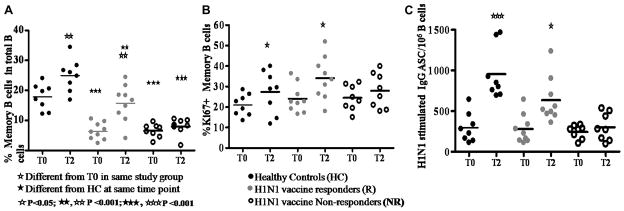
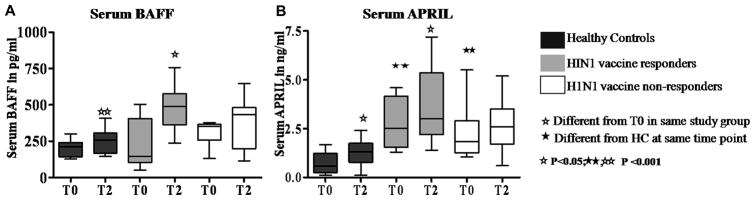
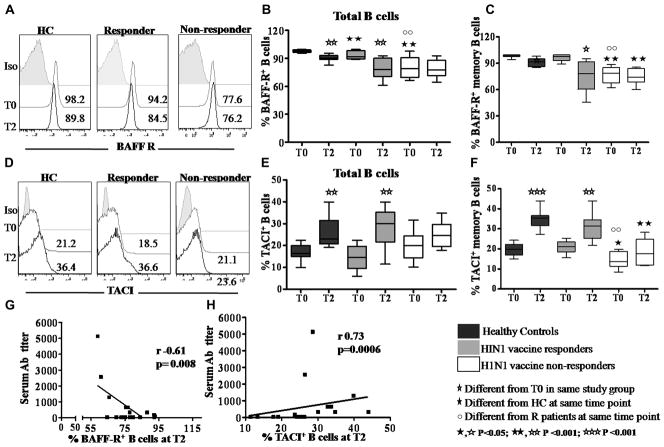
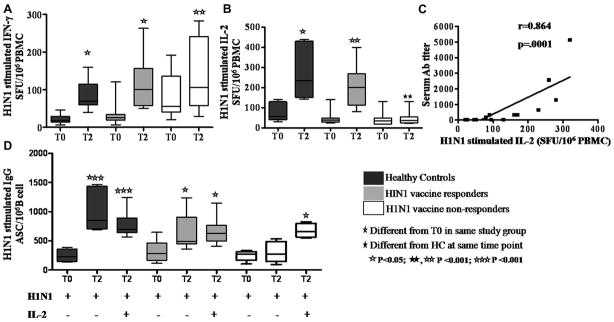
Results: In vaccine responders and HCs, serum levels of BAFF (B cell-activating factor) and APRIL (a proliferation-inducing ligand) increased from T0 to T2 in conjunction with increases in frequencies of memory B cells. Concurrently, receptors for these factors showed changes, with increases in expression of TACI (transmembrane activator and calcium modulator and cyclophilin ligand interactor) and decreases in BAFF receptor in memory B cells. IL-2 secreting cells and IgG antibody-secreting cells increased at T2 in vaccine responders and HCs in ex vivo H1N1 antigen-stimulated cultures. These immunologic responses were not evident at T1 and were deficient in vaccine nonresponder patients at T2. At T0, vaccine nonresponders had lower frequencies of BAFF receptor and TACI-expressing memory B cells than did responders.
Conclusion: Impaired memory B-cell responses, deficiencies in serum BAFF and APRIL, and alterations in their receptors on B cells were associated with failure of H1N1/09 influenza vaccine responses among virologically controlled HIV-infected patients.
Copyright © 2011 American Academy of Allergy, Asthma & Immunology. Published by Mosby, Inc. All rights reserved.
Conflict of interest statement
Figures
References
-
- Use of influenza A (H1N1) 2009 monovalent vaccine: recommendations of the Advisory Committee on Immunization Practices (ACIP), 2009. MMWR Recomm Rep. 2009;58:1–8. - PubMed
-
- Hancock K, Veguilla V, Lu X, Zhong W, Butler EN, Sun H, et al. Cross-reactive antibody responses to the 2009 pandemic H1N1 influenza virus. N Engl J Med. 2009;361:1945–52. - PubMed
-
- Klein MB, Lu Y, DelBalso L, Cote S, Boivin G. Influenzavirus infection is a primary cause of febrile respiratory illness in HIV-infected adults, despite vaccination. Clin Infect Dis. 2007;45:234–40. - PubMed
Publication types
MeSH terms
Substances
Grants and funding
LinkOut - more resources
Full Text Sources
Medical
Miscellaneous
