


Bionic ankle-foot prosthesis normalizes walking gait for persons with leg amputation
- PMID: 21752817
- PMCID: PMC3234569
- DOI: 10.1098/rspb.2011.1194
Bionic ankle-foot prosthesis normalizes walking gait for persons with leg amputation
Abstract
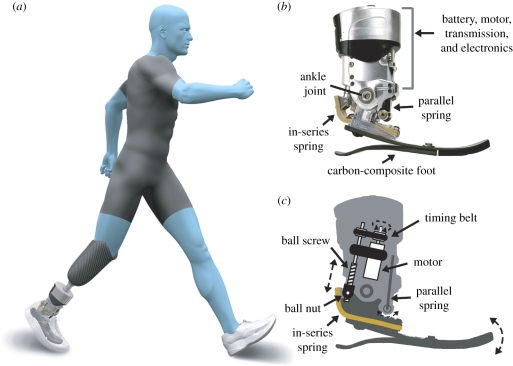
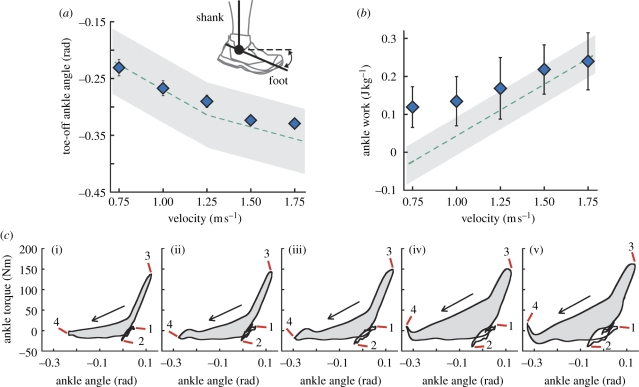
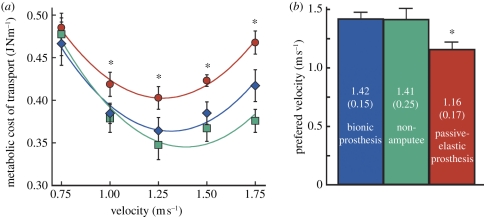
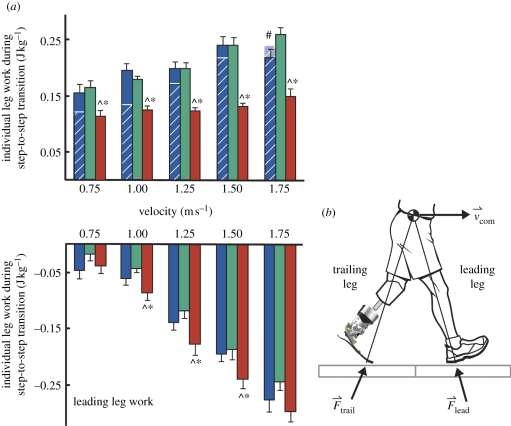
Over time, leg prostheses have improved in design, but have been incapable of actively adapting to different walking velocities in a manner comparable to a biological limb. People with a leg amputation using such commercially available passive-elastic prostheses require significantly more metabolic energy to walk at the same velocities, prefer to walk slower and have abnormal biomechanics compared with non-amputees. A bionic prosthesis has been developed that emulates the function of a biological ankle during level-ground walking, specifically providing the net positive work required for a range of walking velocities. We compared metabolic energy costs, preferred velocities and biomechanical patterns of seven people with a unilateral transtibial amputation using the bionic prosthesis and using their own passive-elastic prosthesis to those of seven non-amputees during level-ground walking. Compared with using a passive-elastic prosthesis, using the bionic prosthesis decreased metabolic cost by 8 per cent, increased trailing prosthetic leg mechanical work by 57 per cent and decreased the leading biological leg mechanical work by 10 per cent, on average, across walking velocities of 0.75-1.75 m s(-1) and increased preferred walking velocity by 23 per cent. Using the bionic prosthesis resulted in metabolic energy costs, preferred walking velocities and biomechanical patterns that were not significantly different from people without an amputation.
Figures
References
-
- Donelan J. M., Kram R., Kuo A. D. 2002. Mechanical work for step-to-step transitions is a major determinant of the metabolic cost of human walking. J. Exp. Biol. 205, 3717–3727 - PubMed
-
- Grabowski A., Farley C. T., Kram R. 2005. Independent metabolic costs of supporting body weight and accelerating body mass during walking. J. Appl. Physiol. 98, 579–583 10.1152/japplphysiol.00734 (doi:10.1152/japplphysiol.00734) - DOI - PubMed
-
- Kuo A. D., Donelan J. M., Ruina A. 2005. Energetic consequences of walking like an inverted pendulum: Step-to-step transitions. Exerc. Sport Sci. Rev. 33, 88–97 10.1097/00003677-200504000-00006 (doi:10.1097/00003677-200504000-00006) - DOI - PubMed
-
- Margaria R. 1968. Positive and negative work performances and their efficiencies in human locomotion. Int. Z. Angew. Physiol. 25, 339–351 10.1007/BF00699624 (doi:10.1007/BF00699624) - DOI - PubMed
-
- Winter D. A. 1983. Energy generation and absorption at the ankle and knee during fast, natural, and slow cadences. Clin. Ortho. Rel. Res. 175, 147–154 - PubMed
Publication types
MeSH terms
LinkOut - more resources
Full Text Sources
Other Literature Sources
Medical
