


Multiplex real-time PCR melting curve assay to detect drug-resistant mutations of Mycobacterium tuberculosis
- PMID: 21752982
- PMCID: PMC3165625
- DOI: 10.1128/JCM.02046-10
Multiplex real-time PCR melting curve assay to detect drug-resistant mutations of Mycobacterium tuberculosis
Abstract
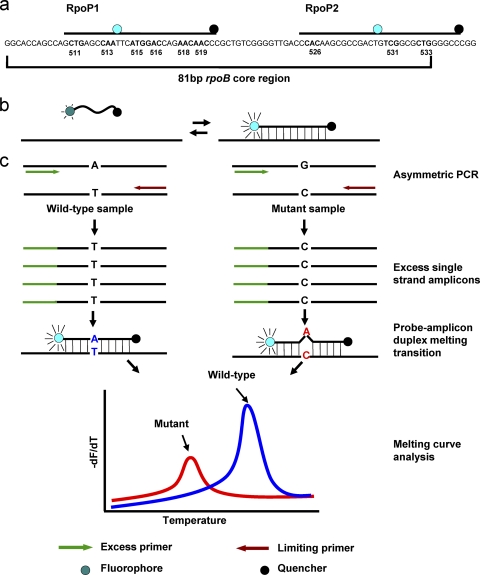
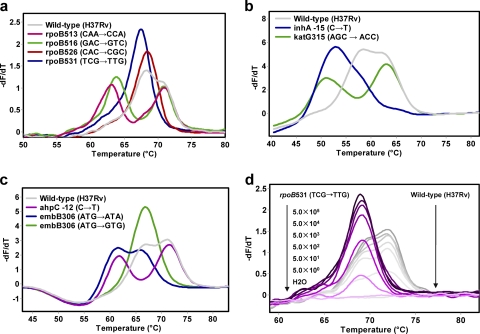
Early diagnosis of drug-resistant Mycobacterium tuberculosis is urgently needed to optimize treatment regimens and to prevent the transmission of resistant strains. Real-time PCR assays have been developed to detect drug resistance rapidly, but none of them have been widely applied due to their complexity, high cost, or requirement for advanced instruments. In this study, we developed a real-time PCR method based on melting curve analysis of dually labeled probes. Six probes targeting the rpoB 81-bp core region, katG315, the inhA promoter, the ahpC promoter, and embB306 were designed and validated with clinical isolates. First, 10 multidrug-resistant (MDR) strains with a wide mutation spectrum were used to analyze the melting temperature (T(m)) deviations of different mutations by single real-time PCR. All mutations can be detected by significant T(m) reductions compared to the wild type. Then, three duplex real-time PCRs, with two probes in each, were developed to detect mutations in 158 MDR isolates. Comparison of the results with the sequencing data showed that all mutations covered by the six probes were detected with 100% sensitivity and 100% specificity. Our method provided a new way to rapidly detect drug-resistant mutations in M. tuberculosis. Compared to other real-time PCR methods, we use fewer probes, which are labeled with the same fluorophore, guaranteeing that this assay can be used for detection in a single fluorescent channel or can be run on single-channel instruments. In conclusion, we have developed a widely applicable real-time PCR assay to detect drug-resistant mutations in M. tuberculosis.
Figures
References
-
- Andrews J. R., et al. 2008. Exogenous reinfection as a cause of multidrug-resistant and extensively drug-resistant tuberculosis in rural South Africa. J. Infect. Dis. 198:1582–1589 - PubMed
-
- Banerjee A., et al. 1994. inhA, a gene encoding a target for isoniazid and ethionamide in Mycobacterium tuberculosis. Science 263:227–230 - PubMed
Publication types
MeSH terms
Substances
Grants and funding
LinkOut - more resources
Full Text Sources
Other Literature Sources
Medical
