. 2011 Jul 13;31(28):10262-9.
doi: 10.1523/JNEUROSCI.1145-11.2011.

Medial temporal lobe damage causes deficits in episodic memory and episodic future thinking not attributable to deficits in narrative construction

Affiliations

Medial temporal lobe damage causes deficits in episodic memory and episodic future thinking not attributable to deficits in narrative construction

Elizabeth Race et al. J Neurosci. .

Abstract

The medial temporal lobe (MTL) makes critical contributions to episodic memory, but its contributions to episodic future thinking remain a matter of debate. By one view, imagining future events relies on MTL mechanisms that also support memory for past events. Alternatively, it has recently been suggested that future thinking is independent of MTL-mediated processes and can be supported by regions outside the MTL. The current study investigated the nature and necessity of MTL involvement in imagining the future and tested the novel hypothesis that the MTL contributes to future thinking by supporting online binding processes related to narrative construction. Human amnesic patients with well characterized MTL damage and healthy controls constructed narratives about (1) future events, (2) past events, and (3) visually presented pictures. While all three tasks place similar demands on narrative construction, only the past and future conditions require memory/future thinking to mentally generate relevant narrative information. Patients produced impoverished descriptions of both past and future events but were unimpaired at producing detailed picture narratives. In addition, future-thinking performance positively correlated with episodic memory performance but did not correlate with picture narrative performance. Finally, future-thinking impairments were present when MTL lesions were restricted to the hippocampus and did not depend on the presence of neural damage outside the MTL. These results indicate that the ability to generate and maintain a detailed narrative is preserved in amnesia and suggest that a common MTL mechanism supports both episodic memory and episodic future thinking.


Figures
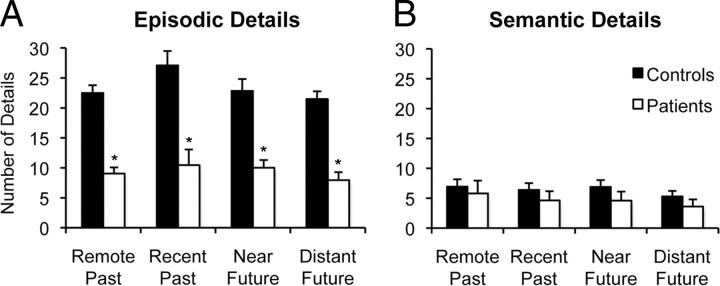
Figure 1.
Figure 1.
Memory and future-thinking performance. Mean number of episodic details (A) and semantic details (B) generated by MTL patients and controls for remote past, recent past, near future, and far future events. Error bars indicate SEM. *p < 0.001 compared to controls.
Figure 2.
Figure 2.
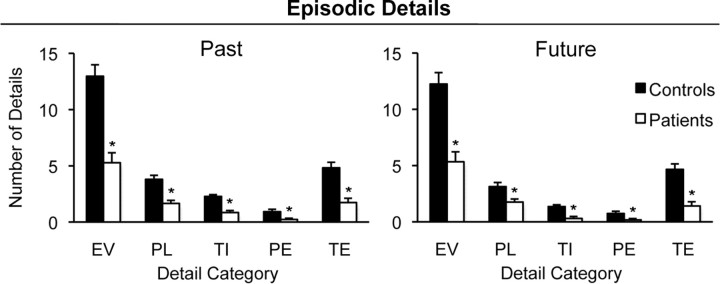
Mean number of episodic details generated by patients and controls in each episodic detail category for past and future events (averaged across recent/remote and near/distant temporal distances, respectively). Detail categories are defined as follows: EV, event; PL, place; TI, time; PE, perceptual; TE, thought/emotion. Error bars indicate SEM. *p < 0.05 compared to controls.
Figure 3.
Figure 3.
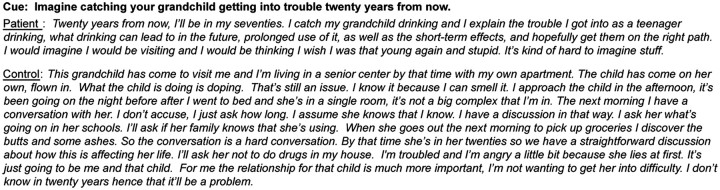
Representative sample of future event narratives generated by amnesic patient P05 (top) and a control subject (bottom) when instructed to imagine catching a grandchild getting into trouble 20 years from now.
Figure 4.
Figure 4.
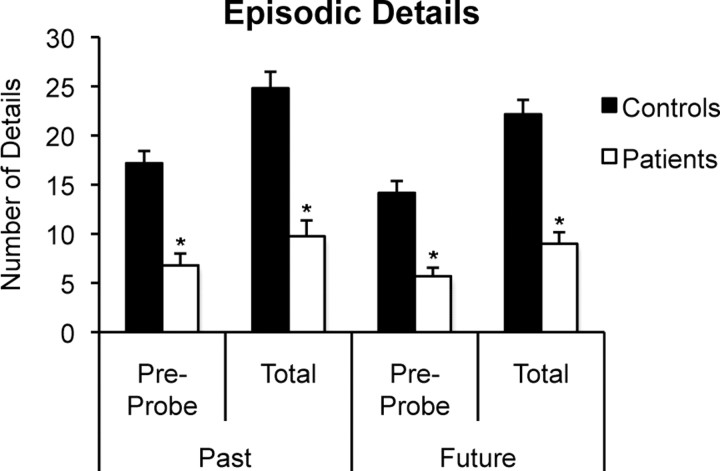
Mean number of episodic details generated by patients and controls before the cuing probe (pre-probe) and in total (pre-probe + post-probe) for past and future events. Error bars indicate SEM. *p < 0.001 compared to controls.
Figure 5.
Figure 5.
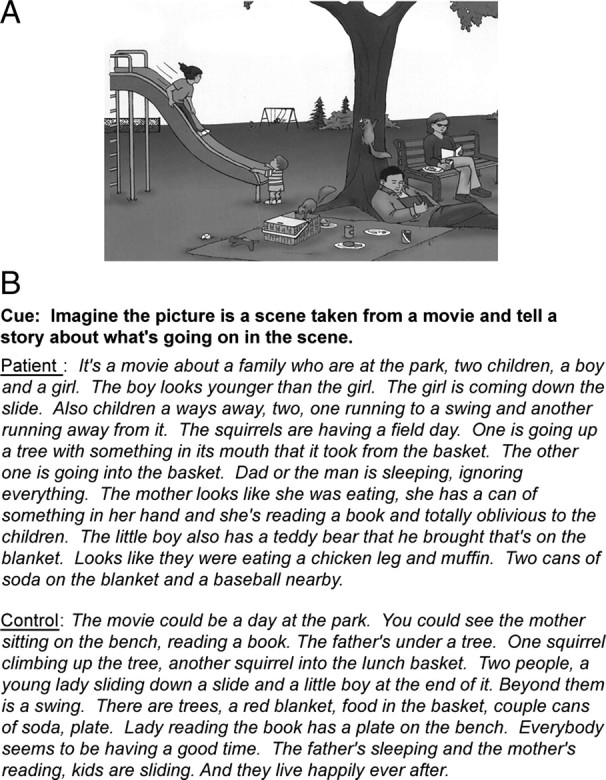
Representative sample of a picture used for the picture narrative condition (A) and representative sample of picture narratives generated by an amnesic patient (top) and a control subject (bottom) when instructed to describe a story about what's going on in the scene (B).
Figure 6.
Figure 6.
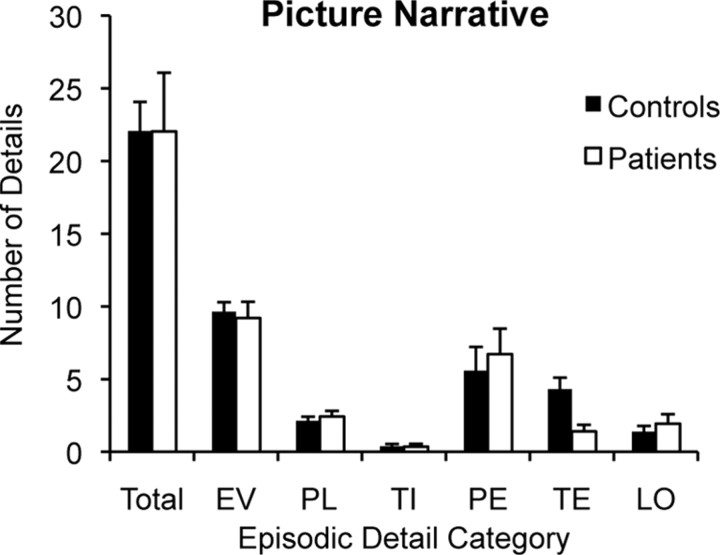
Picture narrative performance. Mean number of episodic details generated by patients and controls during picture narratives. Detail categories are defined as follows: EV, event; PL, place; TI, time; PE, perceptual; TE, thought/emotion; LO, object-location. Error bars indicate SEM.
Figure 7.
Figure 7.
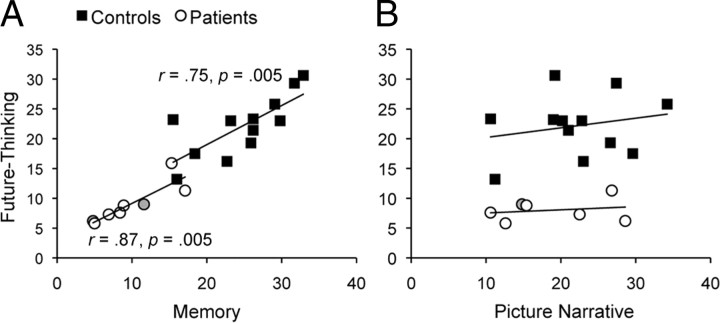
Scatter plots and regression lines showing significant correlations between future-thinking performance and memory performance (number of episodic details generated for future events vs number of episodic details generated for past events) for both controls and patients (A) and nonsignificant correlations between future-thinking performance and picture narrative performance (number of episodic details generated for future events vs number of episodic details generated for picture narratives) for both controls and patients (B). Amnesic patients are represented by circles and controls are represented by squares. The data point representing the patient whose MTL lesion is restricted to the hippocampus (P05) is indicated by a light gray fill in both panels. B excludes the patient with outlier performance on the picture narrative task (P01).

References

    1. Addis DR, Schacter DL. Constructive episodic simulation: temporal distance and detail of past and future events modulate hippocampal engagement. Hippocampus. 2008;18:227–237. - PubMed
    1. Addis DR, Wong AT, Schacter DL. Remembering the past and imagining the future: common and distinct neural substrates during event construction and elaboration. Neuropsychologia. 2007;45:1363–1377. - PMC - PubMed
    1. Addis DR, Cheng T, Roberts RP, Schacter DL. Hippocampal contributions to the episodic simulation of specific and general future events. Hippocampus. 2010 doi: 10.1002/hipo.20870. - DOI - PMC - PubMed
    1. Andelman F, Hoofien D, Goldberg I, Aizenstein O, Neufeld MY. Bilateral hippocampal lesion and a selective impairment of the ability for mental time travel. Neurocase. 2010;16:426–435. - PubMed
    1. Baddeley A. The episodic buffer: a new component of working memory? Trends Cogn Sci. 2000;4:417–423. - PubMed

Publication types

LinkOut - more resources