. 2012 Apr;19(4):365-74.
doi: 10.1038/gt.2011.104. Epub 2011 Jul 14.

Single-chain VαVβ T-cell receptors function without mispairing with endogenous TCR chains

Affiliations

Single-chain VαVβ T-cell receptors function without mispairing with endogenous TCR chains

D H Aggen et al. Gene Ther. 2012 Apr.

Abstract

Transduction of exogenous T-cell receptor (TCR) genes into patients' activated peripheral blood T cells is a potent strategy to generate large numbers of specific T cells for adoptive therapy of cancer and viral diseases. However, the remarkable clinical promise of this powerful approach is still being overshadowed by a serious potential consequence: mispairing of the exogenous TCR chains with endogenous TCR chains. These 'mixed' heterodimers can generate new specificities that result in graft-versus-host reactions. Engineering TCR constant regions of the exogenous chains with a cysteine promotes proper pairing and reduces the mispairing, but, as we show here, does not eliminate the formation of mixed heterodimers. By contrast, deletion of the constant regions, through use of a stabilized Vα/Vβ single-chain TCR (scTv), avoided mispairing completely. By linking a high-affinity scTv to intracellular signaling domains, such as Lck and CD28, the scTv was capable of activating functional T-cell responses in the absence of either the CD3 subunits or the co-receptors, and circumvented mispairing with endogenous TCRs. Such transduced T cells can respond to the targeted antigen independent of CD3 subunits via the introduced scTv, without the transduced T cells acquiring any new undefined and potentially dangerous specificities.


Conflict of interest statement

Conflict of interest

The authors do not have a conflict of interest.

Figures
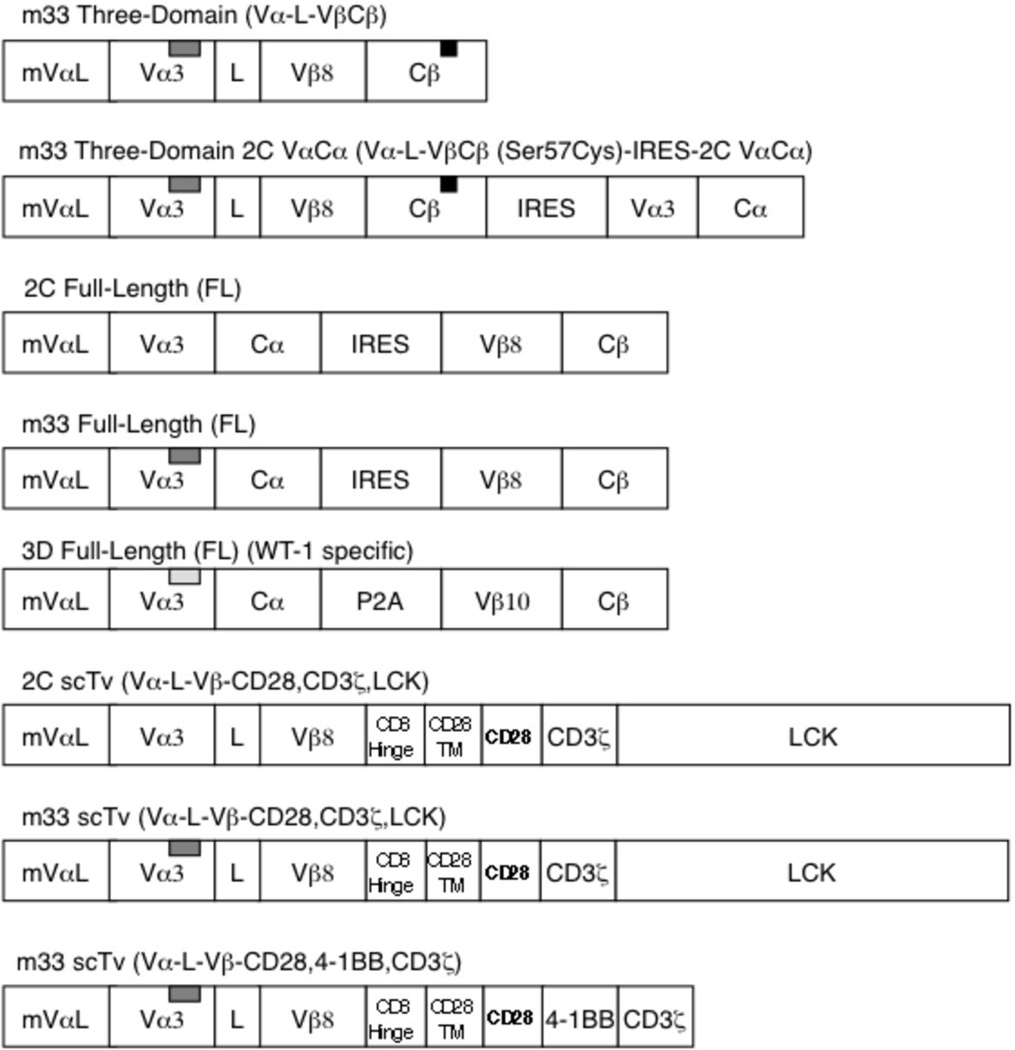
FIGURE 1
FIGURE 1
Full length, three-domain, and single-chain VαVβ (Tv) TCR constructs. TCRs derived from the 2C or 3D TCR were introduced into the murine stem cell virus (MSCV) retroviral vector. The m33 high affinity variant of the 2C TCR differs only in the CDR3α sequence: 2C CDR3α-GFASA, m33 CDR3α-LHRPA (designated by gray insert rectangle). The 3D full-length receptor also contained CDR3α mutations that confer higher affinity to WT-1/Db. The m33 three domain constructs contained a non-native cysteine mutation (Cβ: Cys57), indicated by the black rectangle. IRES refers to internal ribosome entry site, CD28TM refers to the CD28 transmembrane domain, and mVαL refers to the murine Vα leader sequence.
FIGURE 2
FIGURE 2
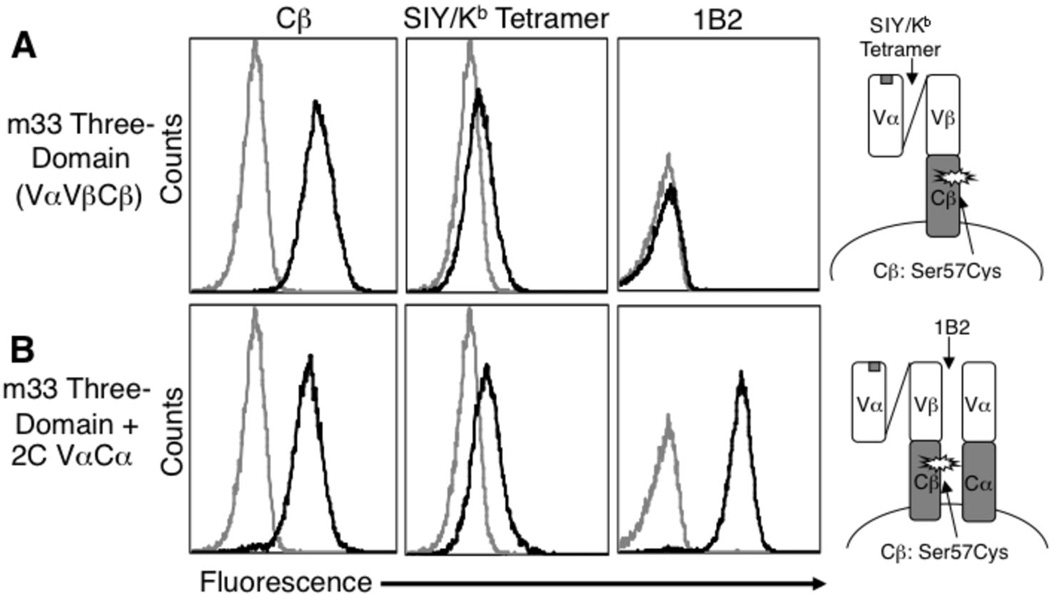
Three-domain m33 TCR mispairs with endogenous TCR α chains. T cell hybridoma 58−/− mock (no vector DNA) transduced cells (gray line) and transduced cells (black line) were analyzed by flow cytometry for surface expression after transduction with (A) the m33 three-domain construct or (B) the m33 three-domain construct and the 2C full α chain construct (2C VαCã̤ Transduced cells were examined with anti-Cβ antibody, SIY/Kb Tetramer (100 nM) or 1B2 clonotypic antibody. The m33 three-domain cassettes in both constructs contained a Cβ non-native cysteine while the 2C VαCα chain contained unmodified constant domains. The schematic in (B) depicts the binding sites of SIY/Kb tetramer and 1B2. A fraction of the receptors in (B) that mispair would bind to 1B2, and not bind to SIY/Kb tetramer, while other properly associated three-domain receptors on the same cell could bind to SIY/Kb tetramer.
FIGURE 3
FIGURE 3
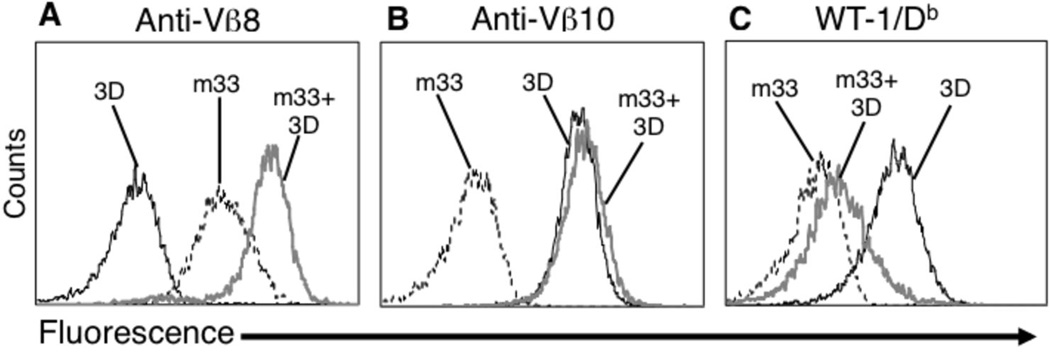
Three-domain m33 TCR mispairs with endogenous TCR 3D. The WT-1 specific TCR 3D, which contains unmodified murine constant domains, was used to mimic an endogenous TCR (3D TCR: mVα3, mVβ10). 3D TCR-positive T cell hybridoma 58−/− were transduced with the m33 three-domain TCR (Vβ8+) construct. Vβ8-sorted cells were analyzed with anti-Vβ8 (A), anti-Vβ10 (B) or WT-1/Db DimerX at 125 nM (C). Transduced 3D cells that co-express the m33 three-domain construct (gray line) were compared to cells that express only the 3D full-length TCR (black line), or only the m33 three-domain construct (black dashed line).
FIGURE 4
FIGURE 4
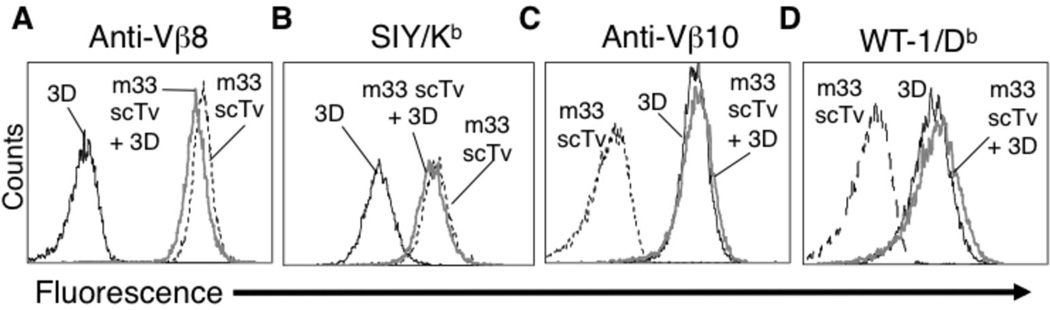
A single-chain VαVβ TCR (scTv) construct avoids detectable mispairing with endogenous TCR 3D. 3D expressing T cells were transduced as in Fig. 3, but in this instance with the m33 scTv. Following sorting with anti-Vβ8 antibody, cells were analyzed with anti-Vβ8 (A), SIY/Kb tetramer at 100 nM (B) anti-Vβ10 (C), or WT-1/Db DimerX at 125 nM (D). Transduced 3D cells that co-express the m33 scTv construct (gray line) were compared to cells that express only the 3D full-length TCR (black line), or only the m33 scTv construct (black dashed line).
FIGURE 5
FIGURE 5
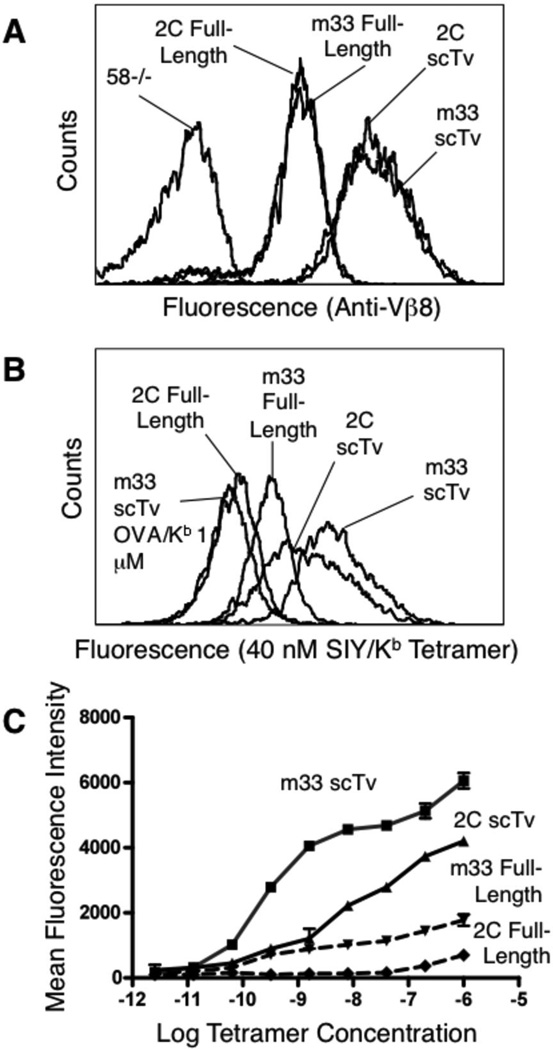
Surface levels and SIY/Kb binding by scTv and full-length TCRs. scTv and full-length 2C (Kd=30 µM for SIY/Kb) and m33 (Kd=30 nM for SIY/Kb) constructs were introduced into 58−/− cells. Cell surface expression was monitored with anti-Vβ8 (A) or SIY/Kb SA:PE labeled tetramer at 40 nM (B) by flow cytometry. SIY/Kb tetramer binding to scTv and full-length constructs was examined at various concentrations of tetramer (C).
FIGURE 6
FIGURE 6
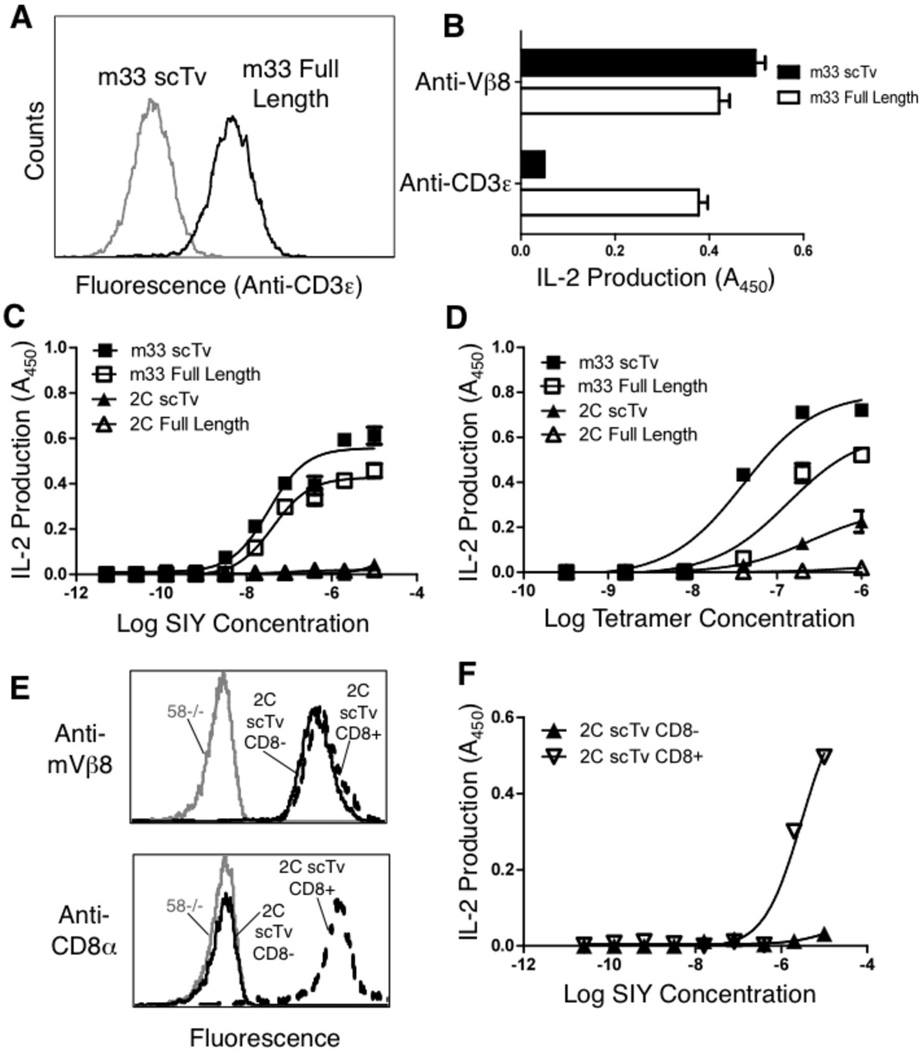
Comparison of m33 (high affinity) and 2C (low affinity) full-length and scTv constructs for antigen specific T cell activation. (A) CD3ε surface expression of the m33 scTv (gray line) and full-length TCR (black line). (B) Activation of IL-2 release from m33 scTv and full-length expressing cells with plate bound anti-Vβ8 or anti-CD3ε antibodies. (C) Antigen specific activation of 2C and m33 scTv and full-length transduced cells using peptide-loaded T2-Kb cell line at various concentrations of exogenous SIY peptide. (D) Antigen specific activation of 2C and m33 scTv and full-length transduced cells using plate bound SIY/Kb tetramer. (E) Cell surface levels of 2C scTv (as monitored with anti-Vβ8) and CD8α in 2C scTv CD8αβ+ and CD8αβ- T cells. (F) Antigen specific activation of 2C scTv CD8 and CD8+ transduced cells with peptide-loaded T2-Kb cell line at various concentrations of exogenous SIY peptide. Data for B, C, and D, and F is representative of three independent experiments for each panel. OVA peptide (10 µM) loaded T2-Kb cells and OVA/Kb plate-bound pepMHC tetramer gave absorbance values from the IL-2 ELISA at background levels (not shown).
FIGURE 7
FIGURE 7
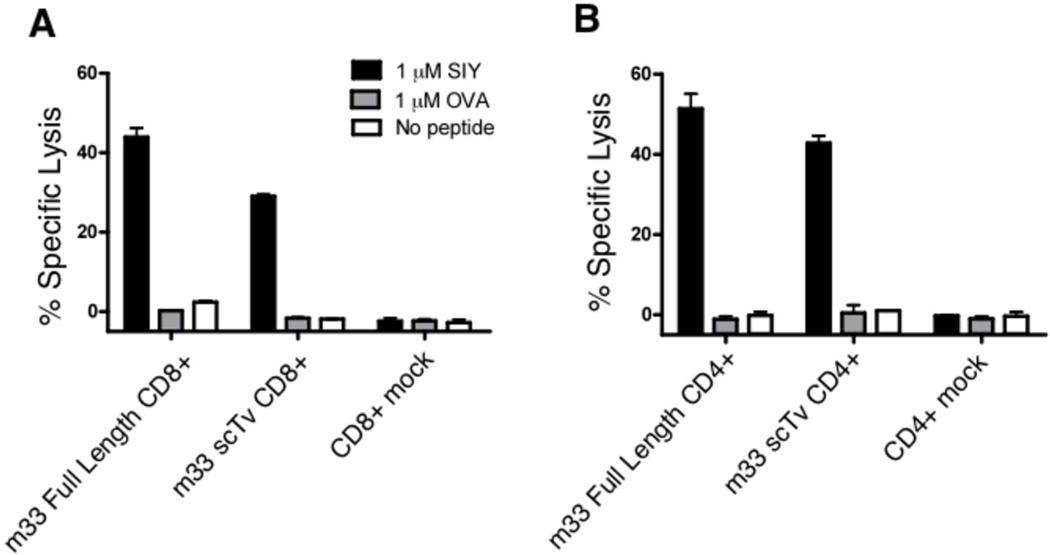
Comparison of m33 CD28, 4-1BB, CD3ζ scTv and m33 full-length TCR in T cell cytotoxicity directed against SIY+ APCs. Full-length m33 αβ TCR or m33 CD28, 4-1BB, CD3ζ scTv (m33 scTv) receptors were introduced into purified, activated CD8+ (A) or CD4+ (B) primary C57Bl/6 T cells and T cell cytotoxicity was assessed in a 4-hour 51Cr release assay with T2 target cells loaded with 1 µM exogenous SIY, OVA, or no peptide. T cell effector to T2 target cell ratio was fixed at 20:1. Mock – splenocytes activated without the addition of an endogenous receptor (untransduced).
FIGURE 8
FIGURE 8
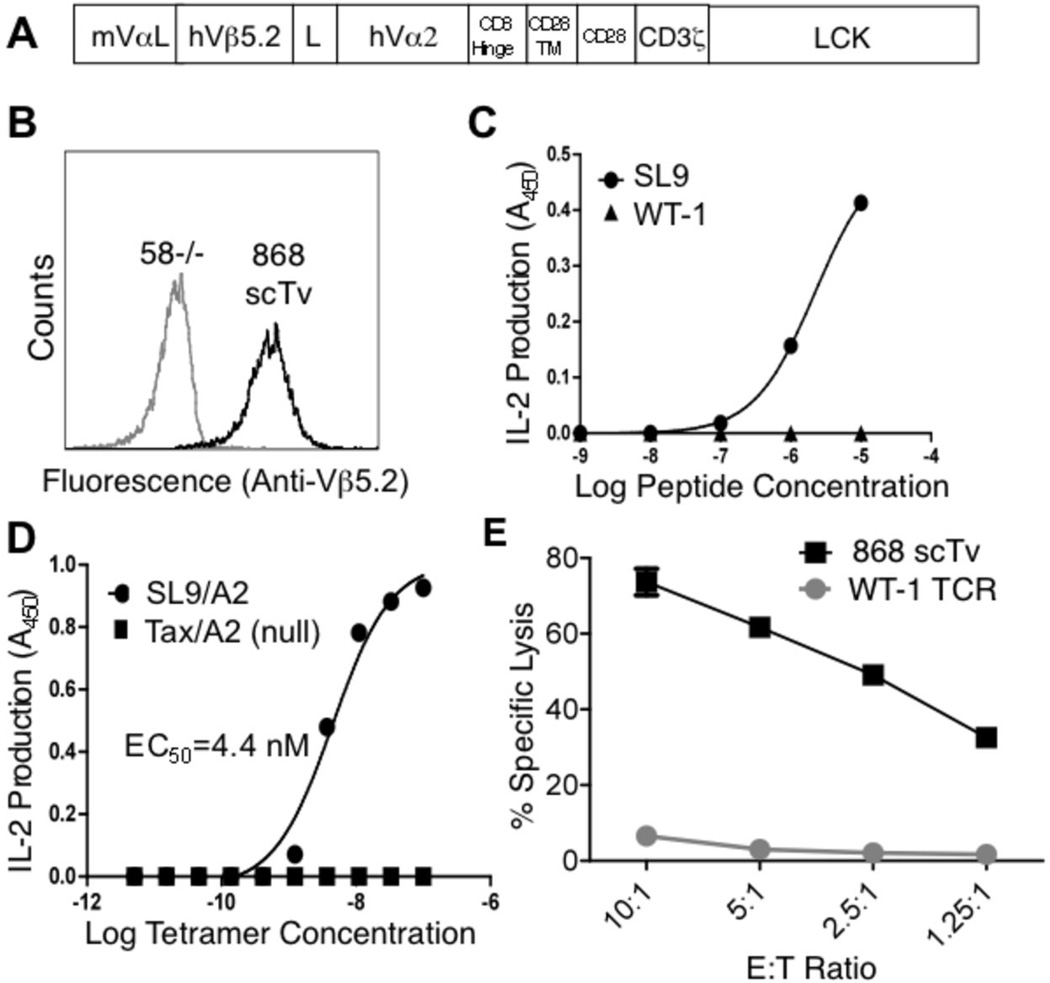
The human high-affinity HIV-specific 868 scTv mediates antigen-specific activity in 58−/− T cells. (A) The leader from the 2C scTv was introduced upstream of the 868 scTv, and the human TCR was expressed as a fusion to murine intracellular signaling subunits. (B) Surface expression of 868 scTv in transduced cells was monitored by anti-human Vβ5.2. (gray line - 58−/− cells, black line – 868 scTv). To assess antigen specific activation, 868 scTv expressing cells were stimulated with (C) SL9 or WT-1 (null) peptide loaded T2 cells or (D) plate-bound SL9/A2 or Tax/A2 tetramers at various concentrations. Data in C and D are representative of two independent experiments for each panel. (E) T cell cytotoxicity with human PBMCs transduced with a WT-1 specific TCR (mock) or 868 scTv with T2 target cells pulsed with exogenous SL9 (10 µM) peptide. Data in E is representative of two experiments.

References

    1. Bendle GM, Haanen JB, Schumacher TN. Preclinical development of T cell receptor gene therapy. Curr Opin Immunol. 2009;21:209–214. - PubMed
    1. Morgan RA, Dudley ME, Wunderlich JR, Hughes MS, Yang JC, Sherry RM, et al. Cancer regression in patients after transfer of genetically engineered lymphocytes. Science. 2006;314:126–129. - PMC - PubMed
    1. Johnson LA, Morgan RA, Dudley ME, Cassard L, Yang JC, Hughes MS, et al. Gene therapy with human and mouse T-cell receptors mediates cancer regression and targets normal tissues expressing cognate antigen. Blood. 2009;114:535–546. - PMC - PubMed
    1. Bendle GM, Linnemann C, Hooijkaas AI, Bies L, de Witte MA, Jorritsma A, et al. Lethal graft-versus-host disease in mouse models of T cell receptor gene therapy. Nat Med. 2010;16:565–570. 561p following 570. - PubMed
    1. Davis MM, Boniface JJ, Reich Z, Lyons D, Hampl J, Arden B, et al. Ligand recognition by alpha beta T cell receptors. Annu Rev Immunol. 1998;16:523–544. - PubMed

Publication types

Substances