. 2012 Jan;6(1):21-30.
doi: 10.1038/ismej.2011.89. Epub 2011 Jul 14.

Long-term effects of ocean warming on the prokaryotic community: evidence from the vibrios

Affiliations

Long-term effects of ocean warming on the prokaryotic community: evidence from the vibrios

Luigi Vezzulli et al. ISME J. 2012 Jan.

Abstract

The long-term effects of ocean warming on prokaryotic communities are unknown because of lack of historical data. We overcame this gap by applying a retrospective molecular analysis to the bacterial community on formalin-fixed samples from the historical Continuous Plankton Recorder archive, which is one of the longest and most geographically extensive collections of marine biological samples in the world. We showed that during the last half century, ubiquitous marine bacteria of the Vibrio genus, including Vibrio cholerae, increased in dominance within the plankton-associated bacterial community of the North Sea, where an unprecedented increase in bathing infections related to these bacteria was recently reported. Among environmental variables, increased sea surface temperature explained 45% of the variance in Vibrio data, supporting the view that ocean warming is favouring the spread of vibrios and may be the cause of the globally increasing trend in their associated diseases.


Figures
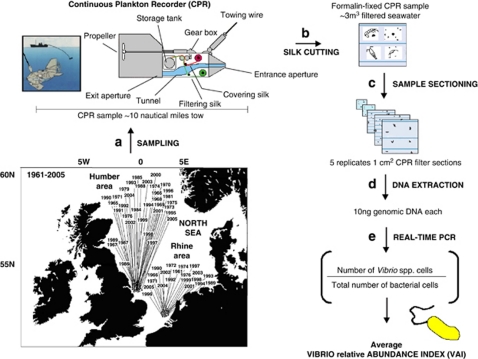
Figure 1
Figure 1
Retrospective assessment of relative abundance of vibrios, Vibrio relative abundance index (VAI), in the North Sea. Methods used to calculate the relative abundance of vibrios (VAI index) from formalin-fixed plankton samples collected by the CPR survey off the Rhine and Humber estuaries, in August, from 1961 to 2005. (a) CPR samples were collected in the North Sea from 1961 to 2005 by the CPR survey. (b) Back in the laboratory, the silk containing the entrapped plankton (under 4–10% buffered formalin) is cut into blocks, each representing 10 nautical miles of tow (3 m3 of filtered seawater). (c) Five replicate 1-cm2 sections are prepared from each CPR block for microbiological molecular analyses. (d) Genomic DNA is extracted from each section and purified. (e) The ratio of Vibrio spp. cells to total bacterial cells is assessed by real-time PCR of 10 ng of genomic DNA from each section using genus-specific and universal primers, respectively, producing small amplicons of similar size (113 vs 98 bp) to avoid age- and formalin-induced bias (see main text). The VAI is then calculated for each sample by average values of this ratio for the five replicate measurements.
Figure 2
Figure 2
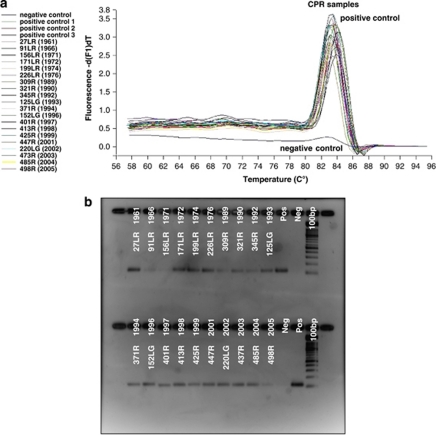
PCR-based amplification of bacterial DNA extracted from historical CPR samples dating back to August 1961. Melting curve analysis (a) and agarose gel (b) showing the output of real-time PCR amplification of a 113-bp DNA fragment targeting the 16SDNA gene of Vibrio spp. from genomic DNA extracted from archived formalin-fixed CPR samples from the North Sea off the Rhine estuary dating back to August 1961.
Figure 3
Figure 3
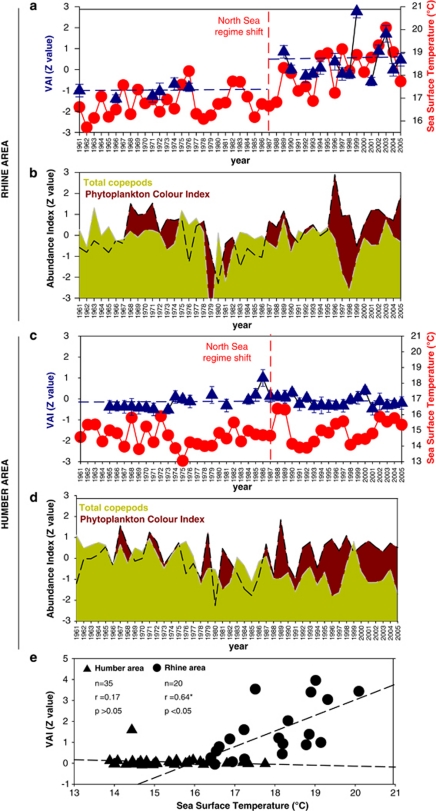
Relative abundance of Vibrio spp. and levels of environmental variables. Long-term variation in the abundance of Vibrio (a, c) (blue triangles; error bars indicate s.d., n=5), SST (a, c) (red circles), phytoplankton colour index (b, d) and total copepods (b, d) for 1961–2005 off the Rhine and Humber estuaries in the North Sea. Vertical red line=regime shift step change in temperature after 1987 (Kirby et al., 2007). Horizontal blue lines=average standardised Vibrio relative abundance index (VAI) values for the two periods, –0.94 s.d. (1961–1976) and +0.4 s.d. (1989–2005) for the Rhine area and –0.13 s.d. (1965–1987) and −0.13 s.d. (1988–2005) for the Humber area. (e) The Pearson correlation analysis between Vibrio abundance and SST in the North Sea (Pearson's correlation on pooled data; n=55; r=0.27*; P<0.05). Z values are obtained by subtracting the population mean and dividing the difference by the s.d.
Figure 4
Figure 4
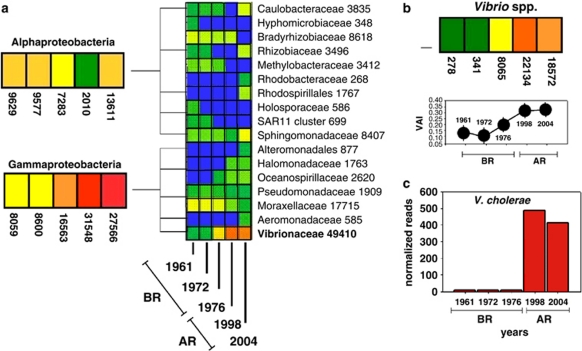
16S rDNA pyrosequencing-based comparative analysis of the microbial community from historical CPR samples. Comparative analysis of 16S rDNA pyrosequencing data for dominant Alpha- and Gammaproteobacteria groups are shown for CPR samples collected in 1961, 1972, 1976, 1998 and 2004 off the Rhine Estuary. A heat map is shown, where the numbers of normalised reads taken by each taxon in each year are represented as colours (cold-to-hot colour representing low to high number of reads). The cumulative number of normalised reads across the different years is also shown for each taxon (Mitra et al., 2009). AR=after regime shift; BR=before regime shift. (a) The tree is collapsed to the ‘family' level; (b) results for the Vibrio genus, Vibrio relative abundance index (VAI) index is reported for comparison; (c) number of normalised read sequences showing >95% identity to V. cholerae (see also Supplementary Figure S3).

References

    1. Acinas SG, Marcelino LA, Klepac-Ceraj V, Polz MF. Divergence and redundancy of 16S rRNA sequences in genomes with multiple rrn operons. J Bacteriol. 2004;186:2629–2635. - PMC - PubMed
    1. Anderson MJ. DISTLM Forward: A FORTRAN Computer Program to Calculate a Distance-Based Multivariate Analysis for a Linear Model Using Forward Selection. Department of Statistics, University of Auckland: New Zealand; 2003.
    1. Andersen PH. Infections with seawater bacteria. EPI-NEWS. 2006;1:26–32.
    1. Andersson Y, Ekdahl K. Wound infections due to Vibrio cholerae in Sweden after swimming in the Baltic Sea, summer 2006. Euro Surveill. 2006;11:E060803.2. - PubMed
    1. Austin B.2005Bacteria pathogens of marine fishIn: Belkin S, Colwell RR (eds).Ocean and Health Pathogens in the Marine Environment Springer-Verlag: New York; 391–413.

Publication types