


Efficacy and safety of bazedoxifene for postmenopausal osteoporosis
- PMID: 21753870
- PMCID: PMC3131985
- DOI: 10.2147/CIA.S15711
Efficacy and safety of bazedoxifene for postmenopausal osteoporosis
Abstract
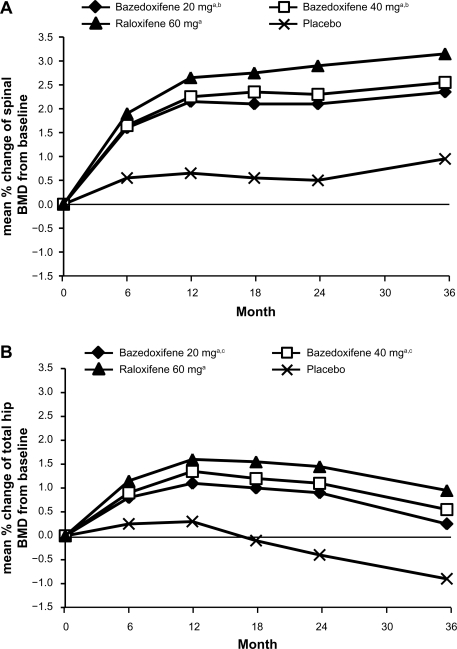
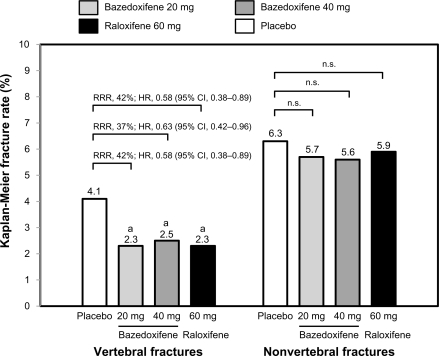
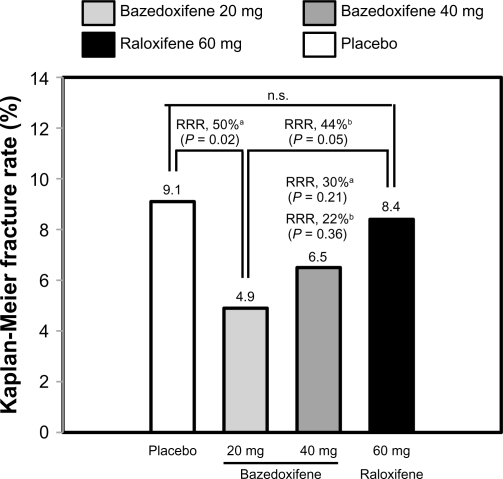
Bazedoxifene, a novel selective estrogen receptor modulator, has been developed to have favorable effects on bone and the lipid profile while minimizing stimulation of uterine or breast tissues. Two large Phase III clinical trials showed that bazedoxifene, as well as raloxifene, increased bone mineral density, decreased levels of bone turnover markers, and significantly reduced the risk of new vertebral fractures in postmenopausal women compared with placebo. Although the incidence of nonvertebral fractures with bazedoxifene or raloxifene did not differ significantly from that with placebo, a post hoc analysis of a subgroup of women at higher fracture risk revealed that bazedoxifene significantly reduced the nonvertebral fracture risk relative to placebo and raloxifene. Bazedoxifene also improved the lipid profile by reducing the serum concentrations of total cholesterol and low-density lipoprotein cholesterol, with an increase in the serum level of high-density lipoprotein cholesterol. The incidences of vasodilatation (hot flushes), leg cramps, and venous thromboembolic events were significantly higher with bazedoxifene and raloxifene compared with placebo. There was no evidence of endometrial and breast stimulation with bazedoxifene. Taking advantage of the favorable effects of bazedoxifene on the breast and endometrium, the pairing of bazedoxifene with conjugated estrogens is under investigation for the treatment of menopausal symptoms and prevention of postmenopausal osteoporosis. A Phase III trial showed that combination therapy of bazedoxifene and conjugated estrogens significantly increased bone mineral density and decreased bone turnover markers, with relief of hot flushes and improvement of vaginal atrophy. This article reviews the clinical efficacy and safety of bazedoxifene in the treatment of postmenopausal osteoporosis.
Keywords: endometrium; estrogen receptor; nonvertebral fracture; osteoporosis; selective estrogen receptor modulators.
Figures
References
-
- Sambrook P, Cooper C. Osteoporosis. Lancet. 2006;367(9527):2010–2018. - PubMed
-
- Cauley JA, Thompson DE, Ensrud KC, Scott JC. Risk of mortality following clinical fractures. Osteoporos Int. 2000;11(7):556–561. - PubMed
-
- Siris ES, Brenneman SK, Barrett-Connor E, et al. The effect of age and bone mineral density on the absolute, excess, and relative risk of fracture in postmenopausal women aged 50–99 results from the National Osteoporosis Risk Assessment (NORA) Osteoporos Int. 2006;17(4):565–574. - PubMed
Publication types
MeSH terms
Substances
LinkOut - more resources
Full Text Sources
Medical
