


Safety and efficacy of silodosin for the treatment of benign prostatic hyperplasia
- PMID: 21753871
- PMCID: PMC3131986
- DOI: 10.2147/CIA.S13803
Safety and efficacy of silodosin for the treatment of benign prostatic hyperplasia
Abstract
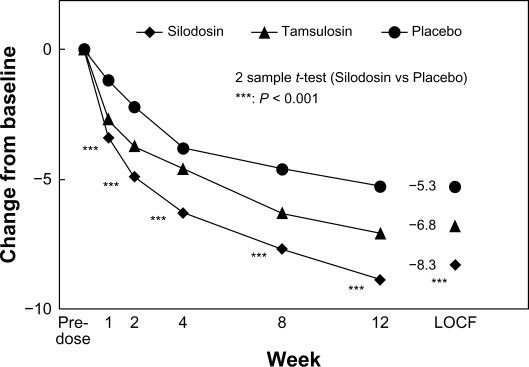
Lower urinary tract symptoms (LUTS) associated with benign prostatic hyperplasia (BPH) are highly prevalent in older men. Medical therapy is the first-line treatment for LUTS associated with BPH. Mainstays in the treatment of male LUTS and clinical BPH are the α(1)-adrenergic receptor antagonists. Silodosin is a new α(1)-adrenergic receptor antagonist that is selective for the α(1A)-adrenergic receptor. By antagonizing α(1A)-adrenergic receptors in the prostate and urethra, silodosin causes smooth muscle relaxation in the lower urinary tract. Since silodosin has greater affinity for the α(1A)-adrenergic receptor than for the α(1B)-adrenergic receptor, it minimizes the propensity for blood pressure-related adverse effects caused by α(1B)-adrenergic receptor blockade. In the clinical studies, patients receiving silodosin at a total daily dose of 8 mg exhibited significant improvements in the International Prostate Symptom Score and maximum urinary flow rate compared with those receiving placebo. Silodosin showed early onset of efficacy for both voiding and storage symptoms. Furthermore, long-term safety of silodosin was also demonstrated. Retrograde or abnormal ejaculation was the most commonly reported adverse effect. The incidence of orthostatic hypotension was low. In conclusion, silodosin, a novel selective α(1A)-adrenergic receptor antagonist, was effective in general and without obtrusive side effects. This review provides clear evidence in support of the clinical usefulness of silodosin in the treatment of LUTS associated with BPH.
Keywords: benign prostatic hyperplasia; lower urinary tract symptoms; selective; silodosin; α1A-adrenoceptor antagonist.
Figures
References
-
- American Urological Association Guideline: Management of benign prostatic hyperplasia (BPH) Chapter 1: Guideline on the management of benign prostatic hyperplasia (BPH) 2010 Available from: http://www.auanet.org/content/guidelines-and-quality-care/clinical-guide.... Accessed May 13, 2011.
-
- Wasserman NF. Benign prostatic hyperplasia: A review and ultrasound classification. Radiol Clin North Am. 2006;44:689–710. - PubMed
-
- Thorpe A, Neal D. Benign prostatic hyperplasia. Lancet. 2003;361:1359–1367. - PubMed
-
- Roehrborn CG, McConnell JD. Benign prostatic hyperplasia: Etiology, pathophysiology, epidemiology, and natural history. In: Wein AJ, Kavoussi LR, Novick AC, et al., editors. Campbell-Walsh Urology. 9th ed. Philadelphia, PA: WB Saunders; 2007.
Publication types
MeSH terms
Substances
LinkOut - more resources
Full Text Sources
Medical
