


doi: 10.1155/2011/101298.
Epub 2011 Jul 7.
Yeast methylotrophy: metabolism, gene regulation and peroxisome homeostasis
Affiliations
- PMID: 21754936
- PMCID: PMC3132611
- DOI: 10.1155/2011/101298
Item in Clipboard
Yeast methylotrophy: metabolism, gene regulation and peroxisome homeostasis
Int J Microbiol.
2011.
Abstract
Eukaryotic methylotrophs, which are able to obtain all the carbon and energy needed for growth from methanol, are restricted to a limited number of yeast species. When these yeasts are grown on methanol as the sole carbon and energy source, the enzymes involved in methanol metabolism are strongly induced, and the membrane-bound organelles, peroxisomes, which contain key enzymes of methanol metabolism, proliferate massively. These features have made methylotrophic yeasts attractive hosts for the production of heterologous proteins and useful model organisms for the study of peroxisome biogenesis and degradation. In this paper, we describe recent insights into the molecular basis of yeast methylotrophy.
Figures
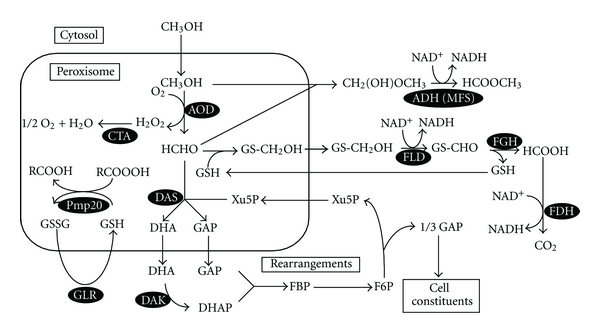
Outline of methanol metabolism in methylotrophic yeasts. Enzymes: ADH (MFS): alcohol dehydrogenase (methylformate-synthesizing enzyme); AOD: alcohol oxidase; CTA: catalase; DAK: dihydroxyacetone kinase; DAS: dihydroxyacetone synthase; FDH: formate dehydrogenase; FGH: S-formylglutathione hydrolase; FLD: formaldehyde dehydrogenase; GLR: glutathione reductase; Pmp20: peroxisome membrane protein which has glutathione peroxidase activity. Abbreviations: DHA: dihydroxyacetone; DHAP: dihydroxyacetone phosphate; F6P: fructose 6-phosphate; FBP: fructose 1,6-bisphosphate; GAP: glyceraldehyde 3-phosphate; GS-CH2OH: S-hydroxymethyl glutathione; GS-CHO: S-formylglutathione; GSH: reduced form of glutathione; GSSG: oxidized form of glutathione; RCOOOH: alkyl hydroperoxide; Xu5P: xylulose 5-phosphate.
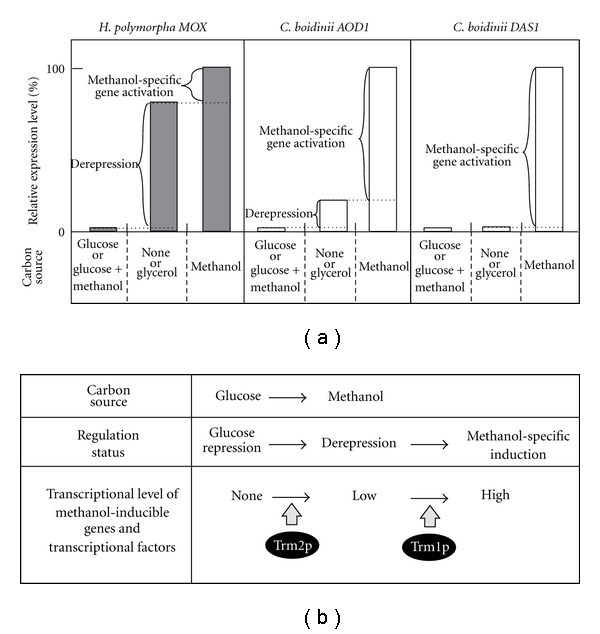
Molecular mechanism of methanol-inducible gene expression. (a) Relative expression levels of H. polymorpha MOX (encoding AOD), C. boidinii AOD1, and C. boidinii DAS1 during growth on various carbon sources. On glucose-containing media, expression is completely repressed. When glucose is completely consumed or cells are shifted to glycerol medium, a derepressed level of expression of the AOD genes is induced (derepression) and the extent of derepression of the AOD genes differs between H. polymorpha and C. boidinii. When cells are grown on methanol, the maximum level of expression of AOD genes is achieved not only by derepression but also by methanol-specific gene activation. The induction of DAS1 on methanol medium is achieved only by methanol-specific gene activation. (b) During growth on glucose, expression of methanol-inducible genes is repressed. When cells are shifted to methanol, initially, a Trm2p-related derepression event occurs followed by a Trm1p-related methanol-specific gene activation.
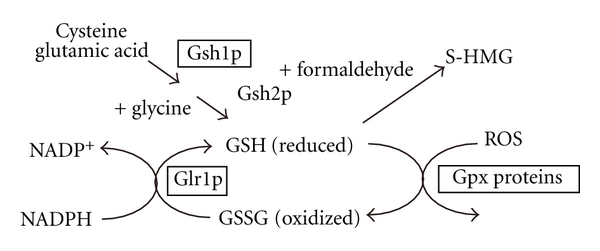
Schematic drawing of GSH dynamics and its regulation by Yap1. The proteins enclosed within the boxes represent factors found to be induced by Yap1 at the level of transcription. Enzymes: Gsh1p: γ-glutamylcysteine synthetase; Gsh2p: glutathione synthetase; Glr1p: glutathione reducatse; Gpx: glutathione peroxidase. S-HMG: S-hydroxymethyl glutathione; GSH: reduced form of glutathione; GSSG: oxidized form of glutathione; ROS: reactive oxygen species.
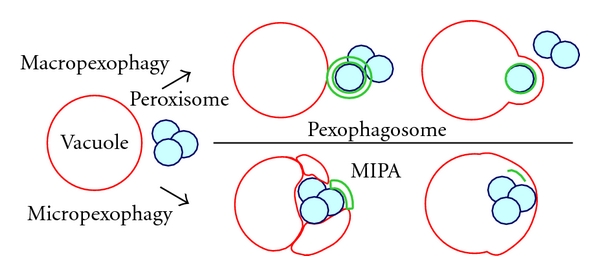
Model of organelle dynamics observed during pexophagy in methylotrophic yeasts. The green portions of the figure (MIPA and pexophagosome) represent autophagic membrane structures newly synthesized by the action of Atg proteins.
References
-
- Anthony C. The Biochemistry of Methylotrophs. London, UK: Academic Press; 1982.
-
- Yurimoto H, Kato N, Sakai Y. Assimilation, dissimilation, and detoxification of formaldehyde, a central metabolic intermediate of methylotrophic metabolism. Chemical Record. 2005;5(6):367–375. - PubMed
-
- Chistoserdova L. Modularity of methylotrophy, revisited. Environmental Microbiology. In press. - PubMed
-
- Limtong S, Srisuk N, Yongmanitchai W, Yurimoto H, Nakase T. Ogataea chonburiensis sp. nov. and Ogataea nakhonphanomensis sp. nov., thermotolerant, methylotrophic yeast species isolated in Thailand, and transfer of Pichia siamensis and Pichia thermomethanolica to the genus Ogataea . International Journal of Systematic and Evolutionary Microbiology. 2008;58(1):302–307. - PubMed
LinkOut - more resources
Full Text Sources
Other Literature Sources
