


Reasons Why Post-Trial Access to Trial Drugs Should, or Need not be Ensured to Research Participants: A Systematic Review
- PMID: 21754950
- PMCID: PMC3133737
- DOI: 10.1093/phe/phr013
Reasons Why Post-Trial Access to Trial Drugs Should, or Need not be Ensured to Research Participants: A Systematic Review
Abstract
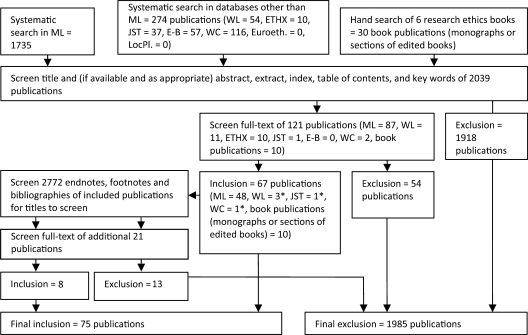
Background: researchers and sponsors increasingly confront the issue of whether participants in a clinical trial should have post-trial access (PTA) to the trial drug. Legislation and guidelines are inconsistent, ambiguous or silent about many aspects of PTA. Recent research highlights the potential importance of systematic reviews (SRs) of reason-based literatures in informing decision-making in medicine, medical research and health policy. PURPOSE: to systematically review reasons why drug trial participants should, or need not be ensured PTA to the trial drug and the uses of such reasons. DATA SOURCES: databases in science/medicine, law and ethics, thesis databases, bibliographies, research ethics books and included publications' notes/bibliographies. Publication selection: a publication was included if it included a reason as above. See article for detailed inclusion conditions. Data extraction and analysis: two reviewers extracted and analyzed data on publications and reasons. RESULTS: of 2060 publications identified, 75 were included. These mentioned reasons based on morality, legality, interests/incentives, or practicality, comprising 36 broad (235 narrow) types of reason. None of the included publications, which included informal reviews and reports by official bodies, mentioned more than 22 broad (59 narrow) types. For many reasons, publications differed about the reason's interpretation, implications and/or persuasiveness. Publications differed also regarding costs, feasibility and legality of PTA. LIMITATIONS: reason types could be applied differently. The quality of reasons was not measured. CONCLUSION: this review captured a greater variety of reasons and of their uses than any included publication. Decisions based on informal reviews or sub-sets of literature are likely to be biased. Research is needed on PTA ethics, costs, feasibility and legality and on assessing the quality of reason-based literature.
Figures
References
-
- 45CFR46 revised (2009). Code of federal regulations title 45. Public welfare. Department of health and human services. National Institutes of Health Office for Protection from Research Risks. 45.
-
- Ashcroft R. After the Trial is Over: What are the Sponsor’s Obligations? 2005 http://www.scidev.net/en/policy-briefs/after-the-trial-is-over-what-are-... [accessed 27 May 2011]
-
- Ballantyne A. HIV International Clinical Research: Exploitation and Risk. Bioethics. 2005;19:476–491. - PubMed
-
- Ballantyne A J. 2006a. Exploitation in HIV/AIDS International Clinical Research. PhD Dissertation, Monash University.
LinkOut - more resources
Full Text Sources
