Emergency department visits in Veterans Affairs medical facilities
- PMID: 21756015
- PMCID: PMC6519060
Emergency department visits in Veterans Affairs medical facilities
Abstract
Objective: To identify the frequency of, and risk factors for, repeat emergency department (ED) visits and hospitalizations following a treat-andrelease ED visit in patients from Veterans Affairs Medical Centers (VAMCs).
Study design: Retrospective cohort study.
Methods: Subjects were veterans who visited 1 of 102 VAMC EDs between October 1, 2007, and June 30, 2008. Generalized estimating equations were used to identify factors related to repeat ED visits and hospitalizations within 30 days of the index ED visit.
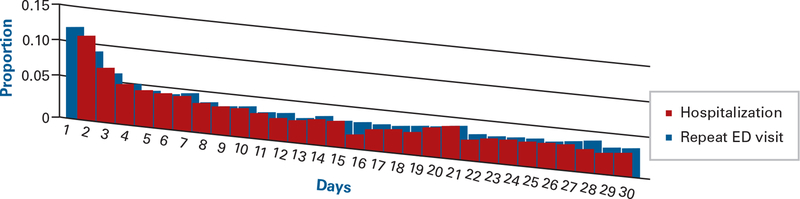
Results: At their index ED visit, 80% of veterans were treated and released. Of these, 15% returned to the ED and 5% were hospitalized in the next 30 days. In adjusted= models, factors associated with increased odds of repeat ED visits included homelessness (odds ratio [OR] 1.70; 95% confidence interval [CI] 1.59, 1.82) and having a previous ED visit (OR 1.66; 95% CI 1.58, 1.74). Odds of hospitalization were higher among older (OR 1.35; 95% CI 1.26, 1.46), homeless (OR 1.61; 95% CI 1.44,.,and functionally impaired (OR 1.52; 95% CI 1.35, 1.76) veterans, those with greater comorbidity (OR 1.31; 95% CI 1.27, 1.34), previous hospitalization (OR 2.48; 95% CI 2.28, 2.70), and an original ED visit related to a chronic condition (OR 1.30; 95% CI 1.23, 1.37). Among veterans who returned to the ED, 71.7% did not see another VA outpatient provider between their original and return visits.
Conclusions: A substantial proportion of veterans treated and released from VAMC EDs returned to the ED or were hospitalized within 30 days.
Figures
References
-
- Veterans Health Administration. VHA Directive 2006–051, 9/15/06, Standards for Nomenclature and Operations in VHA Facility Emergen- cy Departments. http://www1.va.gov/vhapublications/ViewPublication. asp?pub_ID=1485. Accessed August 26, 2010.
-
- Kessler C, Chen J, Dill C, Tyndall G, Olszyk MD. State of affairs of emergency medicine in the Veterans Health Administration. Am J Emerg Med. 2010;28(8):947–951. - PubMed
-
- Pitts SR, Niska RW, Xu J, Burt CW. National Hospital Ambulatory Medical Care Survey: 2006 emergency department summary. Natl Health Stat Report. 2008;(7):1–38. - PubMed
-
- Owens PL, Mutter R. Payers of Emergency Department Care, 2006 HCUP Statistical Brief #77. July 2009. Healthcare Cost and Utilization Project, Agency for Healthcare Research and Quality; http://www. hcup-us.ahrq.gov/reports/statbriefs/sb77.pdf. Accessed August 26, 2010. - PubMed
-
- Hastings SN, Oddone EZ, Fillenbaum G, Sloane RJ, Schmader KE. Frequency and predictors of adverse health outcomes in older Medicare beneficiaries discharged from the emergency department. Med Care. 2008;46(8):771–777. - PubMed