


Reproductive capacity in iron overloaded women with thalassemia major
- PMID: 21757620
- PMCID: PMC3172803
- DOI: 10.1182/blood-2011-06-360271
Reproductive capacity in iron overloaded women with thalassemia major
Abstract
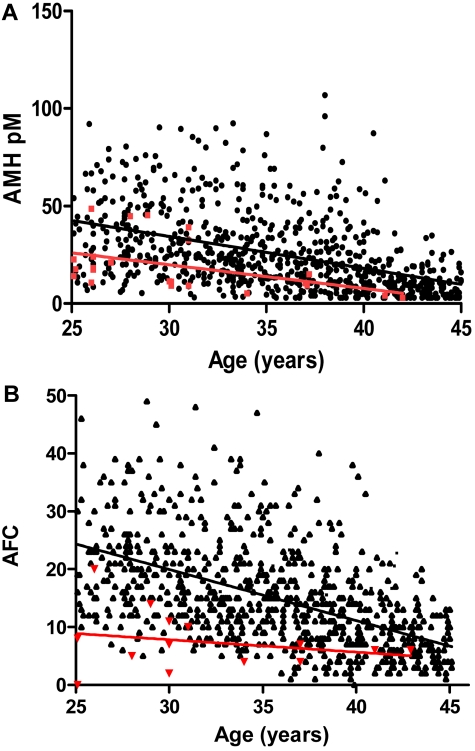
The pathophysiology of iron-induced compromised fertility in women with thalassemia major (TM) was evaluated in 26 adult TM females. Low gonadotropin secretion resulted in reduced ovarian antral follicle count and ovarian volume, but levels of anti-müllerian hormone (AMH), a sensitive marker for ovarian reserve independent of gonadotropin effect, were mostly normal. AMH correlated with non-transferrin-bound iron (NTBI), suggesting a role of labile iron in the pathogenesis of decreased reproductive capacity, possibly occurring in parallel to cardiac iron toxicity, as cardiac iron was associated with the presence of amenorrhea and with NTBI levels. AMH emerges as an important biomarker for assessment of reproductive capacity in TM, demonstrating that fertility is preserved in the majority of those younger than 30 to 35 years. AMH can be useful in future studies aiming at improved chelation for fertility preservation, whereas NTBI and labile plasma iron may be valuable for monitoring iron effect on the reproductive system.
Figures
References
-
- Al-Rimawi HS, Jallad MF, Amarin ZO, Obeidat BR. Hypothalamic-pituitary-gonadal function in adolescent females with beta-thalassemia major. Int J Gynaecol Obstet. 2005;90(1):44–47. - PubMed
-
- Skordis N, Petrikkos L, Toumba M, et al. Update on fertility in thalassaemia major. Pediatr Endocrinol Rev. 2004;2(suppl 2):296–302. - PubMed
-
- Broekmans FJ, Kwee J, Hendriks DJ, Mol BW, Lambalk CB. A systematic review of tests predicting ovarian reserve and IVF outcome. Hum Reprod Update. 2006;12(6):685–718. - PubMed
-
- Kwee J, Schats R, McDonnell J, Themmen A, de Jong F, Lambalk C. Evaluation of anti-Mullerian hormone as a test for the prediction of ovarian reserve. Fertil Steril. 2008;90(3):737–743. - PubMed
Publication types
MeSH terms
Substances
Grants and funding
LinkOut - more resources
Full Text Sources
Medical
