Comparative Study
. 2011 Sep 9;286(36):31731-41.
doi: 10.1074/jbc.M111.248310. Epub 2011 Jul 14.

Agonist-directed interactions with specific beta-arrestins determine mu-opioid receptor trafficking, ubiquitination, and dephosphorylation

Affiliations
Comparative Study

Agonist-directed interactions with specific beta-arrestins determine mu-opioid receptor trafficking, ubiquitination, and dephosphorylation

Chad E Groer et al. J Biol Chem. .

Abstract

Morphine and other opiates mediate their effects through activation of the μ-opioid receptor (MOR), and regulation of the MOR has been shown to critically affect receptor responsiveness. Activation of the MOR results in receptor phosphorylation, β-arrestin recruitment, and internalization. This classical regulatory process can differ, depending on the ligand occupying the receptor. There are two forms of β-arrestin, β-arrestin1 and β-arrestin2 (also known as arrestin2 and arrestin3, respectively); however, most studies have focused on the consequences of recruiting β-arrestin2 specifically. In this study, we examine the different contributions of β-arrestin1- and β-arrestin2-mediated regulation of the MOR by comparing MOR agonists in cells that lack expression of individual or both β-arrestins. Here we show that morphine only recruits β-arrestin2, whereas the MOR-selective enkephalin [D-Ala(2),N-Me-Phe(4),Gly(5)-ol]enkephalin (DAMGO), recruits either β-arrestin. We show that β-arrestins are required for receptor internalization and that only β-arrestin2 can rescue morphine-induced MOR internalization, whereas either β-arrestin can rescue DAMGO-induced MOR internalization. DAMGO activation of the receptor promotes MOR ubiquitination over time. Interestingly, β-arrestin1 proves to be critical for MOR ubiquitination as modification does not occur in the absence of β-arrestin1 nor when morphine occupies the receptor. Moreover, the selective interactions between the MOR and β-arrestin1 facilitate receptor dephosphorylation, which may play a role in the resensitization of the MOR and thereby contribute to overall development of opioid tolerance.


Figures
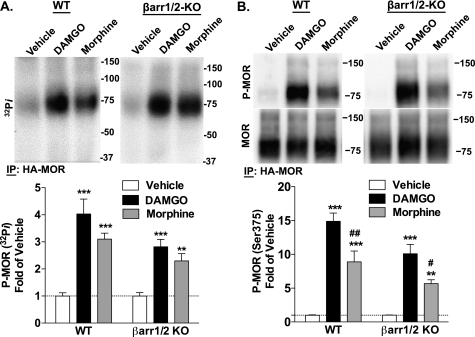
FIGURE 1.
FIGURE 1.
Agonist-induced HA-MOR phosphorylation in WT and βarr1/2-KO MEFs. HA-MOR WT and βarr1/2-KO MEFs were treated with vehicle, DAMGO (1 μm), or morphine (10 μm) for 10 min prior to immunoprecipitation (IP) of the HA-MOR. A, whole cell phosphorylation was determined by [32P]phosphate incorporation. Top, representative autoradiographs. Bottom, densitometric analysis of four experiments shows mean ± S.E. (error bars). DAMGO and morphine induced phosphorylation in both genotypes (one-way ANOVA, p < 0.0001; Bonferroni's post-test, p < 0.001 (***) and p < 0.01 (**) for agonist treatment versus vehicle of the same genotype; n = 8). B, phosphorylation at Ser-375 was detected by Western blotting. Top, representative immunoblots. Bottom, densitometric analysis of seven experiments shows mean ± S.E. of phospho-MOR (P-MOR) normalized to total MOR. DAMGO and morphine induce phosphorylation at Ser-375 in both genotypes, and morphine induces less robust phosphorylation than DAMGO in both genotypes (one-way ANOVA, p < 0.0001; Bonferroni's post-test, p < 0.001 (***) and p < 0.01 (**) for agonist treatment versus vehicle of the same genotype, p < 0.05 (#) and p < 0.01 (##) versus DAMGO of the same genotype; n = 8–9).
FIGURE 2.
FIGURE 2.
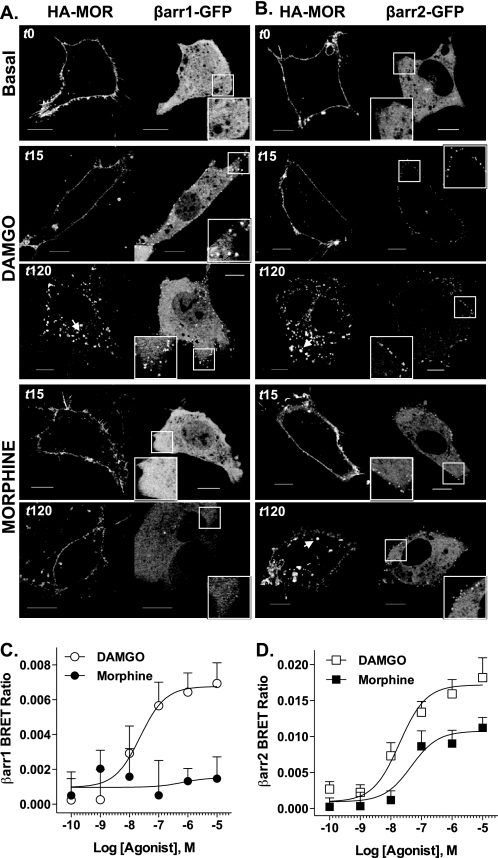
Agonist-induced β-arrestin recruitment. A and B, confocal microscopy. HA-MOR (left side of each panel) and either βarr1-GFP (A) or βarr2-GFP (B) (right side of each panel, puncta; inset, ×2 magnification) expressed in βarr1/2-KO MEFs were treated with DAMGO (1 μm) or morphine (10 μm). Representative confocal images of live cell β-arrestin-GFP translocation observed 15 and 120 min after drug addition are shown from at least three experiments (scale bars, 10 μm). C and D, BRET. HEK-293 cells expressing MOR-Rluc, GRK2, and either βarr1-GFP2 (C) or βarr2-GFP2 (D) were stimulated with opioid agonists for 5 min prior to substrate addition. Graphs show mean ± S.E. (n = 5–8); data were fit to a non-linear regression curve using GraphPad Prism software. C, DAMGO induces a concentration-dependent increase in βarr1-GFP2 BRET with MOR, but morphine does not (nonconvergence). D, both DAMGO and morphine induce concentration-dependent increase of βarr2-GFP2 interactions with the MOR, but morphine is less efficacious (extra sum of squares F test, p = 0.0008).
FIGURE 3.
FIGURE 3.
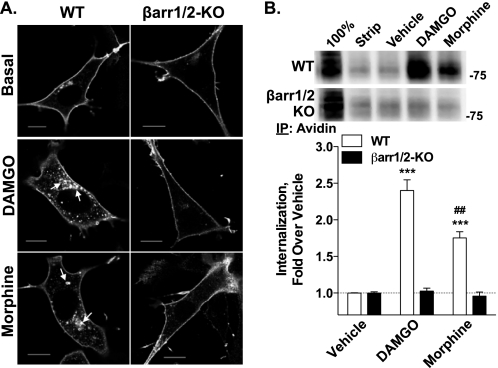
Agonist-induced MOR trafficking in HA-MOR WT and βarr1/2-KO MEFs. A, internalization of HA-MOR was determined with an anti-HA antibody following agonist incubation (2 h). DAMGO (1 μm) and morphine (10 μm) lead to an increase in intracellular receptor staining only in the WT MEFs (arrows). In βarr1/2-KO MEFs, the HA-MOR remains on the cell surface after treatment with either drug. Representative images are shown from at least three experiments (scale bars, 10 μm). B, agonist-induced HA-MOR internalization was quantified in HA-MOR WT and βarr1/2-KO MEFs using a cell surface biotinylation assay. Representative immunoblots are shown. Controls for protein biotinylation (100%; cells were not incubated in stripping buffer) and stripping (Strip; cells were biotinylated, stripped, and lysed without drug treatment) are included. Densitometric analysis of seven biotinylation experiments done in duplicate shows the mean ± S.E. (error bars) of internalized HA-MOR. DAMGO and morphine induce internalization in WT MEFs (***, p < 0.001 versus vehicle; Student's t test; n = 8–9), but not in the βarr1/2 KO MEFs (p > 0.05; Student's t test; n = 10–14). Morphine induces significantly less MOR internalization than DAMGO in the WT MEFs (##, p < 0.01; Student's t test; n = 7–8). IP, immunoprecipitation.
FIGURE 4.
FIGURE 4.
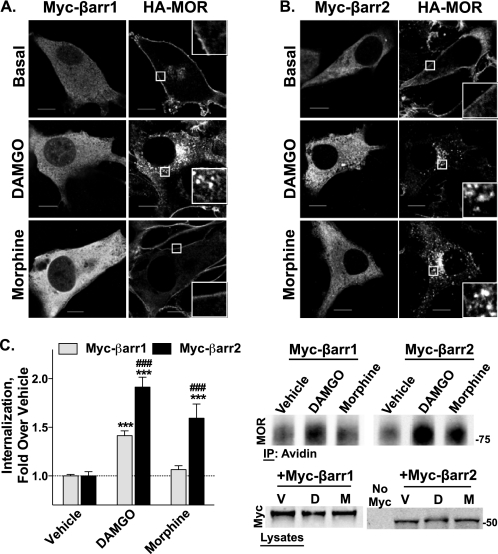
β-Arrestin rescue of HA-MOR internalization in βarr1/2-KO MEFs. HA-MOR βarr1/2-KO MEFs were transiently transfected with either Myc-βarr1 or Myc-βarr2 and treated with DAMGO (1 μm) or morphine (10 μm) for 2 h. A and B, confocal microscopy. Receptor internalization was detected by anti-HA immunocytochemistry following drug treatment. Myc-β-arrestins are labeled with an anti-Myc antibody, followed by an anti-mouse secondary AlexaFluor 568 conjugate (fluorescence on the left side of each panel). HA-MOR is labeled using anti-HA AlexaFluor 488 conjugate (right side of each panel; inset, ×4 magnification). A, expression of Myc-βarr1 rescues HA-MOR internalization only by DAMGO and not morphine. B, expression of Myc-βarr2 rescues both DAMGO- and morphine-induced HA-MOR internalization. Representative images are shown from at least three experiments (scale bars, 10 μm). C, biotinylation. Agonist-induced HA-MOR internalization was quantified using cell surface biotinylation assays. Densitometric analysis of three experiments done in duplicate or triplicate shows the mean ± S.E. (error bars) of internalized HA-MOR. Expression of Myc-βarr2 rescues both DAMGO- and morphine-induced internalization, whereas Myc-βarr1 transfection rescues only DAMGO-induced HA-MOR internalization (one-way ANOVA, p < 0.0001; Bonferroni's multiple comparison test, p < 0.001 (***) versus vehicle of the same transfection and p < 0.001 (###) versus Myc-βarr1 with the same treatment; n = 4–8). Representative immunoblots of biotin pull-downs and Myc transfections are shown.
FIGURE 5.
FIGURE 5.
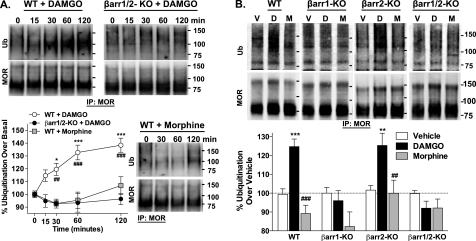
Agonist-induced MOR ubiquitination. The HA-MOR was immunoprecipitated from cell lysates of WT and β-arrestin KO MEFs treated with DAMGO (1 μm) or morphine (10 μm) for the times indicated. Ubiquitination was detected by Western blotting. Representative immunoblots, as well as densitometric analysis of ubiquitinated MOR normalized to total MOR and then expressed as changes in regard to basal levels, are shown (mean ± S.E., from eight separate experiments, n = 3–29 for each data point). A, comparison of agonists in WT and βarr1/2 KO MEFs. In WT MEFs, DAMGO induces a time-dependent increase in MOR ubiquitination, whereas morphine does not (one-way ANOVA; DAMGO, p < 0.0001; morphine, p > 0.05), and the time courses differ significantly (two-way ANOVA; WT DAMGO versus WT morphine; p < 0.01 for time, p < 0.001 for drug, and p < 0.01 for the interaction; Bonferroni's post-test, p < 0.05 (*) and p < 0.001 (***)). DAMGO is unable to promote MOR ubiquitination in the βarr1/2-KO MEFs (one-way ANOVA: p > 0.05), and the DAMGO time courses differ significantly between genotypes (two-way ANOVA, WT DAMGO versus KO DAMGO, p < 0.01 for time, p < 0.001 for genotype, and p < 0.001 for the interaction; Bonferroni's post-test, p < 0.01 (##) and p < 0.001 (###)). B, comparison of DAMGO (1 μm) and morphine (10 μm) effects in WT, βarr1-KO, βarr2-KO, and βarr1/2-KO MEFs (60-min treatment). Representative immunoblots are shown, and densitometric analysis was performed as above (mean ± S.E. (error bars) from at least three separate experiments performed in triplicate, n = 9–23 per condition). In WT and βarr2-KO MEFs, only DAMGO induces MOR ubiquitination (one-way ANOVA, p < 0.0001 for WT and p < 0.01 for βarr2-KO; Bonferroni's multiple comparisons test, p < 0.001 (***) and p < 0.01 (**) versus vehicle of the same genotype; p < 0.001 (###) and p < 0.01 (##) versus DAMGO of the same genotype). For the βarr1-KO and βarr1/2-KO MEFs, agonist-induced MOR ubiquitination is not observed (one-way ANOVA, p > 0.05). IP, immunoprecipitation.
FIGURE 6.
FIGURE 6.
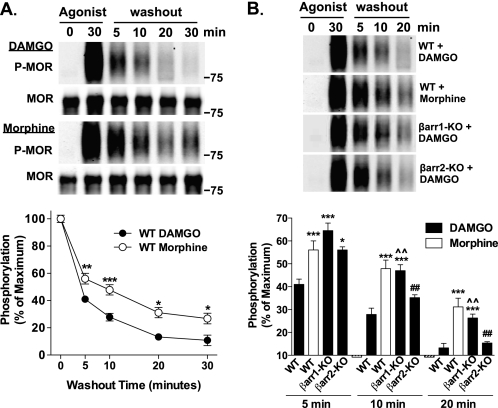
Dephosphorylation of the HA-MOR at Ser-375 following the removal of agonist. WT and β-arrestin KO MEFs were treated with DAMGO (1 μm) or morphine (10 μm) for 30 min. Following drug washout at the indicated time points, HA-MOR was immunoprecipitated, and the extent of MOR phosphorylation was determined by Western blotting. Representative immunoblots are shown; densitometric analysis includes normalization of phosphorylated MOR (P-MOR) over total MOR (MOR), expressed as the percentage of maximal phosphorylated MOR levels observed after 30 min of agonist treatment. (In B, total MOR blots are not shown for brevity). A, comparison of agonists between WT and βarr1/2 KO MEFs. In the WT MEFs, washout after DAMGO treatment results in a time-dependent loss of P-MOR detection, with levels approaching basal detection at 20 min. Although washout after morphine treatment also induces a time-dependent loss in phosphorylated MOR detection, it is not as robust as compared with that seen with DAMGO (two-way ANOVA, DAMGO versus morphine, p < 0.0001 for drug, p < 0.0001 for time, and p < 0.01 for the interaction; Bonferroni's post-test, p < 0.05 (*), p < 0.01 (**), and p < 0.001 (***), n = 9–18). B, comparison of the contribution of individual β-arrestins to the extent of dephosphorylation over time. βarr1-KO MEFs treated with DAMGO resemble WT MEFs treated with morphine because both treatments result in significantly more phosphorylated MOR remaining after washout compared with WT MEFs treated with DAMGO. Further, DAMGO washout results in equivalent amounts of phosphorylated MOR remaining between WT and βarr2-KO MEFs at 10 and 20 min, yet phosphorylated MOR levels were higher in βarr2 KO MEFs at 5 min (one-way ANOVA for each time point, p < 0.0001; Tukey's multiple comparison test within each time point, p < 0.05 (*) and p < 0.001 (***) versus WT DAMGO; p < 0.01 (##) versus WT morphine; and p < 0.01 (^^) versus βarr2-KO DAMGO). Error bars, S.E.
FIGURE 7.
FIGURE 7.
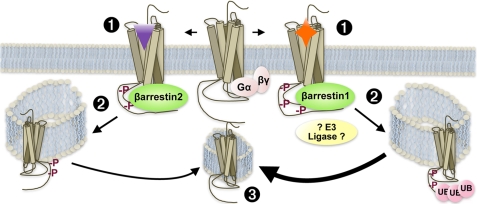
The ability of a ligand to recruit different β-arrestins to the MOR impacts regulation of the receptor. 1, the nature of the agonist determines the interaction with a particular β-arrestin. In this study, we have shown that morphine preferentially induces interactions with β-arrestin2, whereas DAMGO promotes recruitment of both β-arrestins. 2, the particular β-arrestin determines receptor fate. In this study, we show that the morphine occupied MOR can functionally utilize β-arrestin2 but not β-arrestin1 to induce receptor internalization, whereas DAMGO can promote MOR internalization via either β-arrestin. Further, recruitment of β-arrestin1 is necessary for receptor ubiquitination (UB), which may involve β-arrestin1-mediated recruitment of an E3 ligase (although this has not been demonstrated in this study). 3, while the receptor can be dephosphorylated following agonist washout independent of the agonist, the nature of the β-arrestin appears to influence the rate of dephosphorylation whereby β-arrestin1 interactions positively influence the rate of MOR dephosphorylation (thicker arrow), presumably via stabilizing recruitment of phosphatases.

References

    1. Bohn L. M., Dykstra L. A., Lefkowitz R. J., Caron M. G., Barak L. S. (2004) Mol. Pharmacol. 66, 106–112 - PubMed
    1. Whistler J. L., von Zastrow M. (1998) Proc. Natl. Acad. Sci. U.S.A. 95, 9914–9919 - PMC - PubMed
    1. Zhang J., Ferguson S. S., Barak L. S., Bodduluri S. R., Laporte S. A., Law P. Y., Caron M. G. (1998) Proc. Natl. Acad. Sci. U.S.A. 95, 7157–7162 - PMC - PubMed
    1. Girnita L., Shenoy S. K., Sehat B., Vasilcanu R., Girnita A., Lefkowitz R. J., Larsson O. (2005) J. Biol. Chem. 280, 24412–24419 - PubMed
    1. Shenoy S. K., McDonald P. H., Kohout T. A., Lefkowitz R. J. (2001) Science 294, 1307–1313 - PubMed

Publication types