. 2011 Aug 26;286(34):29964-72.
doi: 10.1074/jbc.M111.263715. Epub 2011 Jul 8.

Attenuated CagA oncoprotein in Helicobacter pylori from Amerindians in Peruvian Amazon

Affiliations

Attenuated CagA oncoprotein in Helicobacter pylori from Amerindians in Peruvian Amazon

Masato Suzuki et al. J Biol Chem. .

Abstract

Population genetic analyses of bacterial genes whose products interact with host tissues can give new understanding of infection and disease processes. Here we show that strains of the genetically diverse gastric pathogen Helicobacter pylori from Amerindians from the remote Peruvian Amazon contain novel alleles of cagA, a major virulence gene, and reveal distinctive properties of their encoded CagA proteins. CagA is injected into the gastric epithelium where it hijacks pleiotropic signaling pathways, helps Hp exploit its special gastric mucosal niche, and affects the risk that infection will result in overt gastroduodenal diseases including gastric cancer. The Amerindian CagA proteins contain unusual but functional tyrosine phosphorylation motifs and attenuated CRPIA motifs, which affect gastric epithelial proliferation, inflammation, and bacterial pathogenesis. Amerindian CagA proteins induced less production of IL-8 and cancer-associated Mucin 2 than did those of prototype Western or East Asian strains and behaved as dominant negative inhibitors of action of prototype CagA during mixed infection of Mongolian gerbils. We suggest that Amerindian cagA is of relatively low virulence, that this may have been selected in ancestral strains during infection of the people who migrated from Asia into the Americas many thousands of years ago, and that such attenuated CagA proteins could be useful therapeutically.


Figures
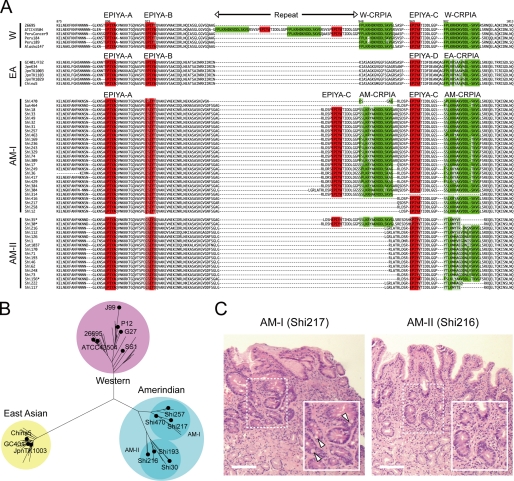
FIGURE 1.
FIGURE 1.
Amerindian CagA is distinct from Western and East Asian CagA. A, shown is multiple sequence alignment of the PY regions of CagA from Hp isolates. The EPIYA (red) and CRPIA motifs (green) are highlighted. CagA was categorized Western (W), East Asian (EA), and Amerindian (AM-I and AM-II) based on ClustalW analysis. Amerindian isolates, such as Shi35, Shi30, and Shi156, had marginal CRPIA genotypes between AM-I and AM-II (shown with asterisks). B, shown is a neighbor-joining tree of amino acid sequences of the PY regions. C, shown is hematoxylin/eosin staining of gastric antral biopsies from the indicated Hp-infected individuals. Bar = 100 μm. Arrowheads indicate goblet cells in sites of intestinal metaplasia.
FIGURE 2.
FIGURE 2.
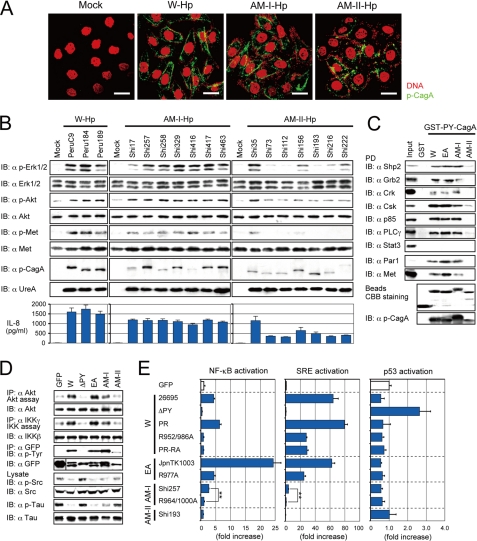
Amerindian CagA has a reduced ability to induce host responses. A, shown is immunostaining of AGS cells infected for 6 h with the indicated Hp strains (W, 26695; AM-I, Shi257; AM-II, Shi193). Bar = 20 μm. B, immunoblotting (IB) is shown of lysates 4 h post-infection (upper) and ELISAs for IL-8 in the culture supernatants 8 h post-infection (lower). C, shown is immunoblotting of lysates (Input) and pulled-down proteins (PD) by the indicated GST-fused PY regions of CagA (W, 26695; EA, JpnTK1003; AM-I, Shi257; AM-II, Shi193). Coomassie brilliant blue (CBB) stains of the purified GST-proteins (lower) are shown. D, shown are kinase assays and immunoblotting of lysates from 293T cells transfected with the indicated GFP-CagA (W, 26695; ΔPY, 26695 ΔPY; EA, JpnTK1003; AM-I, Shi257; AM-II, Shi193) plasmids and then subjected to immunoprecipitation (IP). E, shown are luciferase assays on lysates from HEK293 cells co-transfected with the indicated reporters and GFP-CagA plasmids (**, p < 0.01). 26695, R952A/R986A, JpnTK1003, R977A, and Shi257 R964A/R1000A are loss-of-function the CagA mutants of CRPIA motifs.
FIGURE 3.
FIGURE 3.
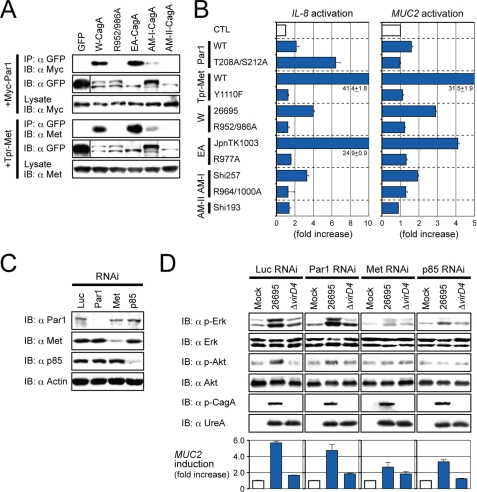
The CRPIA motif is important for CagA-mediated MUC2 expression. A, immunoblotting (IB) is shown of lysates from 293T cells co-transfected with the indicated GFP-CagA (W, 26695; R952/986A, 26695 R952A/R986A; EA, JpnTK1003; AM-I, Shi257; AM-II, Shi193) and Myc-Par1 or Tpr-Met expression plasmids and then subjected to immunoprecipitation (IP). B, shown are luciferase assays on lysates from AGS cells co-transfected with the indicated reporters (IL-8 or MUC2 promoter) and the indicated GFP-CagA, Myc-Par1 (wild type or kinase-dead T208A/S212A), or Tpr-Met (wild type or kinase-dead Y1110F) plasmids. C and D, AGS cells were transfected for 48 h with the indicated siRNAs (C) and then infected for 4 h with the indicated Hp strain 26695 or its ΔvirD4 derivative (type IV secretion system-defective) (D). Immunoblotting of lysates (C and D, upper) and RT-PCR assays for MUC2 mRNA expression using total RNAs (D, lower) is shown.
FIGURE 4.
FIGURE 4.
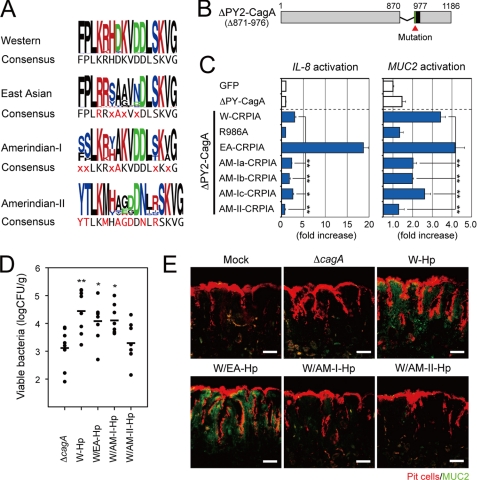
The CRPIA motif in Amerindian CagA is associated with attenuated Hp pathogenesis. A, sequence logos and consensus sequences of the indicated CRPIA motifs of CagA are shown. B, schema of ΔPY2 CagA derivative of Western strain 26695 and sites of point mutation changes are shown. C, luciferase assays of lysates from AGS cells co-transfected with the indicated reporters (IL-8 or MUC2 promoter) and GFP-ΔPY2-CagA plasmids (*, p < 0.05; **, p < 0.01) are shown. Sequences of W, R986A, AM-Ia, AM-Ib, AM-Ic, and AM-II CRPIA constructs are shown in supplemental Figs. S6–S8. D, viable counts of bacteria in the indicated ATCC43504 Hp-infected gerbil stomachs 8 weeks after infection (*, p < 0.05; **, p < 0.01). E, immunostaining of gastric antral sections from infected gerbils. Bar = 50 μm.
FIGURE 5.
FIGURE 5.
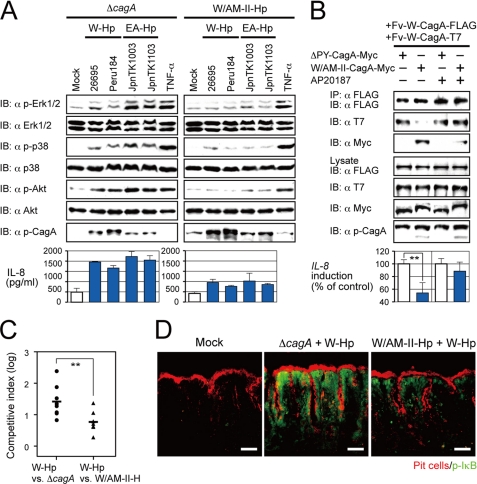
Amerindian CagA competitively inhibits Western and East Asian CagA activities. A, shown is immunoblotting (IB) of lysates from AGS cells infected for 2 h with ΔcagA or W/AM-II cagA containing derivatives of strain ATCC43504 along with W (26695, Peru184) or EA (JpnTK1003, JpnTK1103) Hp or treated with TNF-α (upper) and ELISAs for IL-8 in the culture supernatants (lower). B, immunostaining (upper) and luciferase assays (lower) are shown on lysates from AGS cells co-transfected with the indicated CagA (ΔPY-CagA-Myc or W/AM-II-CagA-Myc), Fv-W-CagA-FLAG, and Fv-W-CagA-T7 plasmids with or without the dimerizer AP20187 (**, p < 0.01). IP, immunoprecipitate. C, shown is a competitive index of viable counts of bacteria from the stomachs of gerbils co-infected for 8 weeks with the indicated ATCC43504 strains (wild type and ΔcagA or wild type and ΔcagA complemented with W/AM-II cagA) (**, p < 0.01). D, immunostaining for IκB phosphorylation in gastric antral sections from infected gerbils is shown. Bar = 50 μm.

References

    1. Vogelmann R., Amieva M. R. (2007) Curr. Opin. Microbiol. 10, 76–81 - PubMed
    1. Suerbaum S., Michetti P. (2002) N. Engl. J. Med. 347, 1175–1186 - PubMed
    1. Montecucco C., Rappuoli R. (2001) Nat. Rev. Mol. Cell Biol. 2, 457–466 - PubMed
    1. Atherton J. C., Blaser M. J. (2009) J. Clin. Invest. 119, 2475–2487 - PMC - PubMed
    1. Yamaoka Y., Kato M., Asaka M. (2008) Intern. Med. 47, 1077–1083 - PMC - PubMed

Publication types

MeSH terms

Associated data