. 2011 Sep 2;286(35):30409-30414.
doi: 10.1074/jbc.M111.234294. Epub 2011 Jul 13.

Functional significance of cytosolic endothelial nitric-oxide synthase (eNOS): regulation of hyperpermeability

Affiliations

Functional significance of cytosolic endothelial nitric-oxide synthase (eNOS): regulation of hyperpermeability

Fabiola A Sánchez et al. J Biol Chem. .

Abstract

Endothelial NOS (eNOS)-derived NO is a key factor in regulating microvascular permeability. We demonstrated previously that eNOS translocation from the plasma membrane to the cytosol is required for hyperpermeability. Herein, we tested the hypothesis that eNOS activation in the cytosol is necessary for agonist-induced hyperpermeability. To study the fundamental properties of endothelial cell monolayer permeability, we generated ECV-304 cells that stably express cDNA constructs targeting eNOS to the cytosol or plasma membrane. eNOS-transfected ECV-304 cells recapitulate the eNOS translocation and permeability properties of postcapillary venular endothelial cells (Sánchez, F. A., Rana, R., Kim, D. D., Iwahashi, T., Zheng, R., Lal, B. K., Gordon, D. M., Meininger, C. J., and Durán, W. N. (2009) Proc. Natl. Acad. Sci. U.S.A. 106, 6849-6853). We used platelet-activating factor (PAF) as a proinflammatory agonist. PAF activated eNOS by increasing phosphorylation of Ser-1177 and inducing dephosphorylation of Thr-495, increasing NO production, and elevating permeability to FITC-dextran 70 in monolayers of cells expressing wild-type and cytosolic eNOS. PAF failed to increase permeability to FITC-dextran 70 in monolayers of cells transfected with eNOS targeted to the plasma membrane. Interestingly, this occurred despite eNOS Ser-1177 phosphorylation and production of comparable amounts of NO. Our results demonstrate that the presence of eNOS in the cytosol is necessary for PAF-induced hyperpermeability. Our data provide new insights into the dynamics of eNOS and eNOS-derived NO in the process of inflammation.


Figures
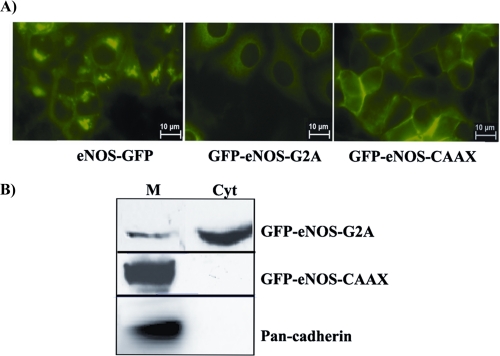
FIGURE 1.
FIGURE 1.
Expression and location of eNOS constructs in ECV-304 cells. A, immunofluorescence images showing the targeting of the eNOS constructs. B, subcellular fractionation of ECV-GFP-eNOS-G2A and ECV-GFP-eNOS-CAAX cells. M, membrane; Cyt, cytosol.
FIGURE 2.
FIGURE 2.
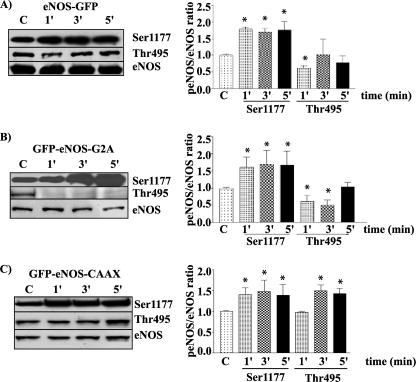
PAF modulates the patterns of phosphorylation in ECV-304 cells transfected with different targeted eNOS constructs. Left panels, Western blots; right panels, quantification. A, phosphorylation of ECV-eNOS-GFP cells at Ser-1177 and Thr-495 (n = 3). B, phosphorylation (p) of ECV-GFP-eNOS-G2A cells at Ser-1177 and Thr-495 (n = 4). C, phosphorylation of ECV-GFP-eNOS-CAAX cells at Ser-1177 and Thr-495 (n = 3). *, p < 0.05 compared with the control (C).
FIGURE 3.
FIGURE 3.
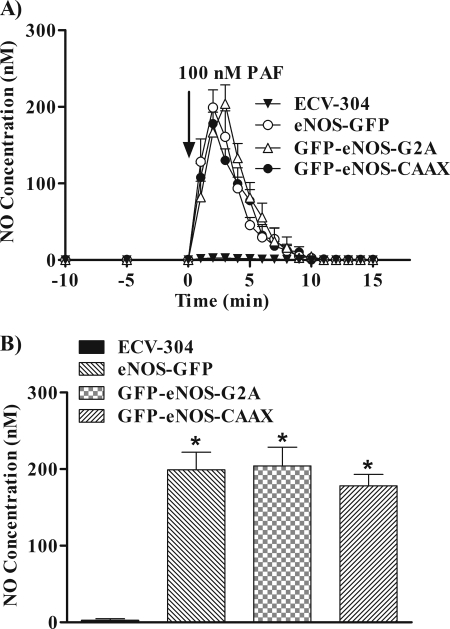
NO production stimulated by 100 nm PAF in naive ECV-304 cells and in ECV-304 cells transfected with different targeted eNOS constructs. The different cell lines grown on glass coverslips were challenged with 100 nm PAF, and NO production was measured as a function of time. A, time course of PAF-induced changes in NO concentration. Base-line production of NO was undetectable. ECV-304 cells transfected with the control empty vector behaved as naive ECV-304 cells and showed no changes in base-line NO concentration and no changes in NO production in response to PAF (not shown). B, statistical analysis of base-line and PAF-induced peak NO concentrations for each of the different cell lines (mean ± S.E., n = 4). *, p < 0.05.
FIGURE 4.
FIGURE 4.
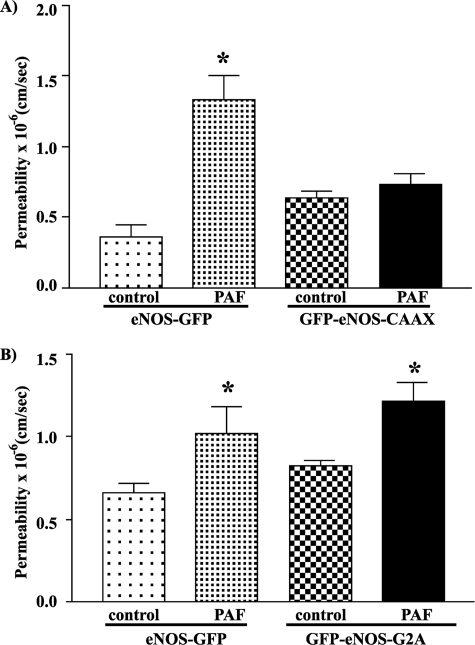
Permeability measurements in ECV-304 cells transfected with different targeted eNOS constructs. Permeability data are expressed as paired bars expressing mean permeability ± S.E. for the base line and after 100 nm PAF. A and B illustrate independent experiments. A, ECV-GFP-eNOS-CAAX cells did not increase permeability in response to PAF (n = 3). B, ECV-GFP-eNOS-G2A cells showed a significant increase in permeability in response to PAF (n = 6). *, p < 0.05.
FIGURE 5.
FIGURE 5.
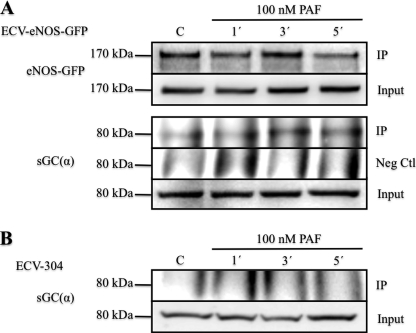
Association of eNOS and sGC. A, experiments in ECV-eNOS-GFP cells. Samples were immunoprecipitated with either anti-eNOS antibody (IP) or nonspecific IgG (negative control (Neg Ctl)) and subsequently blotted for sGC. IP blots correspond to samples obtained after the pulldown process, whereas Input blots correspond to samples before immunoprecipitation and serve as a loading reference. PAF stimulated the time-dependent association of eNOS and sGC in ECV-eNOS-GFP cells. B, experiments in ECV-304 cells that lack eNOS and served as a second negative control for eNOS and as a test for the specificity of anti-eNOS antibody. Samples were immunoprecipitated with anti-eNOS antibody and blotted against sGC. C, control without PAF. n = 3 in both panels.

References

    1. Hatakeyama T., Pappas P. J., Hobson R. W., 2nd, Boric M. P., Sessa W. C., Durán W. N. (2006) J. Physiol. 574, 275–281 - PMC - PubMed
    1. Sánchez F. A., Savalia N. B., Durán R. G., Lal B. K., Boric M. P., Durán W. N. (2006) Am. J. Physiol. Heart Circ. Physiol. 291, H1058–H1064 - PMC - PubMed
    1. Sánchez F. A., Kim D. D., Durán R. G., Meininger C. J., Durán W. N. (2008) Am. J. Physiol. Heart Circ. Physiol. 295, H1642–H1648 - PMC - PubMed
    1. Fulton D., Gratton J. P., McCabe T. J., Fontana J., Fujio Y., Walsh K., Franke T. F., Papapetropoulos A., Sessa W. C. (1999) Nature 399, 597–601 - PMC - PubMed
    1. Fulton D., Gratton J. P., Sessa W. C. (2001) J. Pharmacol. Exp. Ther. 299, 818–824 - PubMed

Publication types

LinkOut - more resources