


A phase Ib study of vosaroxin, an anticancer quinolone derivative, in patients with relapsed or refractory acute leukemia
- PMID: 21760592
- PMCID: PMC4576993
- DOI: 10.1038/leu.2011.157
A phase Ib study of vosaroxin, an anticancer quinolone derivative, in patients with relapsed or refractory acute leukemia
Abstract
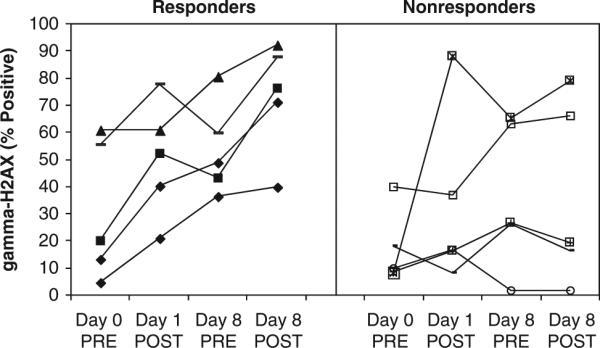
This study of vosaroxin evaluated dose-limiting toxicity (DLT), maximum-tolerated dose (MTD), pharmacokinetics (PK), clinical activity and pharmacodynamics in relapsed/refractory leukemia. Dosing was weekly (days 1, 8 and 15) or twice weekly (days 1, 4, 8 and 11). Seventy-three treated patients had a median age of 65 years, 85% had acute myeloid leukemia and 78% had refractory disease. Weekly schedule: 42 patients received 18-90 mg/m(2); MTD was 72 mg/m(2). Twice-weekly schedule: 31 patients received 9-50 mg/m(2); MTD was 40 mg/m(2). DLT was stomatitis; primary non-hematologic toxicity was reversible gastrointestinal symptoms and febrile neutropenia. Thirty-day all-cause mortality was 11%. Five patients had complete or incomplete remissions; median duration was 3.1 months. A morphologic leukemia-free state (bone marrow blast reduction to <5%) occurred in 11 additional patients. Antileukemic activity was associated with total dose or weekly time above 1 μmol/l plasma vosaroxin concentration (P<0.05). Vosaroxin exposure was dose proportional over 9-90 mg/m(2). The average terminal half-life was ~25 h and clearance was non-renal. No induction or inhibition of vosaroxin metabolism was evident. Vosaroxin-induced DNA damage was detected as increased intracellular γH2AX. Vosaroxin had an acceptable safety profile, linear PK and encouraging clinical activity in relapsed/refractory leukemia.
Figures
References
-
- Tallman MS, Gilliland DG, Rowe JM. Drug therapy for acute myeloid leukemia. Blood. 2005;106:1154–1163. - PubMed
-
- Leith CP, Kopecky KJ, Godwin J, McConnell T, Slovak ML, Chen IM, et al. Acute myeloid leukemia in the elderly: assessment of multidrug resistance (MDR1) and cytogenetics distinguishes biologic subgroups with remarkably distinct responses to standard chemotherapy: a Southwest Oncology Group study. Blood. 1997;89:3323–3329. - PubMed
-
- Leith CP, Kopecky KJ, Chen IM, Eijdems L, Slovak ML, McConnell TS, et al. Frequency and clinical significance of the expression of the multidrug resistance proteins MDR1/P-glycoprotein, MRP1, and LRP in acute myeloid leukemia: a Southwest Oncology Group study. Blood. 1999;94:1086–1099. - PubMed
Publication types
MeSH terms
Substances
Grants and funding
LinkOut - more resources
Full Text Sources
Medical
Research Materials
