


Extended access cocaine self-administration differentially activates dorsal raphe and amygdala corticotropin-releasing factor systems in rats
- PMID: 21762287
- PMCID: PMC3304464
- DOI: 10.1111/j.1369-1600.2011.00329.x
Extended access cocaine self-administration differentially activates dorsal raphe and amygdala corticotropin-releasing factor systems in rats
Abstract
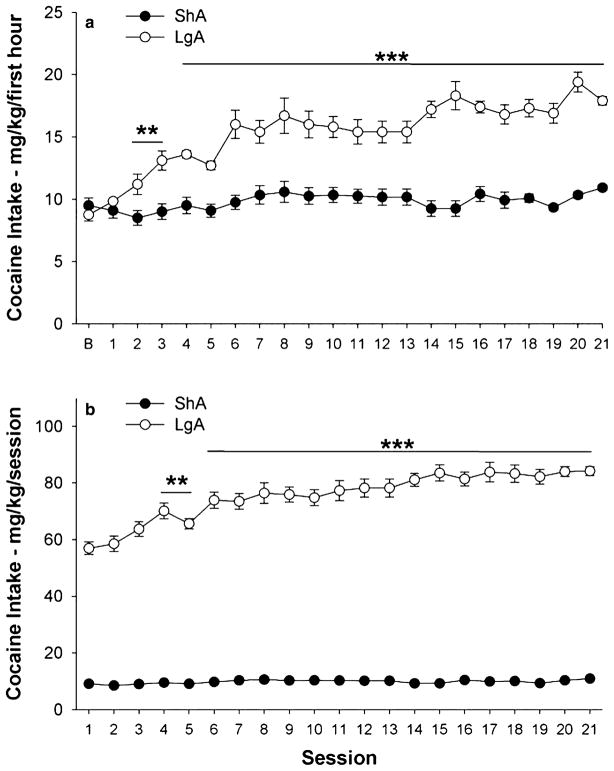
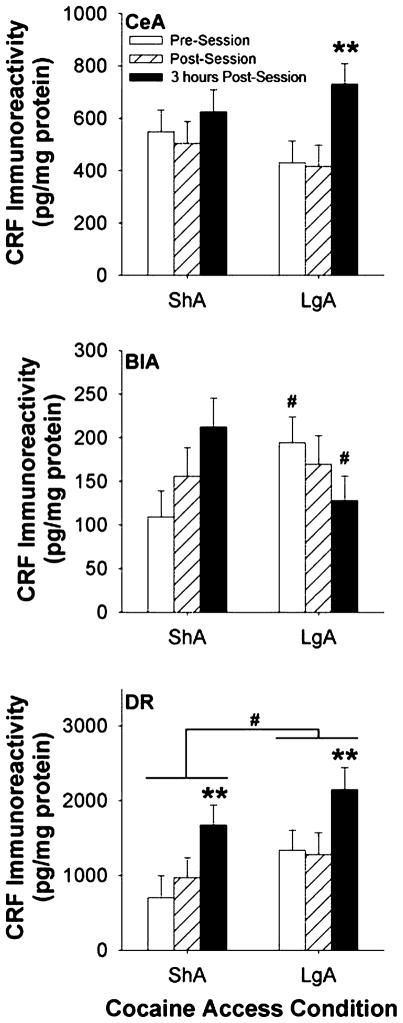
Cocaine-induced neuroadaptation of stress-related circuitry and increased access to cocaine each putatively contribute to the transition from cocaine use to cocaine dependence. The present study tested the hypothesis that rats receiving extended versus brief daily access to cocaine would exhibit regional differences in levels of the stress-regulatory neuropeptide corticotropin-releasing factor (CRF). A secondary goal was to explore how CRF levels change in relation to the time since cocaine self-administration. Male Wistar rats acquired operant self-administration of cocaine and were assigned to receive daily long access (6 hours/day, LgA, n=20) or short access (1 hour/day, ShA, n=18) to intravenous cocaine self-administration (fixed ratio 1, ~0.50 mg/kg/infusion). After at least 3 weeks, tissue CRF immunoreactivity was measured at one of three timepoints: pre-session, post-session or 3 hours post-session. LgA, but not ShA, rats showed increased total session and first-hour cocaine intake. CRF immunoreactivity increased within the dorsal raphe (DR) and basolateral, but not central, nucleus of the amygdala (BLA, CeA) of ShA rats from pre-session to 3 hours post-session. In LgA rats, CRF immunoreactivity increased from pre-session to 3 hours post-session within the CeA and DR but tended to decrease in the BLA. LgA rats showed higher CRF levels than ShA rats in the DR and, pre-session, in the BLA. Thus, voluntary cocaine intake engages stress-regulatory CRF systems of the DR and amygdala. Increased availability of cocaine promotes greater tissue CRF levels in these extrahypothalamic brain regions, changes associated here with a model of cocaine dependence.
© 2011 The Authors, Addiction Biology © 2011 Society for the Study of Addiction.
Figures
References
-
- Ahmed SH, Kenny PJ, Koob GF, Markou A. Neurobiological evidence for hedonic allostasis associated with escalating cocaine use. Nat Neurosci. 2002;5:625–626. - PubMed
-
- Ahmed SH, Koob GF. Transition from moderate to excessive drug intake: change in hedonic set point. Science. 1998;282:298–300. - PubMed
-
- Ahmed SH, Koob GF. Long-lasting increase in the set point for cocaine self-administration after escalation in rats. Psychopharmacology (Berl) 1999;146:303–312. - PubMed
-
- Ambrosio E, Sharpe LG, Pilotte NS. Regional binding to corticotropin releasing factor receptors in brain of rats exposed to chronic cocaine and cocaine withdrawal. Synapse. 1997;25:272–276. - PubMed
-
- Aubry JM, Pozzoli G, Vale WW. Chronic treatment with the antidepressant amitriptyline decreases CRF-R1 receptor mRNA levels in the rat amygdala. Neurosci Lett. 1999;266:197–200. - PubMed
Publication types
MeSH terms
Substances
Grants and funding
LinkOut - more resources
Full Text Sources
Medical
Molecular Biology Databases
