


Are liver function tests, pancreatitis and cholecystitis predictors of common bile duct stones? Results of a prospective, population-based, cohort study of 1171 patients undergoing cholecystectomy
- PMID: 21762294
- PMCID: PMC3163273
- DOI: 10.1111/j.1477-2574.2011.00317.x
Are liver function tests, pancreatitis and cholecystitis predictors of common bile duct stones? Results of a prospective, population-based, cohort study of 1171 patients undergoing cholecystectomy
Abstract
Objective: The purpose of this study was to explore the accuracy of elevated liver function values, age, gender, pancreatitis and cholecystitis as predictors of common bile duct stones (CBDS).
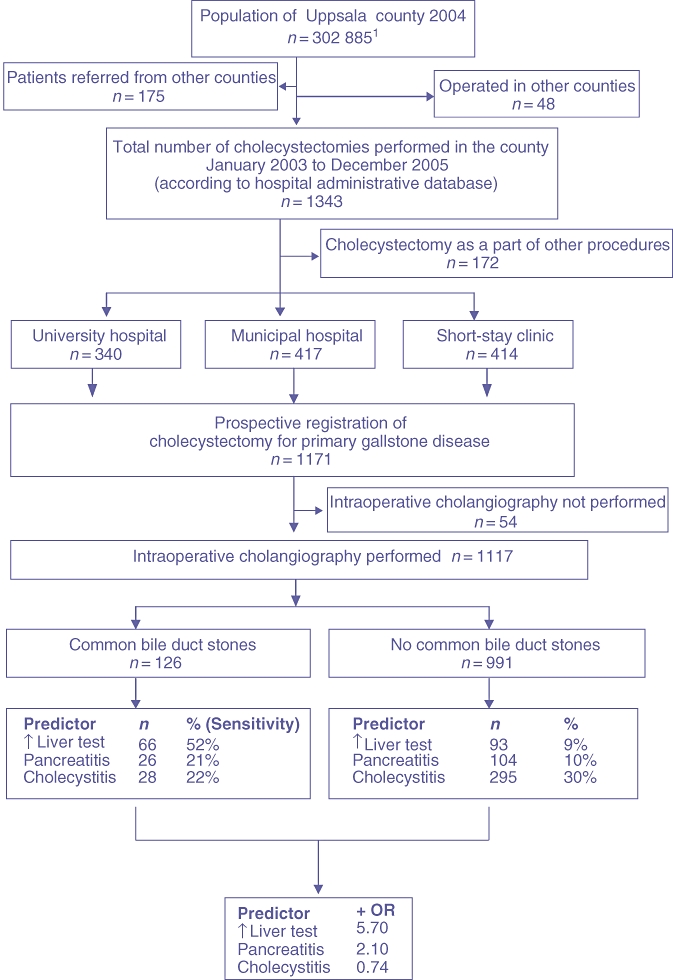
Methods: All patients operated on for gallstone disease over a period of 3 years in a Swedish county of 302,564 citizens were registered prospectively. Intraoperative cholangiography (IOC) was used to detect CBDS.
Results: A total of 1171 patients were registered; 95% of these patients underwent IOC. Common bile duct stones were found in 42% of patients with elevated liver function values, 20% of patients with a history of pancreatitis and 9% of patients with cholecystitis. The presence of CBDS was significantly predicted by elevated liver function values, but not by age, gender, history of acute pancreatitis or cholecystitis. A total of 93% of patients with normal liver function tests had a normal IOC. The best agreement between elevated liver function values and CBDS was seen in patients undergoing elective surgery without a history of acute pancreatitis or cholecystitis.
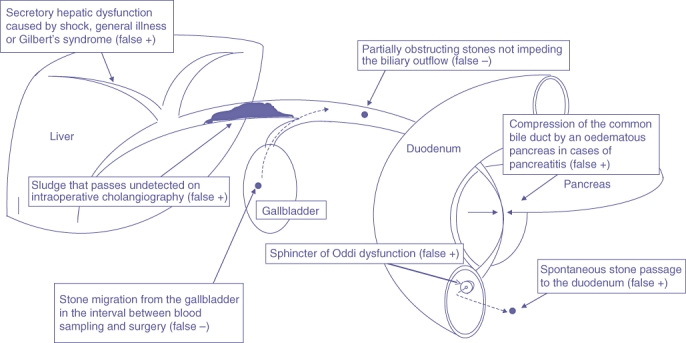
Conclusions: Although alkaline phosphatase (ALP) and bilirubin levels represented the most reliable predictors of CBDS, false positive and false negative values were common, especially in patients with a history of cholecystitis or pancreatitis, which indicates that other mechanisms were responsible for elevated liver function values in these patients.
© 2011 International Hepato-Pancreato-Biliary Association.
Figures
References
-
- Menezes N, Marson LP, Debeaux AC, Muir IM, Auld CD. Prospective analysis of a scoring system to predict choledocholithiasis. Br J Surg. 2000;87:1176–1181. - PubMed
-
- Trondsen E, Edwin B, Reiertsen O, Faerden AE, Fagertun H, Rosseland AR. Prediction of common bile duct stones prior to cholecystectomy: a prospective validation of a discriminant analysis function. Arch Surg. 1998;133:162–166. - PubMed
-
- Trondsen E, Edwin B, Reiertsen O, Fagertun H, Rosseland AR. Selection criteria for endoscopic retrograde cholangiopancreaticography (ERCP) in patients with gallstone disease. World J Surg. 1995;19:852–856. discussion 857. - PubMed
-
- Cohen ME, Slezak L, Wells CK, Andersen DK, Topazian M. Prediction of bile duct stones and complications in gallstone pancreatitis using early laboratory trends. Am J Gastroenterol. 2001;96:3305–3311. - PubMed
-
- Yang MH, Chen TH, Wang SE, Tsai YF, Su CH, Wu CW, et al. Biochemical predictors for absence of common bile duct stones in patients undergoing laparoscopic cholecystectomy. Surg Endosc. 2008;22:1620–1624. - PubMed
MeSH terms
Substances
LinkOut - more resources
Full Text Sources
Medical
